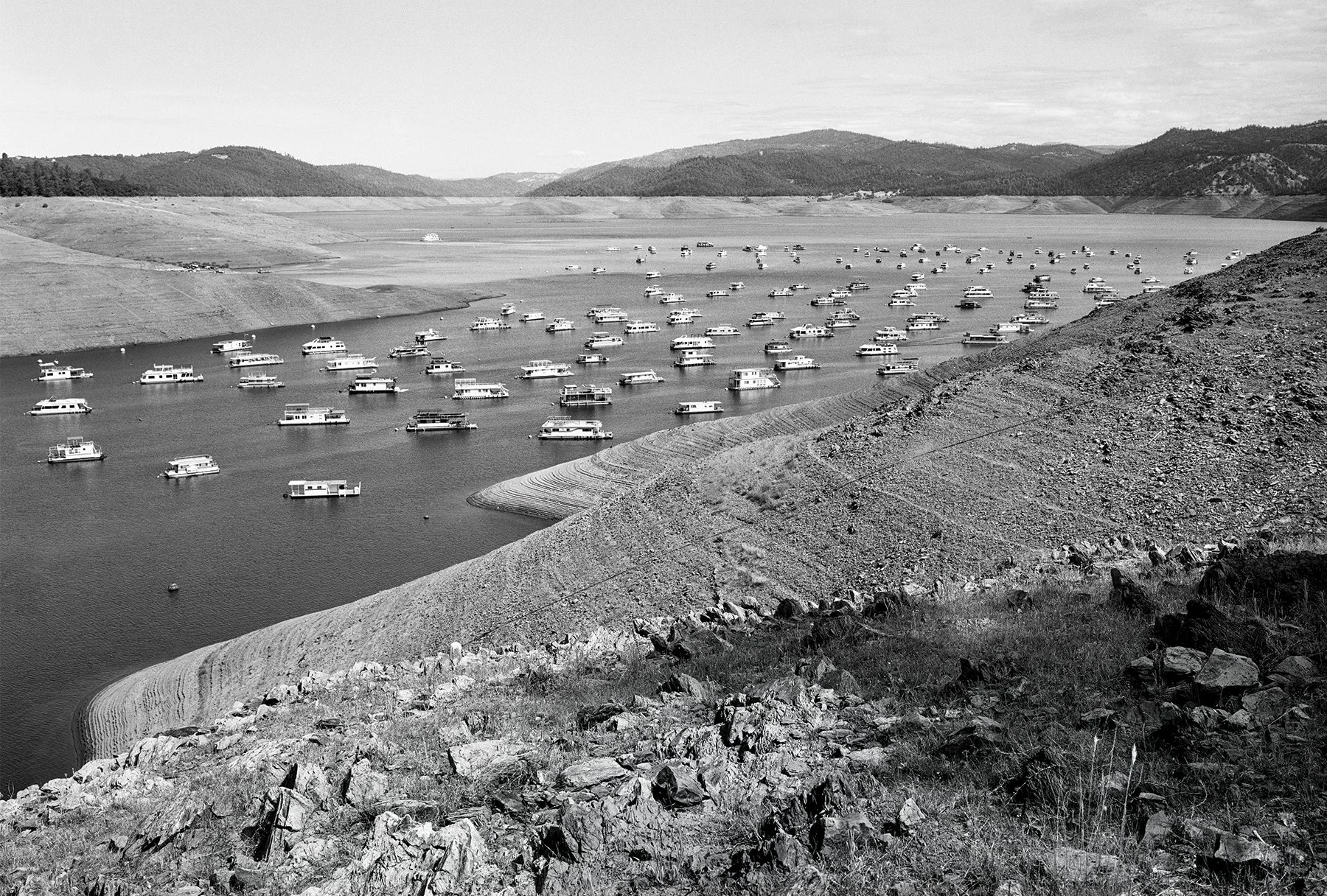
Mimi Plumb (American, born 1953) Adrift, 2021–2025, pigmented inkjet print, High Museum of Art, Atlanta, purchase with funds from the H. B. and Doris Massey Charitable Trust, 2025.107. © Mimi Plumb
Mimi Plumb has photographed the human-altered landscape for five decades to conjure the enduring issues of our day. Blazing Light: Photographs by Mimi Plumb, the artist’s first solo museum exhibition, which opened in February, 2026 at the High Museum of Art, brings together her three most important bodies of work that collectively contemplate the anxieties of contemporary American culture: the combined effects of climate change, unbridled capitalism and ceaseless military conflict. As a teenager in the 1970s, Plumb began photographing during a time of rapid land development coupled with global political and economic instability. Her early artistic life was defined by a burgeoning awareness of global warming and the looming threats posed by the Cold War. This atmosphere attuned her to the evidence of such forces in the land, the built environment, and the ways people carry themselves and relate to one another — concerns that continue to abide in her work. Working in and around San Francisco, Plumb photographs the grand yet fragile beauty of the American West and the peculiarities of urban life with a distinctively raw visual approach.
She skillfully renders California’s notoriously intense sunlight in gritty black-and-white images to amplify the psychological tension and imaginative possibilities that define turbulent times. The White Sky (1972–1978) captures the final glimmers of innocence and optimism during the years following World War II, as cracks in the façade of the American Dream began to widen. Landfall and The Golden City (1984–2020) present a society descending into chaos as an ambiguous disaster looms. The Reservoir (2021–2025) conveys a stark and desolate world seemingly in the aftermath of a powerful, undefined apocalypse. Across these bodies of work, Plumb mournfully charts how persistent unease continues to manifest from the dark realms of imagination into pressing realities.
In the following Q&A, which took place at Plumb’s home in Berkeley, California, in January 2025, we discuss her motivations, her history with the medium and what led her to her most recent body of work, The Reservoir. The conversation has been edited for clarity and length.
Gregory J. Harris: In Blazing Light, we're presenting three bodies of work as if they’re a related series or cycle. What is the throughline in these three bodies of work for you?
Mimi Plumb: I think it's my personal journey. I can't get away from seeing that as a throughline – the things that I've seen in my life, the things that have affected me. In a larger sense, they all speak about global warming. It was happening then, and it's happening now. I think it's just more dire now.
GH: Do you think that revisiting the work that you did in the seventies and the ‘80s led you to make The Reservoir? There was thirty-some years between when you finished Landfall and The Golden City and when you started The Reservoir. It seems as if you've come back to these ideas.
MP: All of my photographs try to address how we coexist in this place, in the West, in America. What it looks like, and what it feels like. The consequences of how we live.
GH: What was your childhood like, and where did you grow up? How does that come through in The White Sky?
MP: I grew up in Walnut Creek, one of the first suburbs of San Francisco, and a lot of The White Sky was shot there. The work is so much about the landscape and how it affected my body. It was very hot and dry. I was a redhead, and I always felt like I was trying to hide from the sun.
I grew up with my mom and dad and three older brothers. At the dinner table, they were always talking about politics, and it was very competitive to speak up. I felt disengaged from my family. My mom was usually either studying for school or going to work. I wrote a poem in my teens, and it was, “My father is playing the piano. I’ve never heard him play the piano before. My mother has gone out to work today, once more she is gone, closing the door.” It's about how they weren't around that much. My dad was very quiet, and my mom was the large presence in the family, always telling us what we should do with our lives.
GH: What was the genesis of the pictures that became The White Sky?
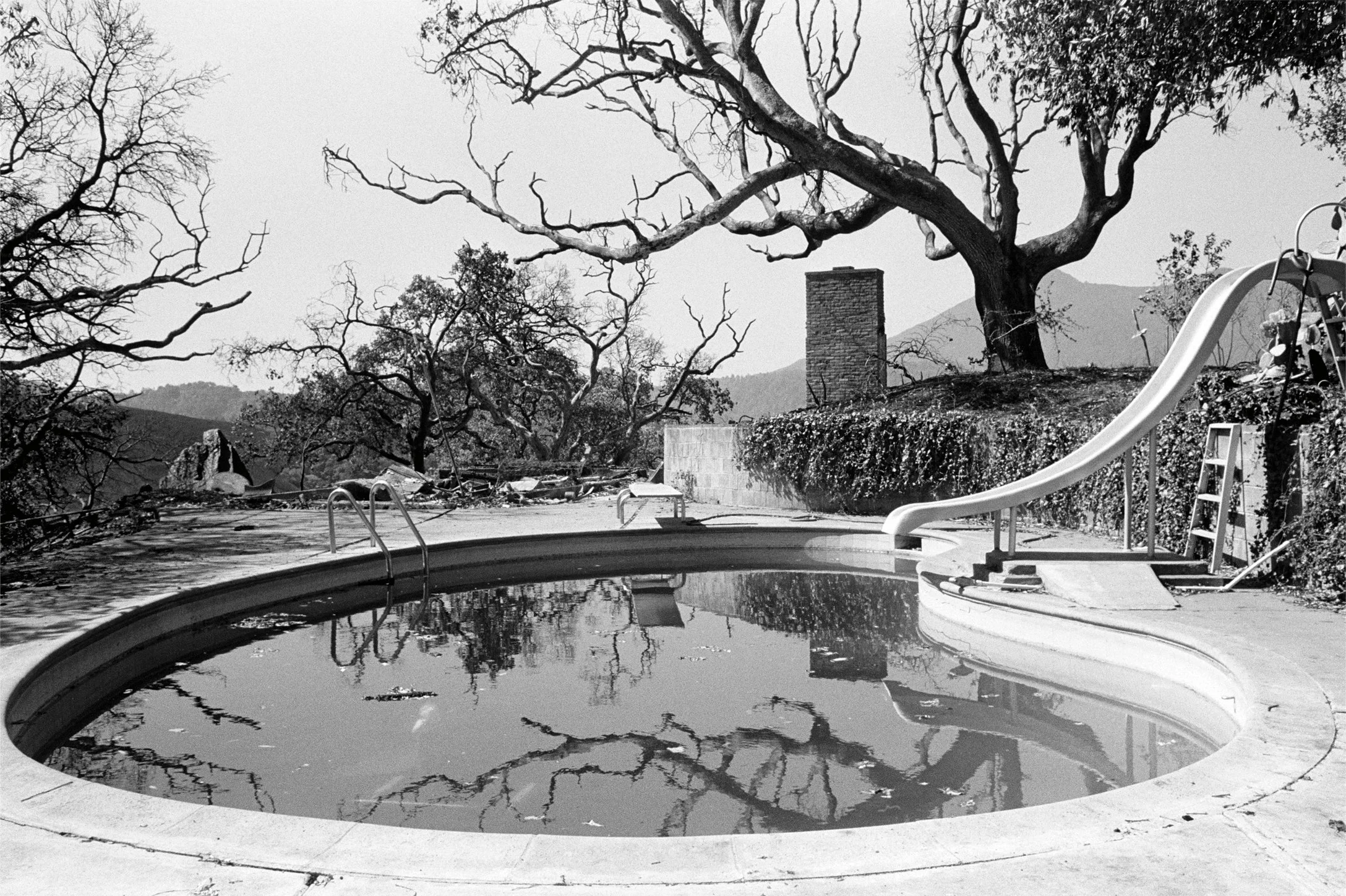
Mimi Plumb (American, born 1953), Pool, Fire Above San Rafael, 1976, pigmented inkjet print, courtesy of the artist. © Mimi Plumb
MP: A big part of what we did in art school was looking back — looking at who you are and what you can say. The personal is political. I don't know that everybody followed that, but I was mining what I knew. I photographed in suburbia because it was where I was from.
GH: Would you show up in a neighborhood and walk around looking for things to photograph?
MP: I’d go to the Walnut Festival, and there were teenagers there doing exactly what I used to do when I was young, and I'd photograph them. When I was a teenager, I'd hide in corners and smoke cigarettes trying to look cool. At times, I would just wander around. I would go to places where I grew up. I'd drive around various neighborhoods to see if there were houses that were interesting to me. You could do that back then. Now, people would be like, “What are you doing? Why are you photographing?” But back then, I would hang out with the kids that I would meet on the street and talk to them and photograph them as they were playing. All that spoke to me. I was trying to get at what it looked and felt like to grow up there. The barren hills, that was very much a backdrop to the work. The landscape and its dryness, the construction, the subdivisions, and the constant building and tearing up of the land to build houses — that's what I grew up with. My work is about my reaction to the world around me. It may not be overt, but in my mind, it is very political. The White Sky is about the oppressiveness of growing up in suburbia.
GH: The White Sky pictures have a distinctive sensibility — intense light. It's a sensibility that's carried through your work today. How did you arrive at that way of rendering the light in California?
MP: Because that's what the light looks like. It's hot, bright light.
GH: But you obviously like that kind of light. What do you like about it?
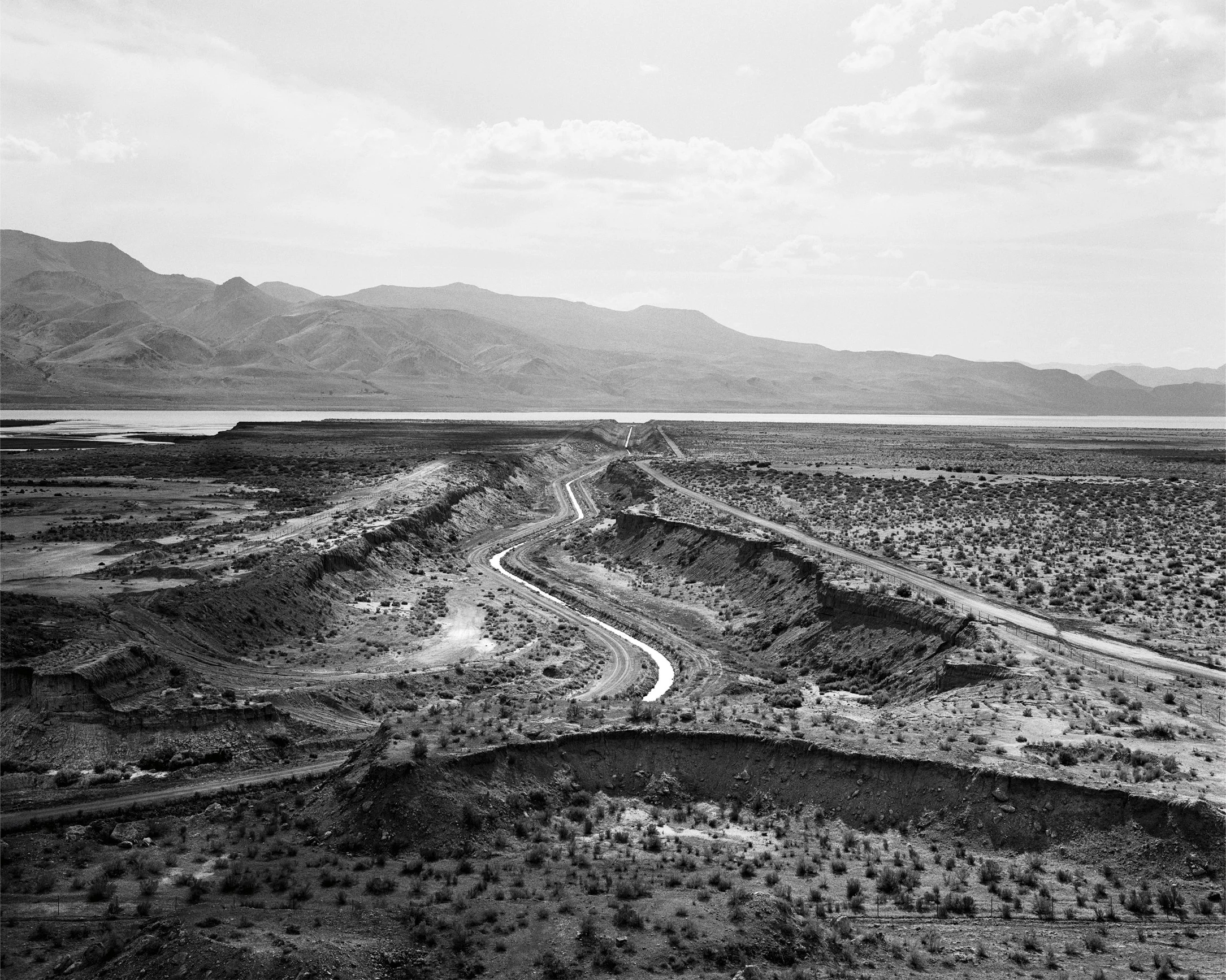
Mimi Plumb (American, born 1953), Truckee Canal, 1985, gelatin silver print, High Museum of Art, Atlanta, gift of Lucas Foglia, 2025.94. © Mimi Plumb
MP: The light is very alive. It's very intense. There's excitement within that light. But it's also really frightening for me because I’m a redhead. I got heatstroke when I was young, and it was scary. The light reflected what growing up there looked and felt like. My family would take a lot of road trips down to L.A. along Highway 99. We’d drive through that heat with no air conditioning in the car because my mother didn't like air conditioning. Hundred-degree heat driving through that hot, sickening heat and bright light. I wanted to get at what it felt like. I wanted that in the pictures.
GH: You've talked before about going against the grain of what other people were doing. You’ve talked before about you being a woman in the San Francisco photography community at a time when it was really dominated by men.
MP: Still is.
GH: How did the fact that you're a woman impact your mindset about your work?
MP: I'm not sure I have perspective on that, except to say that I wasn't as confident as I could have been. When I look at that work now, I think it's really good work, but I didn't have as much belief back then that it was important work.
When I went back to school in 1984, I began to understand that my work was very special. I had been out of school for eight years before I went to grad school. I worked for the California Department of Housing for three years photographing farmworker and Native American housing conditions. I found the work to be important, but I didn’t like working for somebody else. I wanted to photograph from a more personal perspective. From the early ‘80s on, I felt very disillusioned about the world. Reagan had become president. I knew that all of the idealism I had growing up in the 1960s wasn’t going to be realized. Everything seemed to be about money, capitalism and greed. Those things were always going through my mind as I photographed.
I was part of a group early in the 1980s, and we made punk political posters. They were collages. I didn't think my collages were particularly good, and I didn’t really enjoy the process of making them. We’d post them around the Bay Area, and we started getting a lot of acclaim, but it wasn't what I wanted to do. I actually love making photographs. It’s a fun process for me to go out into the world and make pictures, and I realized that’s what I wanted to be doing again.
In grad school, I met Larry Sultan. He was the main teacher at the San Francisco Art Institute (SFAI) for grad students in the mid- to late ‘80s. He was a big influence. My relationship with Larry was kind of like our relationship is, Greg. It was great fun talking with him, and he was deeply supportive of my work from the start.
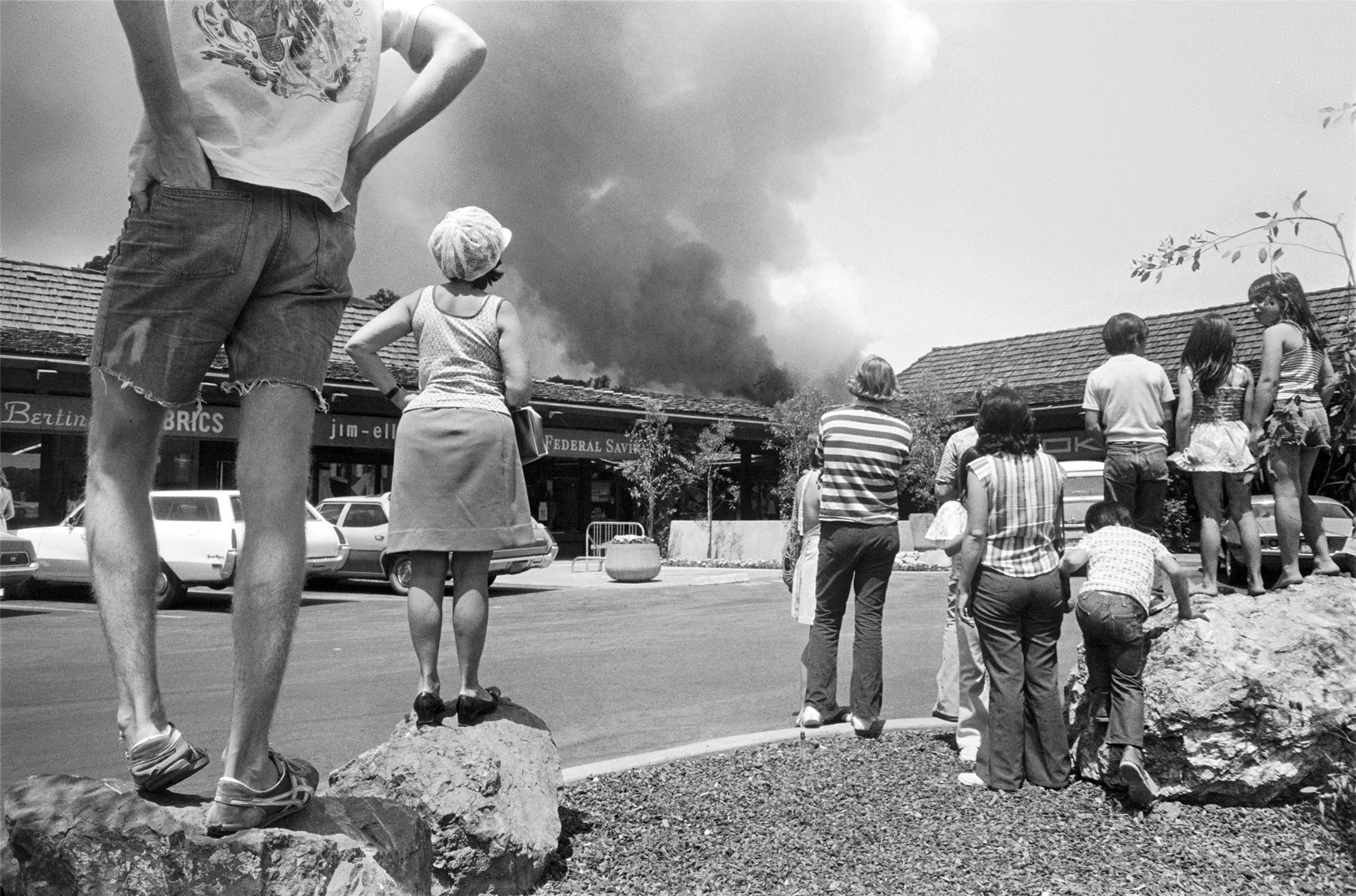
Mimi Plumb (American, born 1953), Crowd and Fire, 1976, pigmented inkjet print, High Museum of Art, Atlanta, purchase with funds from Alan and Jewett Rothschild, 2025.92. © Mimi Plumb
GH: Let's shift gears a little. Around the time that you were coming into your own as a photographer, color was very prominent, but you shot in black and white.
MP: When I started doing the Landfall work in the ‘80s, I began by photographing the landscape in color. I love color, but blue skies were a problem for the work I was making in California.
GH: Color was just too optimistic?
MP: It had too much content. Color was formally too dominant in the pictures. It took up too much space literally and figuratively. Yes, it was too optimistic and happy. It wasn't abstract enough.
GH: You once described Landfall and The Golden City as “a dreamlike vision of an American dystopia.” It's an evocative way to describe those photographs. What was going on in the world that you were responding to? What were you trying to show about the world that you felt wasn't being addressed elsewhere?
MP: Chernobyl happened in 1983. That was a scary thing in my life. Global warming became a part of the conversation. And there were the wars, the Iran/Iraq war in particular, and I felt America’s role in the war was illegitimate and that we were being lied to by the government. I didn’t subscribe to conspiracy theories, but I felt that America’s motivation was about profit and serving the needs of a very wealthy class. It colored how I saw most everything.
There was a group of photographers, photographing in a style called “The New Topographics.” They were looking at what was going on in the landscape and how we were treating it, but they were working from what seemed, to me, to be such an impersonal point of view. I think that's what I brought to it that was different. I was speaking about those issues more personally rather than intellectually.
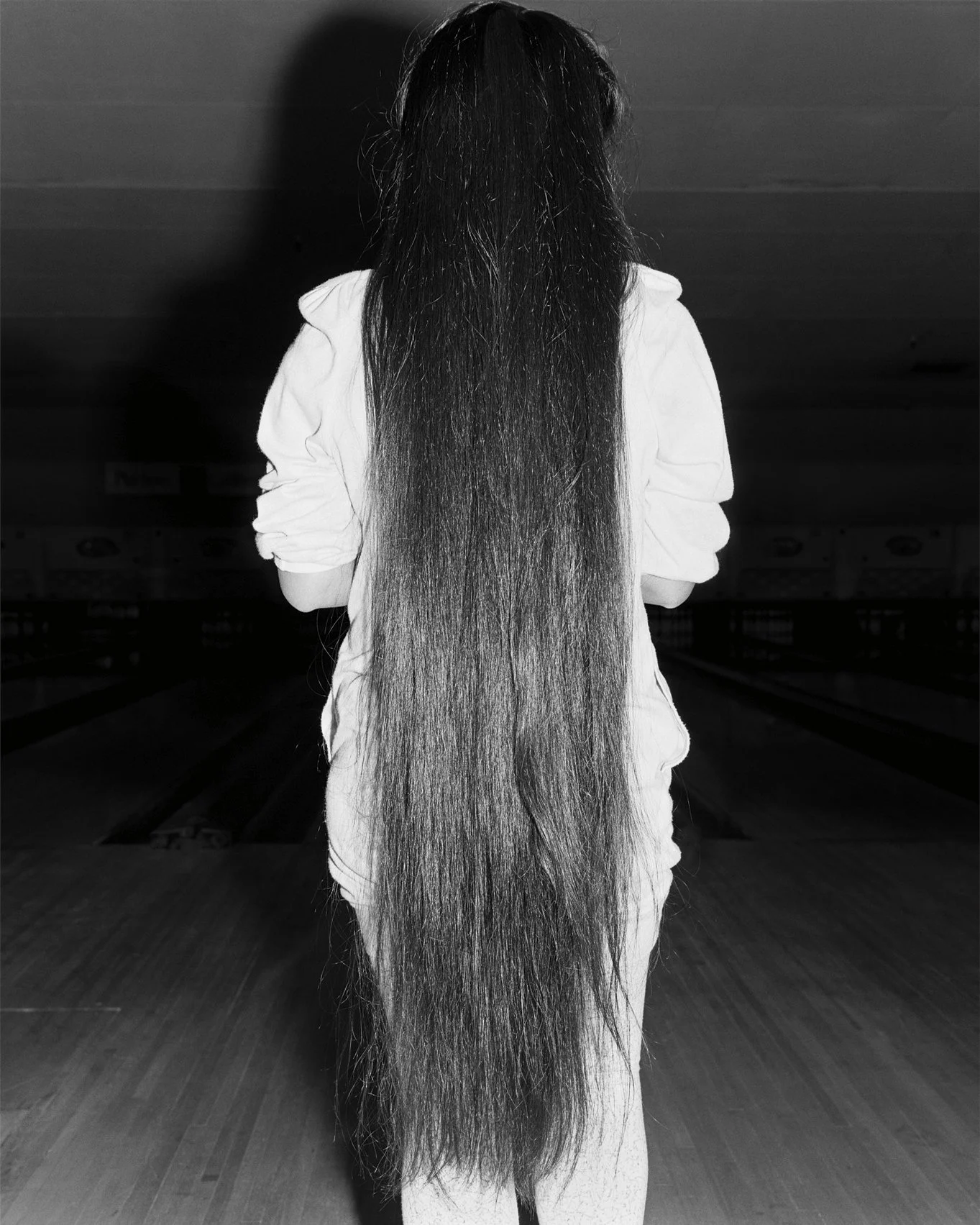
Mimi Plumb (American, born 1953), Tang, 1987, gelatin silver print, High Museum of Art, Atlanta, purchase with funds from the Donald and Marilyn Keough Family Foundation, 2025.102. © Mimi Plumb
GH: Let's talk about how you photographed people. Many of the people that appear in Landfall and The Golden City were your friends. What was that community like? What did you want to show about them?
MP: They were stand-ins for how I felt about the world, and they were people who felt disillusioned about the ‘80s. They were part of the counterculture in San Francisco — political people and artists — who were rejecting the Reagan-esque view of the world. The country was polarized in the same way that it's polarized now.
GH: One of the things that's notable is that you often photograph people from behind.
MP: I know. I didn’t remember that until I went back to look at this work.
GH: Why did you decide not to show people’s faces in many of the pictures? It stands out in Tang, Kim, even the woman who's on the front of The Golden City. I guess you can see her face, but she's not looking directly at the camera.
MP: If you look at the picture of Tang, it isn't Tang at the bowling alley, even though she's at the bowling alley, she's looking out and she doesn't know what she's seeing. She doesn't know what's going to happen, but it looks dark. That's a perfect representation of how I see things. If she was looking at me, it would make it more about her. She’s more of an object here in a sense that I'm speaking through her about what I feel.
GH: There are two things that happen. First, as you said, they become a stand in for you. And second, because you can’t see their faces, it gives the viewer a place to enter the picture and embody their place.
MP: Their posture, whatever it is they're doing?
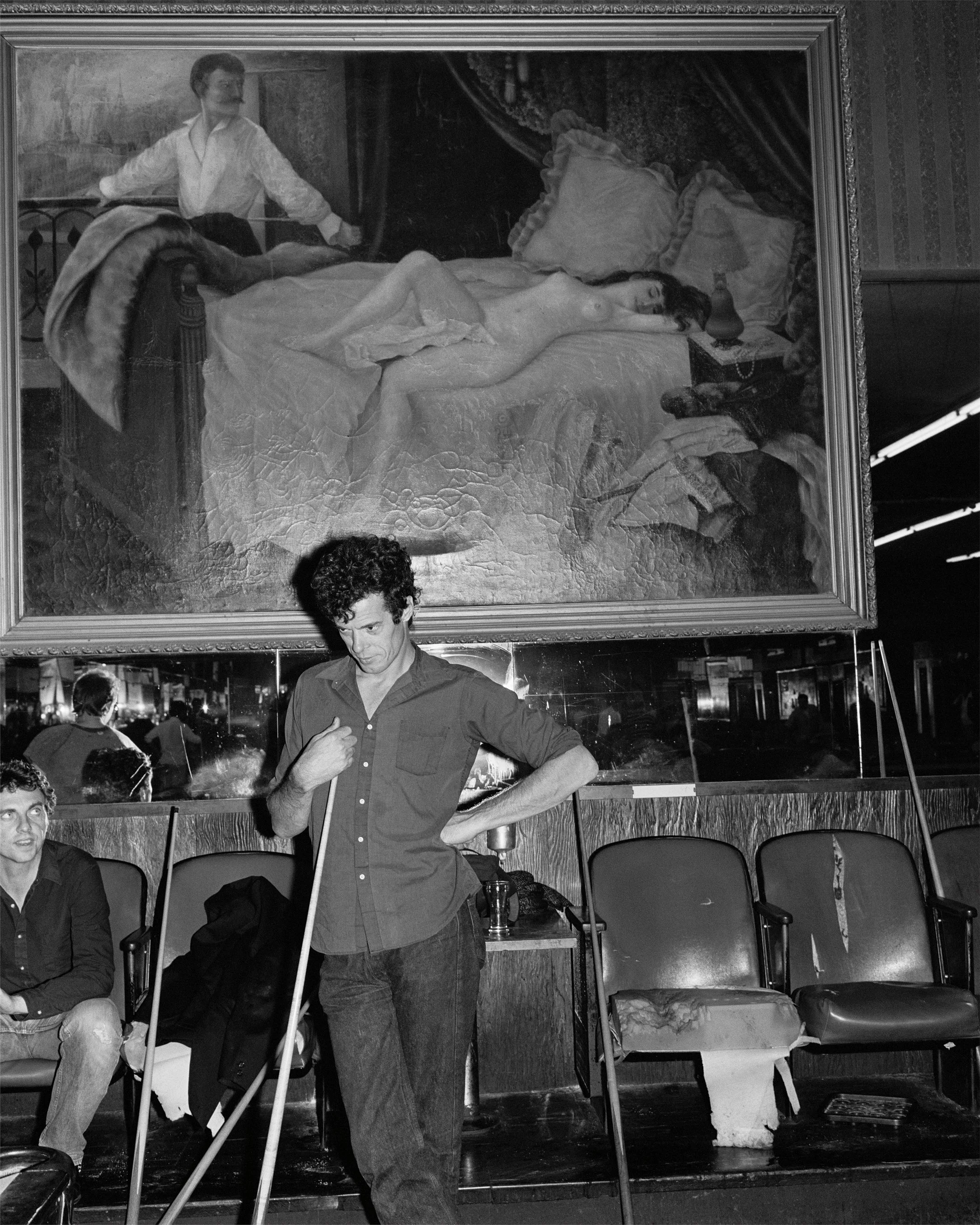
Mimi Plumb (American, born 1953), Richard at the Palace, 1987, gelatin silver print, courtesy of the artist. © Mimi Plumb
GH: Yeah. I think it amplifies the sense of anxiety and unease, because you don’t focus on their facial expression. You focus on the gesture and the shape of their body, whether it's a rigidity or a languid acquiescence.
In the same vein, on-camera flash is prevalent in Landfall and The Golden City. What did you like about flash, and what were you trying to achieve with that kind of lighting?
MP: It was the intensity, the anxiety that the flash created. I was using a flash that was mounted to a metal bracket, but it wasn't ever stable, so the flash would fall off the camera. I learned to let that happen because I’d get these unusual shadows and crazy stuff would happen in the pictures that I loved. That unease, getting the pictures to move away from that more intellectual approach and making them hotter and more intense — the flash did that.
GH: In one of the interviews you gave, you described San Francisco as “a truly golden city, but with an underbelly.” What were some of your favorite places to photograph to show that underbelly?
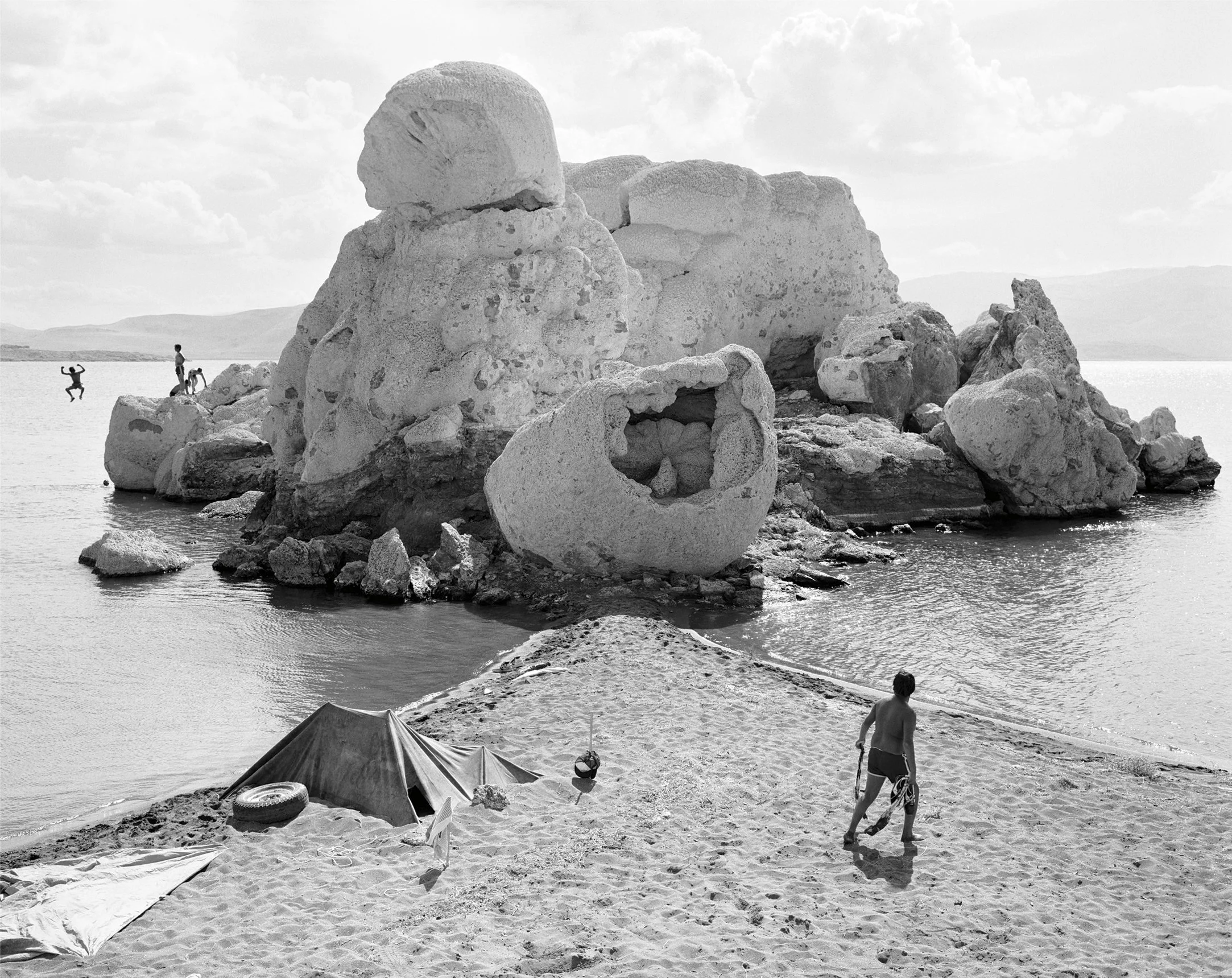
Mimi Plumb (American, born 1953), Pyramid Lake, 1985, gelatin silver print, courtesy of the artist. © Mimi Plumb
MP: I'd go over to Tire Beach, which was about a mile away from where I lived. We called it Tire Beach, but I think it’s officially called Warm Cove Park. It was this part of the San Francisco Bay that was filled with tires. The water goes up and down in the Bay. At times, you could walk out through all the tires. It was an area where people would dump things. They’d dump their cars there. People would often wander in this very surreal, apocalyptic looking landscape.
I would also just wander the streets. I took a lot of the pictures near my house in Bernal Heights on walks up to the top of Bernal Hill. A lot of my pictures, even landscape pictures, were taken there. Between my home and Bernal Hill was the house where there was a big fire. I don't think I was around for the fire, but it was a house just up the street from where I lived. The guy working on the car engine — that was at the top of my street. I lived very near to the Mission District, and a lot of the street scenes are from that area.
GH: Did you exhibit or publish the work around the time you were making it? How was it received?
MP: There was a whole milieu of people that got the work, who really connected with this sense of an apocalyptic future.
I got a lot of notice in the 1980s, but when I got out of school with an MFA, I didn't know how to make a living. I got a job teaching photography at San Jose State University (SJSU), which was important to me. I taught photography for 30 years, predominantly at SJSU, but also at SFAI, Stanford and the School of the Art Institute of Chicago.
In the late ‘80s, I needed to walk away from the work I had been making. It was too much for me psychologically — the intensity of my photographs and how I was depicting the world. It felt like a burden to carry that. I had to ask myself, “Do I really feel this way? Is it really this bad? Is it this intense? Where are we headed? Is our future really apocalyptic?” I think that's what the work spoke about — an apocalyptic future — and I believed that. Unfortunately, that still seems to be part of who I am, and how I see. But from the late ‘90s to the 2000s, I photographed horses because I needed to look at something that was affirmative, that spoke to why I cared about what was happening in the world.
GH: What was it like to revisit that work years later?
MP: First of all, it was fun to go back and look through those pictures because when you scan the negatives, I could see all kinds of pictures that I'd never printed back in the day. But in the 1980s, I did print a lot of the photographs that have become known through my books. I’m fascinated by what I shot because it’s my personal history. I found that I could own the work in a way that I couldn’t when I was younger because I didn’t have the confidence then. This work is still, unfortunately, very relevant. What I was feeling in the ‘80s is where we're heading now in terms of the environment and the disparity between the rich and the poor. Things that I was looking at in the ‘80s are even more prominent now. As much as I enjoy looking at the pictures, I feel like it's haunted work.
I do find the work to be very meaningful, though, and that's touching to me — that I made something that really is meaningful.
Around 2016, Paul [Schiek] from the photobook publisher TBW took notice, and he asked me to publish a book, which was a big deal. It changed everything. When the team at TBW and I saw the first copy, we felt like it was all working, but we didn't know how it would land within the art world. We were at Paris Photo, and nobody came to the book signing. Well, one person came. Paul sent the book out to all his friends. He made sure that people saw it, and that was important because nobody knew who I was.
GH: Let's talk about your recent work, The Reservoir. What drew you to photograph at Folsom Reservoir, and can you describe what the landscape is like there?
MP: I think it was the day in 2020 when the sun just didn’t appear here.
GH: Was it because of a forest fire?
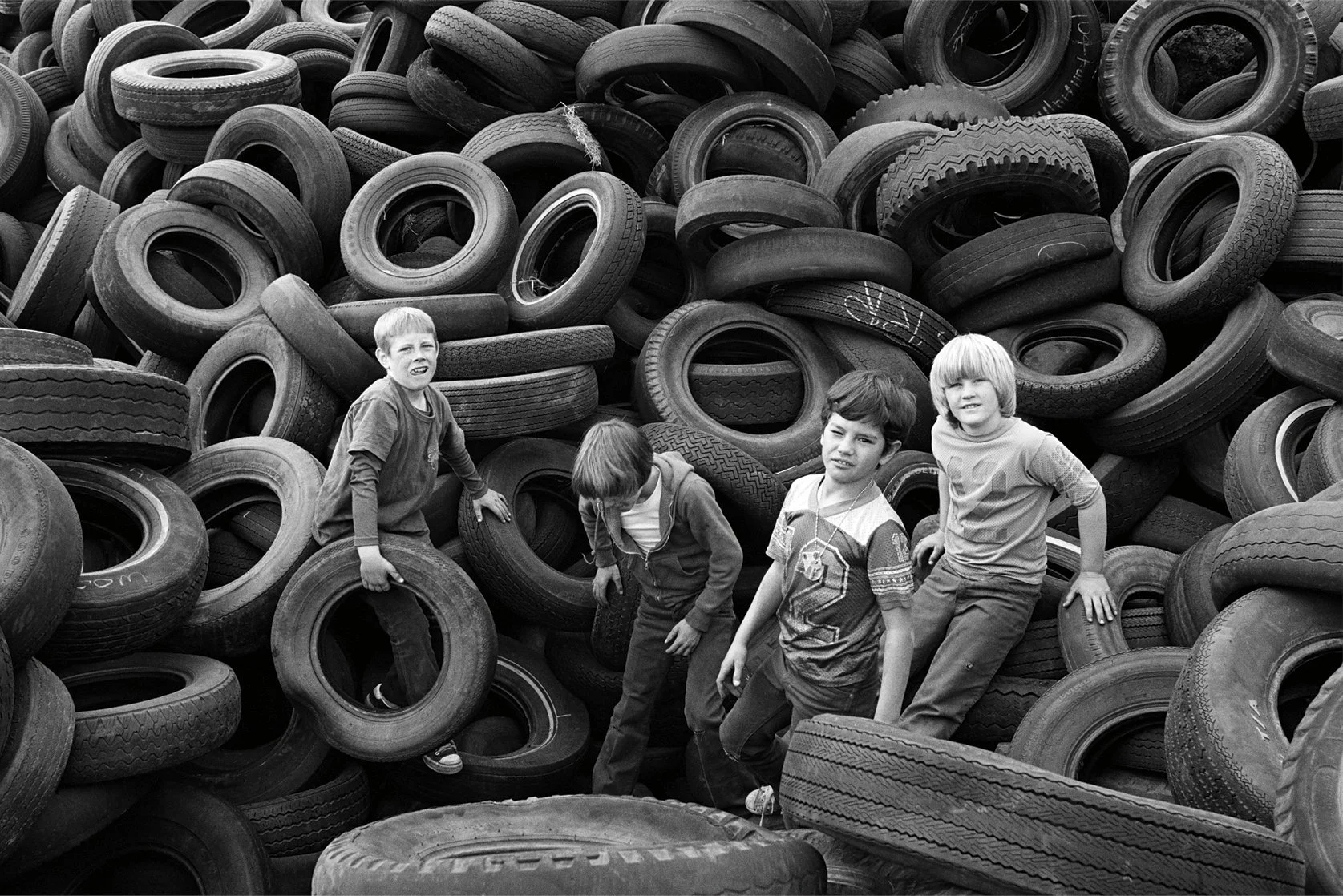
Mimi Plumb (American, born 1953), Boys and Tires, Sears Point, 1976, pigmented inkjet print, High Museum of Art, Atlanta, gift of Lucas Foglia, 2025.87. © Mimi Plumb
MP: Not just the forest fire. It was the forest fire mixing with the fog and whatever that did to the atmosphere — it made the sky stay like night throughout the day. At nine o'clock in the morning, it was dark outside. It was so weird, surreal and frightening. You’d look outside and the street lamps were still on. It looked like the middle of the night. The COVID-19 pandemic was also happening. We were told not to go outdoors because of the air quality. It was scary because it felt like everything around us was burning. I wasn’t even in the fire zone, but the effects of those fires in the Bay Area were so intense.
I thought that the climate was changing more rapidly than we knew, and I felt like I needed to figure out how to directly respond to what was happening in the environment.
At Folsom, I saw people wandering through that lakebed, the drying lakebed, looking for the water. It was the people in that space, trying to get to the water and carrying all the things that they brought with them to have a nice day at the beach, that caught my attention. I found that juxtaposition haunting and powerful.
GH: The Reservoir pictures feel the most spare and compositionally reserved out of all of your work. Were you trying to photograph that landscape differently, or did that landscape call for a different approach?
MP: It just looks different. It is spare. I'm not sure in the ‘80s that I would have photographed it any differently. It's a wide-open, desert-like landscape. But what’s different than some unpopulated desert landscapes is that those are places people wouldn't go to. The reservoir is where people go with all of their stuff to relax, to have a day off from their lives. That juxtaposition was intense.
GH: There's some irony in that.
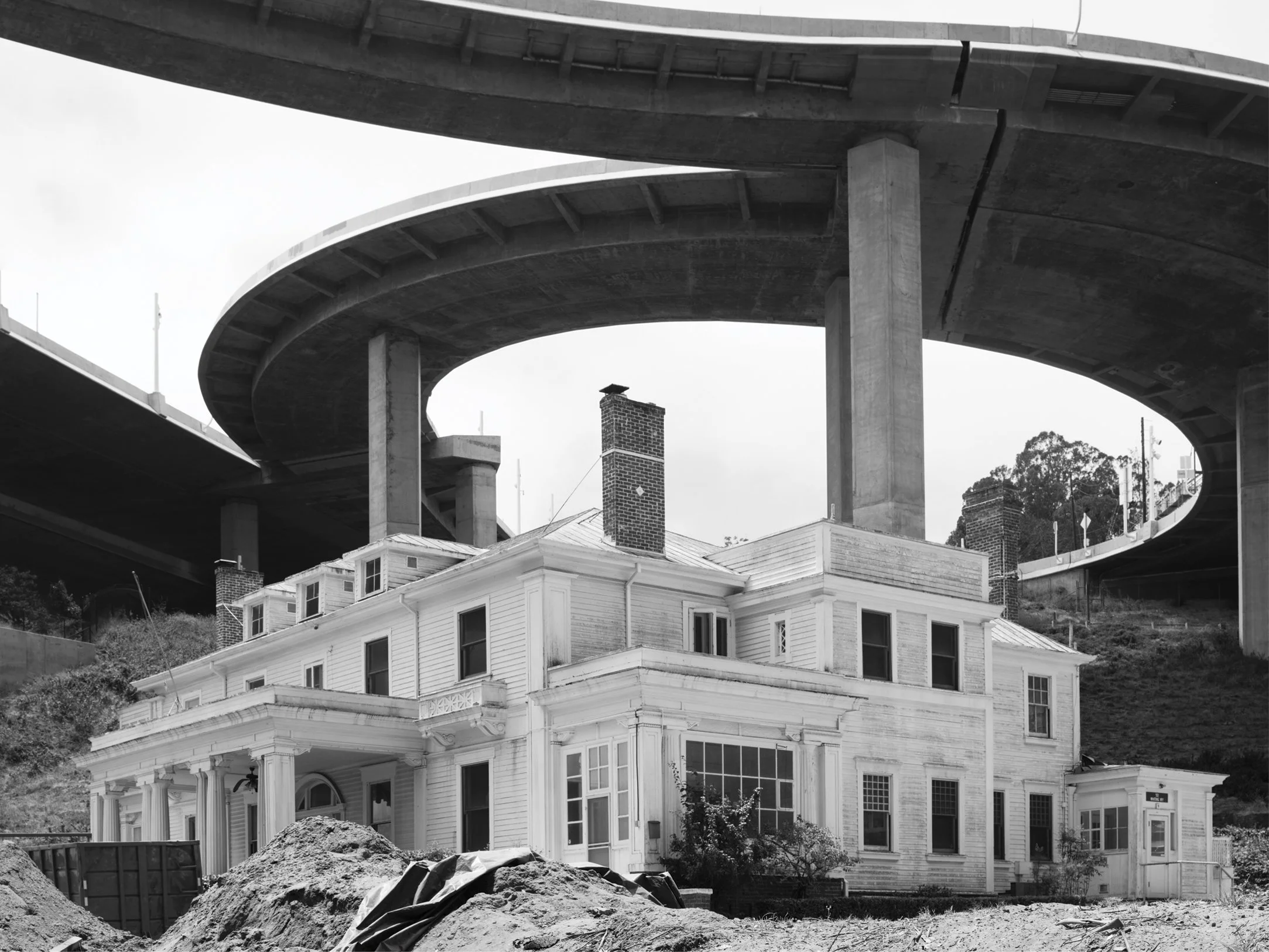
Mimi Plumb (American, born 1953), Treasure Island, 2020, gelatin silver print, High Museum of Art, Atlanta, gift of Lucas Foglia, 2025.103. © Mimi Plumb
MP: There is, and sadness too. I could see the project as soon as I saw the reservoir, and I was fascinated. But it's not an easy place to photograph because it's boring in a way. There’s one picture after another of people wandering around the landscape. Getting a picture that would work in that kind of situation was a challenge. I am fascinated by that landscape and how it changes. To see those trees covered with water when the lake is full and dried out and dying when the water recedes — it's so surreal. I feel like it speaks to our inability to recognize what's happening. I don't sense in people that they recognize that climate change is the reason why they can't find the water and it's 110 degrees. Some people know that, but there are people who would ask me, “What's going on? Why isn't there water?” I found that completely crazy. You know that picture of the family that’s under the tree? What are they doing? It's 110 degrees and they're out under this tree that has no leaves on it with their babies trying to have a nice day. Certain pictures get at it more powerfully than others.
GH: In The Reservoir work, that consciousness of climate change and environmental issues, which has been in your work all along, feels much more urgent.
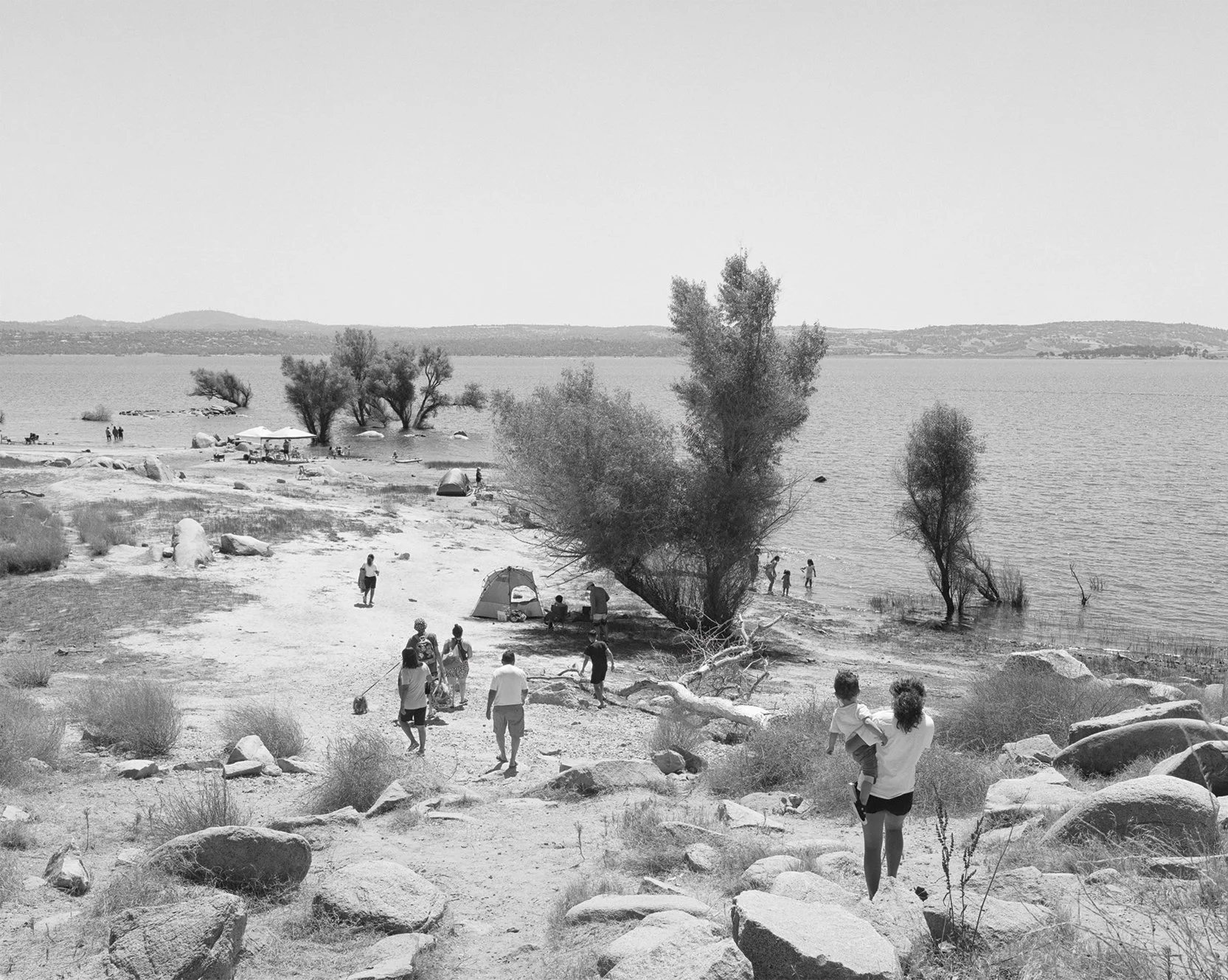
Mimi Plumb (American, born 1953), Families Picnicking by the Lake, 2021–2025, pigmented inkjet print, courtesy of the artist © Mimi Plumb
MP: It’s because of what's going on right now. It is more urgent. I used to always read fiction, and now I'm only reading nonfiction. Things are happening in the environment that scientists can't wrap their heads around. They don't know exactly why it’s happening so quickly. What's happening to the environment is dire. The L.A. fires are an obvious example of that. It could happen here in Berkeley too. I don’t want to be preachy about it, but deep down that possibility certainly terrifies me and so much of what my work has been about is that fear.
GH: Similar to The White Sky, in The Reservoir pictures, it seems that there's tension between innocence and leisure on one hand and danger and precarity on the other.
MP: That's perfect! Thank you.
GH: How do you hold those two opposing sensibilities together in one picture?
MP: Oh, I just take a picture of what people are doing in the landscape. Those two opposing sensibilities are happening in the situation, and I’m making pictures of it.
GH: The pictures record the willful blindness to what's going on in the world, but you can also see them as showing a manner of persisting.
MP: Absolutely. That's the reason I don't want the pictures to be a judgment. It's persistence in the way that we're human and we want to be with our community of friends and family. People have worked hard and want to go out and enjoy the pleasures of the world. The Reservoir pictures show how they tried to make that happen.
###
Blazing Light: Photographs by Mimi Plumb is on view at the High Museum of Art in Atlanta, Georgia, through May 10, 2026. After it debuts at the High, the exhibition will travel to three more venues: Herbert F. Johnson Museum of Art at Cornell University (Ithaca, New York), the Norton Museum of Art (West Palm Beach, Florida) and the Museum of Contemporary Photography at Columbia College Chicago.
In collaboration with the High, Radius Books published a companion catalogue that features more than 100 of Plumb’s photographs along with scholarly essays by Harris; Lauren Richman, William and Sarah Ross Soter, senior curator of photography, Norton Museum of Art; Karen Irvine, chief curator and deputy director, Museum of Contemporary Photography at Columbia College Chicago; and independent curator Amanda Maddox and writer and editor Jordan Bass.
For more information, please visit www.high.org
###
READ MORE FROM IMPACT …