Beginning in October, 2026 artists will be invited to spend focused time on Ossabaw, Georgia’s third-largest barrier island. Just south of Savannah, Georgia, and accessible only by boat, Ossabaw features 26,000 acres of undeveloped maritime forest, tidal wetlands, and Atlantic shoreline. It is protected by the State of Georgia as a heritage preserve to be used for natural, scientific, and cultural study. The Ossabaw Island Residency both advances ARTS Southeast’s commitment to deep creative inquiry by providing artists time and space on Ossabaw and continues the island’s tradition of multidisciplinary study rooted in nature, culture, and reflection first established in 1961 by Eleanor Torrey West and Clifford B. West. 

We are pleased to announce our first 2 cohorts of the Ossabaw Island Residency

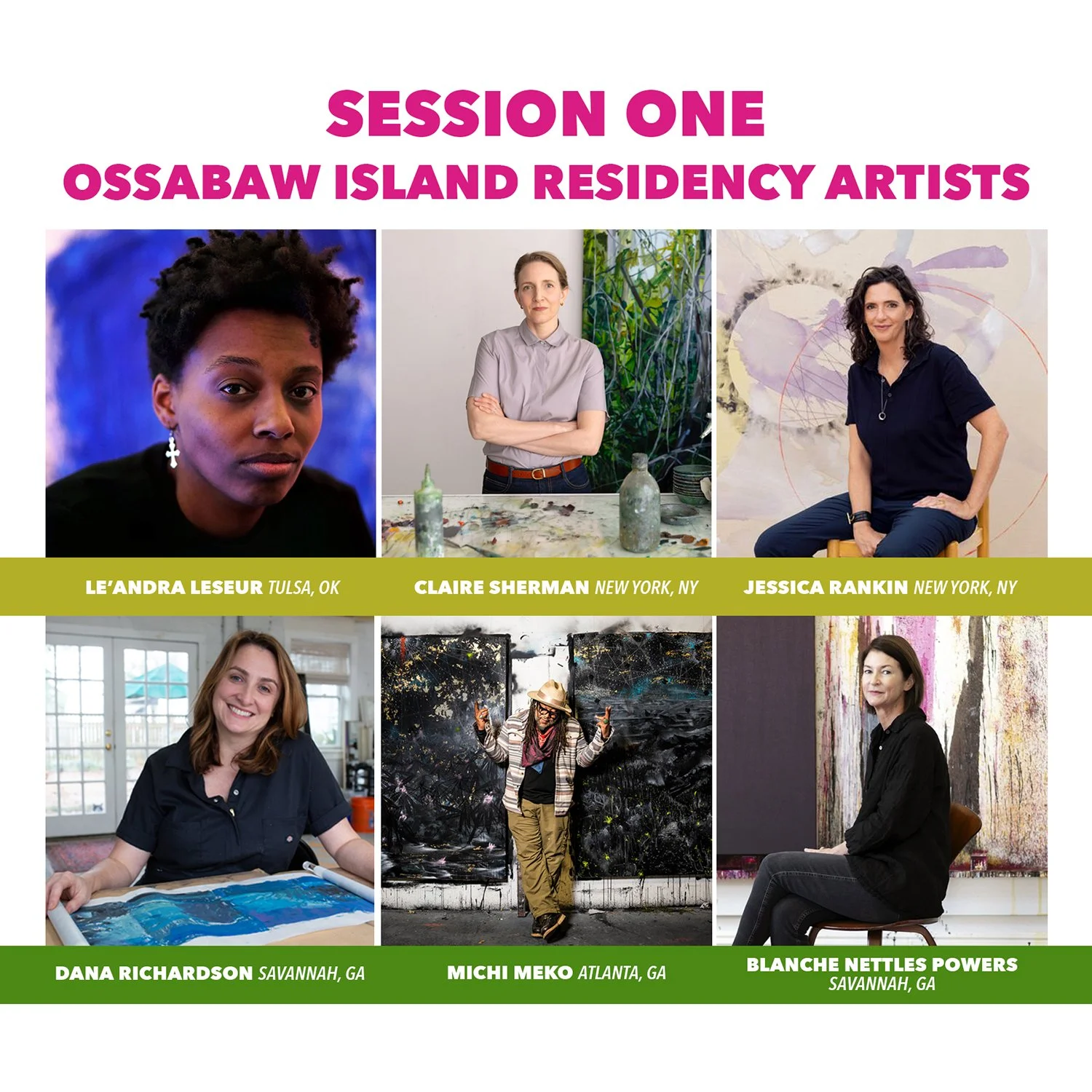
Session One [October 24–31, 2026]

Le’Andra LeSeur

Tulsa, OK

LeSeur is a multidisciplinary artist whose work encompasses a range of media including video, installation, photography, painting, and performance. Her body of work, a celebration of Blackness, queerness, and femininity, seeks to dismantle systems of power and achieve transcendence and liberation through perseverance. 

LeSeur has received the Tulsa Artist Fellowship (2024), Leslie-Lohman Museum Artists Fellowship (2019), the Time-Based Medium Prize as well as the Juried Grand Prize at Artprize 10 (2018). LeSeur has completed residencies at Pioneer Works, iLab at The University of the Arts, Visual Studies Workshop, ArcAthens, NARS Foundation, Marble House Project, and MASS MoCA. 


Michi Meko

Atlanta, GA

Meko creates paintings and sculptures focusing on the African American experience of navigating public and wild spaces while remaining buoyant within them. In 2017, he traveled into the Sierra Nevada seeking to understand what it might mean for a Black man to personify nature. Rather than finding transcendence, he encountered a landscape marked by historical trauma. During the 2020 pandemic, he returned to remote environments as a refuge from anxiety, political unrest, and public visibility. Living in tents, standing in rivers, and recording field notes, he embraced isolation as both freedom and disappearance. This experience continues to shape his studio practice. Working as an explorer, cartographer, and abstractionist, he approaches the landscape as a lone Black man reporting back from an unfamiliar world.

Meko received a BFA in Painting from the University of North Alabama. He is represented by Mariane Ibrahim in Chicago, Paris, and Mexico City.


Photo by Jacob Edenfield

Blanche Nettles Powers

Savannah, GA

Powers’ paintings, assemblages, and mixed-media works engage material systems through repetition, accumulation, and improvisation. Her practice is informed by fractal patterns in natural environments and shaped by an interest in the sensibilities of the Dansaekhwa movement. Working with natural and found materials such as pigment and plant matter, Powers shifts recognizable elements into abstract, structured compositions. Walking, collecting, and close observation are central to her process. Through compression, containment, and layering, materials move between visibility and obscurity, producing irregular patterns that echo botanical, animal, and geological systems. Recent work focuses on regionally specific materials and their relationship to architectural space. The studio serves as a site of ongoing inquiry, where form and meaning emerge gradually through repetition, variation, and attention to material behavior.

Powers received her MFA from the Savannah College of Art and Design. She has completed residencies at Mass MoCA, Vermont Studio Center, and SCAD’s New York Studio Workspace. She has received fellowships from the Jentel Foundation and Anderson Ranch Arts Center, and has completed commissioned projects for Mercedes-Benz Stadium, Verge Yacht Design, and SCAD. 


Jessica Rankin

New York, NY

Using embroidery and needlework on diaphanous panels of organdy, Rankin creates expansive maps of landscapes and the night sky dotted with codes, signs, and symbols that refer to the processes of memory, intuition, and interpretation. Though she states, “in many ways I think I’m a landscape artist,” Rankin’s work is not a naturalistic rendering of the vistas before her. Rather, mountain ranges, constellations, thermodynamic readings, lines of stream-of-consciousness text, and neurological signals morph, merge, and stretch across her embroideries, as well as her works on paper.

Rankin has exhibited widely since the 1990s, with solo exhibitions at Savannah College of Art and Design, Atlanta; PS1 Contemporary Arts Center, New York; and Franklin Artworks, Minneapolis. She has participated in major group exhibitions at Palazzo Grassi, Venice, Italy (2024); Whitworth Art Gallery, Manchester, UK; The Studio Museum in Harlem, New York; The Project, Los Angeles; and Artists Space, New York. 


Dana W. Richardson

Savannah, GA

Richardson’s work follows paths through landscape, story, and time. Working across sculpture, photography, drawing, painting, film, and sound, she uses walking, looking, and collecting as primary tools. 

Richardson holds a BFA in Painting and an MA in Teaching from the Savannah College of Art and Design and received an M.F.A. at the Maryland Institute College of Art. She has exhibited at the Riggs Gallery at Lazarus, Baltimore; ROB Gallery, Lake City, SC; and Savannah, with mural commissions at Telfair Museums’ Jepson Center, the Emma James, and the Starland Mural Project. 


Claire Sherman

New York, NY

Sherman creates paintings that are seductive yet ambivalent, drawing on the history of landscape painting while examining contemporary relationships to the environment and media. Referencing idealized visions of the sublime, the works resist specific locations and move between tropical, arctic, lunar, and ordinary terrain. Through unstable perspectives, layered imagery, and marks that shift between representation and abstraction, the paintings disrupt expectations of landscape and become environments of their own. Recent paintings address environmental change caused by globalization, trade, travel, and human intervention. Dense, tangled forms suggest new ecosystems in which plants and invasive species are forced into coexistence. These works reflect both anxiety and hope as they consider climate change, globalization, and the increasingly unstable relationship between human activity and the natural world.

Sherman received her BA from the University of Pennsylvania and her MFA from the School of the Art Institute of Chicago. She has completed residencies at the Terra Foundation for American Art, the MacDowell Colony, the Sharpe-Walentas Studio Program, Yaddo, The Albers Foundation, and the Lower Manhattan Cultural Council’s Workspace program. She was recently awarded a 2026 John Simon Guggenheim Memorial Foundation Fellowship in Fine Art. Sherman is a Professor at Drew University and is represented by DC Moore Gallery in New York and PATRON Gallery in Chicago.


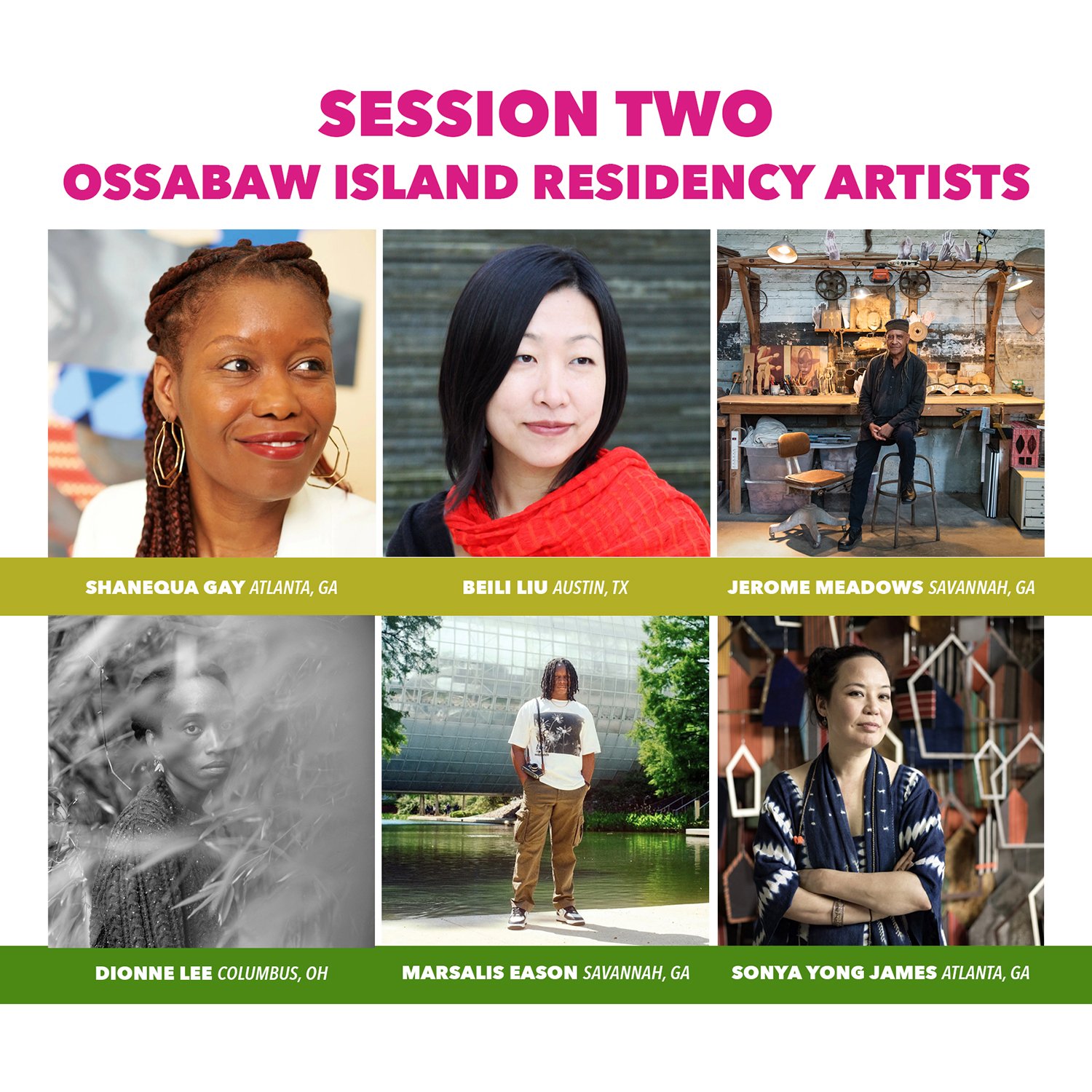
Session Two [April 27–May 4, 2027]

Marsalis Eason

Savannah, GA

Eason is a photojournalist and documentary photographer who specializes in the preservation of Black history and cultural life across the American South. Rooted in Brunswick, GA, his practice is shaped by a deep sense of community and the belief that photographers serve as keepers of time. His path to photography began as a personal pursuit before evolving into a professional career through internships at Harvard and Yale, street photography, and a role as photojournalist for The Savannahian. Influenced by the legacy of Gordon Parks, his work centers on documenting the fleeting, the familiar, and the historically significant — finding meaning in moments that might otherwise go unrecorded. 

Eason has exhibited in Savannah at Telfair Museums’ Jepson Center, Cleo the Project Space, and ARTS Southeast.


Shanequa Gay

Atlanta, GA

Gay is a storyteller whose work draws on the environment and spiritual symbolism of the American South. Blending motifs from regional life, she explores identity, culture, and power through storytelling, highlighting formidable female figures and intergenerational relationships. Her practice encompassing installations, paintings, performance, photography, video, and monumental sculptures challenges dominant narratives, reclaims space through personal memory and mythology, and creates immersive environments that invite reflection on self and belonging. 

Gay is a Do-Good Fellow recipient, an Emory University Arts and Social Justice Fellow (2020), a Hudgens Prize Finalist (2022), and a recipient of the Radcliffe Bailey Award for Excellence in Visual Art (2023). She is an adjunct professor at Spelman College.


Sonya Yong James

Atlanta, GA

James’ practice explores cloth and fiber as carriers of memory, touch, and lived experience. Working from a personal archive of found objects and handwoven textiles, she examines personal history, systems of order, and the passage of time through processes of mending and connection.Through weaving, layering, repetition, and variation, the work moves between the physical and the mythic. Materials including cotton, Georgia clay, and horsehair connect her practice to the American South while supporting imagined narratives and sculptural forms. 

James’ recent work expands the use of horsehair, a material associated with both strength and vulnerability. Woven into sculptural textiles, it becomes a vehicle for memory, instinct, mythology, and transformation, linking the body, the natural world, and the spiritual realm.

James received a BFA from Georgia State University, where she focused on printmaking and sculpture. She received the Artadia grant in 2019, was a nominee for the 2023 United States Artists Fellowship award, and completed residencies at Atlanta Contemporary and Mass MOCA. She is a winner of MOCA-GA’s 2026-2027 Working Artist Project.


Dionne Lee

Columbus, OH

Lee has an interdisciplinary practice grounded in analog photography that examines the tension between recording and interpreting place. Through collage, video, and sculpture, her work challenges traditional views of the American landscape as distant, empty, and detached, instead focusing on the hyperlocal and the ground-level experience of land.

Historical narratives of survival and belonging are central to her practice. The work considers broad environmental issues such as extraction and climate crisis, as well as the specific ways enslavement and the failure of reparation have shaped Black relationships to the American landscape. A recurring question she asks is who is positioned to survive within systems designed to protect some and endanger others.

Experiential research plays an important role in Lee’s work. She has studied ancestral survival skills such as fire-making and star navigation, using these acts to connect bodily knowledge, history, and memory. Her photographs are often collaged with found images and reworked through silver gelatin processes, reclaiming and reframing landscape narratives. Lee views photography within an expanded timeline, linking the darkroom to fossilization, survival practices, and other physical processes. Across her work, these methods investigate how trauma shapes daily life and how resilience can be carried forward and returned to the land.

Lee has exhibited nationally and internationally, including at the Museum of Modern Art, New York; Storm King Art Center, Mountainville, NY; Swiss Institute, New York; Carnegie Museum of Art, Pittsburgh; The Barbican, London; SITE Santa Fe, NM; among others. Lee’s work was included in the 2024 Whitney Biennial. She is a 2025 Guggenheim Fellow.


Beili Liu

Austin, TX 

For more than two decades, Liu has created site-responsive sculptural environments and performances that explore migration, cultural memory, resilience, healing, and hope. Using humble materials such as thread, needles, tar, wax, and cement, her work draws meaning from accumulated labor and the passage of time.

Each project begins with close study of a site’s social history, architecture, atmosphere, and patterns of use. This research guides the materials, process, and final form of the installation. Liu is especially interested in spaces between cultural boundaries, addressing displacement, assimilation, loss, memory, and transformation.

Liu has received numerous fellowships and awards, including the Andrew Carnegie Fellowship (2022-2024), the Pollock Prize for Creativity (2022), the Fulbright Arctic Chair, Norway (2021- 2022), the Joan Mitchell Painters and Sculptors Grant (2016), the National Endowment for the Arts Challenge America Grant through the Museum of Southeast Texas (2014). In 2018, Liu was honored by the Texas Legislature as the Texas State Artist in 3D medium. Liu received the Distinction Award at the Kaunas Biennial, Lithuania (2011), and a San Francisco Mayor’s Award (2008) for her contribution to cultural exchange. Liu received her MFA from the University of Michigan, Ann Arbor (2003) and is the Leslie Waggener Endowed Professor in the College of Fine Arts and a Regents’ Outstanding Teaching Professor at the University of Texas at Austin.


Photo by Emily Earl

Jerome Meadows

Savannah, GA

Meadows creates large-scale public environments, sculpture, assemblage, collage, performance, and spoken-word works. His practice is grounded in history, community, and the African American experience, often addressing racial violence, collective memory, resilience, and the relationship between people and place. His projects frequently combine sculpture, landscape design, and community engagement to create spaces for reflection and dialogue.

Meadows earned a BFA from the Rhode Island School of Design and an MFA from the University of Maryland. Major public commissions include the African Burying Ground Memorial in Portsmouth, New Hampshire; the Ed Johnson Memorial in Chattanooga, TN; works in Savannah’s Yamacraw Square; and Of Communities and the Land and the Trees That Bear Witness to Them at Enmarket Arena, Savannah. In addition to his studio and public-art practice, Meadows has taught at institutions including Howard University, the University of Maryland, the Maryland Institute College of Art, and the College of Charleston. He previously operated Indigo Sky Community Gallery, a gathering place for exhibitions, performance, and cultural exchange on Savannah’s Waters Avenue corridor.


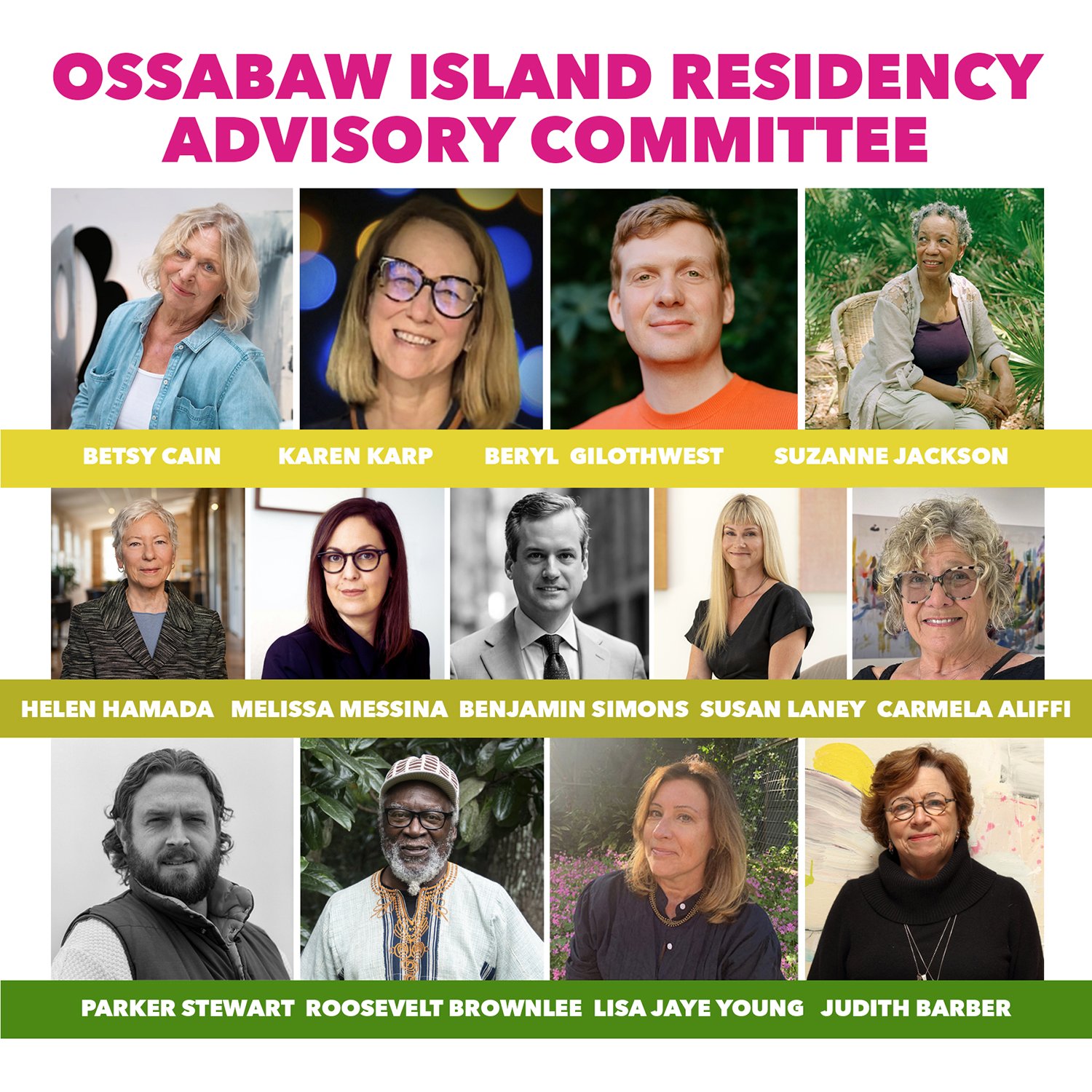
“After taking several one-day trips to Ossabaw, I was finally able to visit the Island on a ten day retreat, with rotating sessions of artists. We walked jagged paths. We were guided to interior forests, aged tabby houses and waterway edges. We indulged our pleasures by painting, drawing, writing, music, photography and day dreaming together – sometimes in solitude.

Magic Ossabaw island is a raw untamed mystical memory- embedded history. It holds low country marsh secrets in the trees, in ancient moss, the birds , the donkeys, the deer, the hogs, all gloriously being everything of a natural place.

Suzanne Fitzallen Jackson Foundation is supporting other artists by sharing the awe inspiring experience in the beauty of this special Georgia island”

– Suzanne Jackson

The Ossabaw Island Residency is intended for artists’ ideas to emerge and take shape, free from urban distractions. It is open to emerging, mid-career, and established artists across disciplines who are encouraged to pursue self-directed work shaped by solitude, a sense of place, and the pace of natural rhythms. There are no thematic requirements or expected deliverables. This is a fully-funded residency, with housing, meals, stipend, and full logistical support provided.
The residency includes:

• Private housing on Ossabaw Island

• All meals during the residency period

• Transportation from Savannah to and from the island

• Travel stipend

• On-island logistical support provided by ARTS Southeast and The Ossabaw Island Foundation

At this time, the Ossabaw Island Residency is invitational.

The Ossabaw Island Residency is made possible with generous support from

National Endowment for the Arts, the Judith Alexander Foundation, the Suzanne Fitzallen Jackson Foundation, Laney Contemporary and Betsy Cain, Savannah Community Foundation, Louisa Abbot, Melinda Borysevicz, Cindy Gilbert, Beryl Gilothwest, Helen Hamada, Karen Karp, Jo Ann Miles, Josh Milliken, William Pagano, Kevin Ryan, the Ossabaw Island Foundation