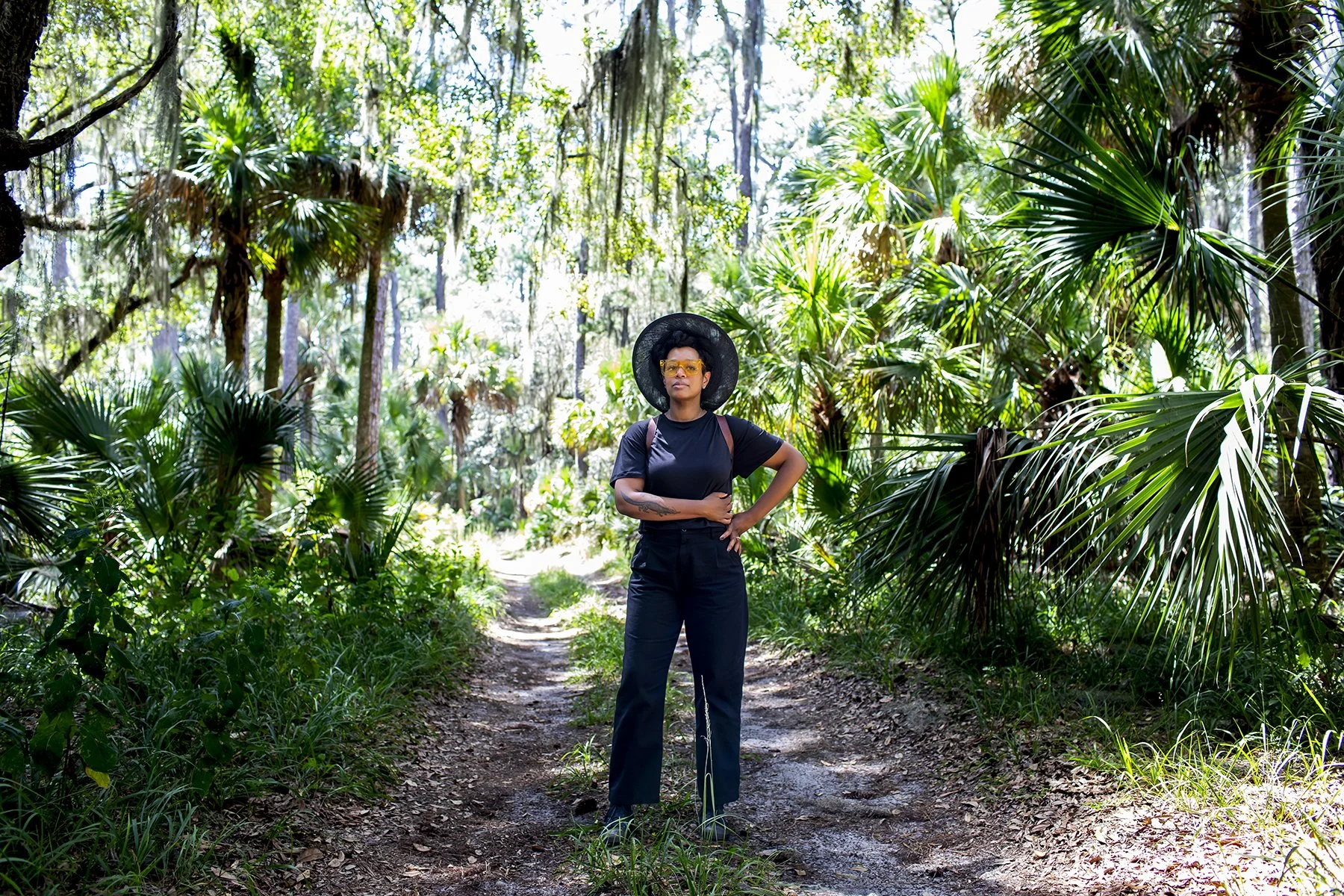
Allison Janae Hamilton on Ossabaw Island, September, 2025. Photo by Jade Takes Pictures
Venus of Ossabaw by artist and filmmaker Allison Janae Hamilton is a wilderness narrative about a young girl named Venus who self-emancipates from captivity on Ossabaw Island in the late 1700s. Ossabaw, a 26,000-acre barrier island off the coast of Savannah, was the site of indigo and cotton plantations cultivated by enslaved laborers from 1763 until the mid-19th century. Venus leaves with her friend Winnie to seek refuge in St. Augustine, Florida, through sanctuary with the Catholic Church or the maroon communities of formerly enslaved people. When a fierce storm capsizes their boat, she is left to finish her journey southward alone. Through her own determination and help from unseen hands, Venus learns to survive in the harsh environments of South Georgia and North Florida, winding her way through deadwood beaches, dense foliage, thorny upturned roots, and paths cocooned by live oaks. Filmed over four days in November, 2025 in Georgia on Ossabaw Island and Myrtle Grove in Richmond Hill, the rich palette of deep blue and warm golden amber emphasize that the landscape serves as both adversary and companion to Venus.
Guest curator Beryl Gilothwest and I have been working with Hamilton since early 2024 on a new commission by Telfair Museums for the exhibition Off the Coast of Paradise: Artists and Ossabaw Island, 1961-Now, which is on view at Telfair’s Jepson Center through September 6, 2026. Allison and I chatted one afternoon in February, 2026, and spoke about her background, evolving moving image practice, her short film Venus of Ossabaw, and her love for Savannah.
Erin Dunn: Our conversations are often revolving around the logistics related to your project Venus of Ossabaw, so it is nice to have a conversation speaking to your broader artistic practice. For the readers who might be unfamiliar with your background and connection to the American South, could we start with your familial history and upbringing?
Allison Janae Hamilton: Well, I was born in Kentucky, and I was raised in Florida, both South and North. My maternal side of the family is from rural western Tennessee and that informs my practice in a deep way. Because I am from so many locations, I consider myself a pan-Southerner. My dad is also from the Carolinas, so I have the privilege of being familiar with many different regions of the American South, and it’s an important element of my own background and my work. My family in Tennessee has a farm that's been ours for many generations. It’s the land and the landscape that have been part of my life from the very beginning. I can't help but include it in my work.
ED: You are often still returning to the South, correct? I know that you mostly live and work in New York but do return to Tallahassee rather frequently.
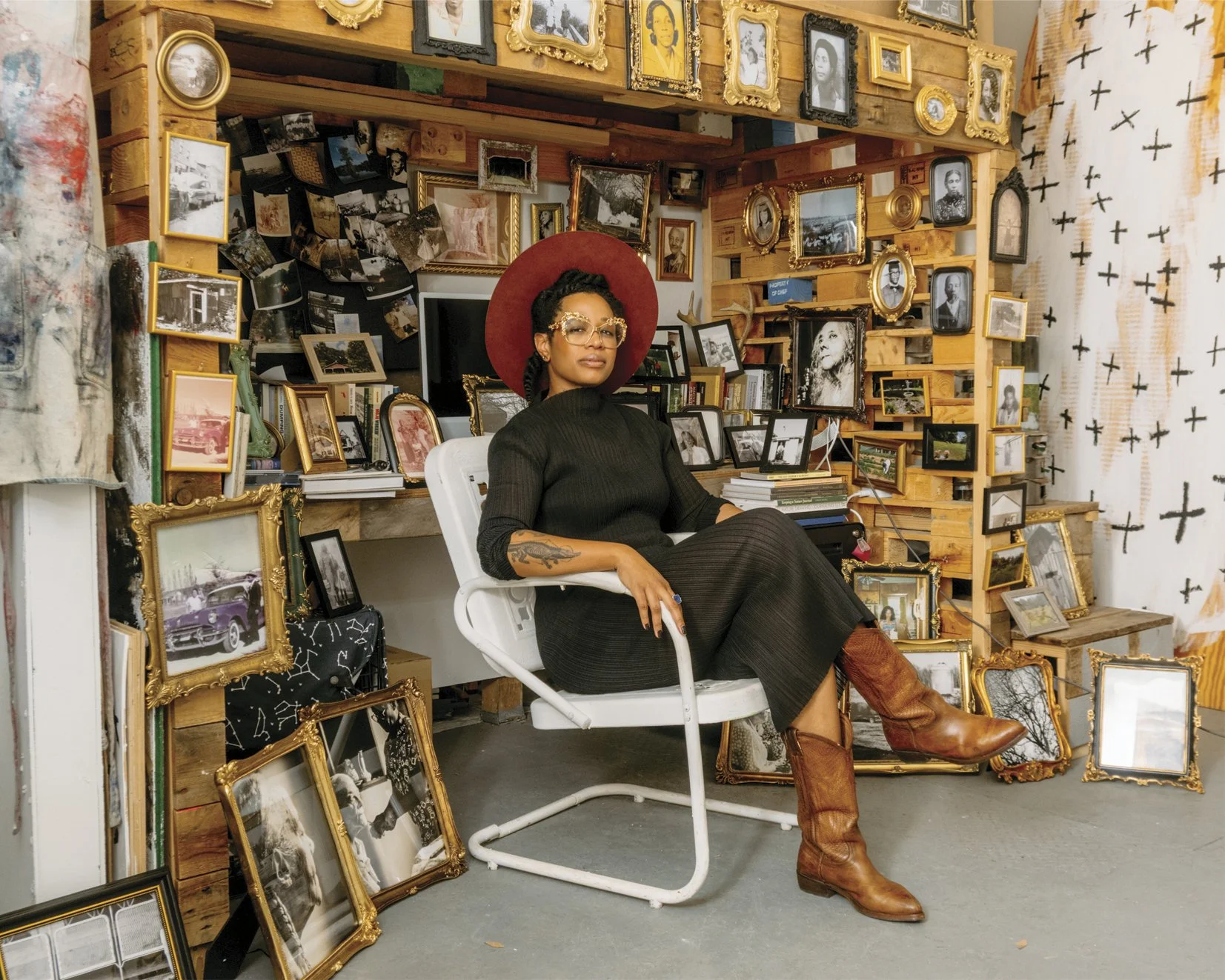
Portrait of Allison Janae Hamilton by DeSean McClinton-Holland
AJH: Yes, I live in New York City, but I am home all the time, whether that's the Tallahassee area (Leon County, Florida) outside of the city, close to the Georgia border, or our farm in Tennessee. It is important for me to make work in the South and to have a routine and a rhythm of being home.
ED: Have you always felt like an artistic person? Is that something that emerged as part of growing up in this unique landscape and wanting to make art about it? Or did that come to you later?
AJH: It came early on. I went to an arts middle school, and my major was photography. I was learning 35mm photography and became fascinated with documenting the landscape, particularly on our farm, because I noticed a lot of things that were already changing even in the ‘90s. Most of my generation of cousins and relatives didn’t go into agriculture. A lot of shifts were happening at the time. Certain animals or crops weren't coming back. And I photographed our barns and different buildings and structures on the property and the animals as early as 12 years old. I always paired making art with the landscape and my family land and history.
ED: In terms of the family farm and generations moving on, was there lack of interest in continuing the farm or was there a sense that it was a hard lifestyle and people wanted to go off and pursue other opportunities?
AJH: As the generations went on in my family, there were more opportunities to do other things that maybe weren't options at the time. Opportunity shifted and changed and people moved away from the county and the state too. But one thing I'll say, my grandmother still lives on our farm at 95 years old and the whole family comes back often, which is really special. The farm no longer operates as an agricultural business in that same way, but we still cherish the land and have a lot of respect for it and pride in it.
ED: Is that something you feel like you're imparting to your daughter as well, who's now probably an age where she's starting to understand and recognize that?
AJH: Absolutely. I try to make sure she's connected and we visit her great grandmother and I have photos of my grandmother’s siblings and my great grandparents and great, great grandparents and even one of my great, great, great grandmother all over my house. I make sure she knows who's in the photos, what's in the photos and what's going on. Especially raising her partly here in New York City, it's important to foster that connection. To be intentional about it.
ED: In terms of going off to pursue opportunities, you attended Florida State University and later moved to New York City for further education. I wondered if you could share your winding path to your present career as an artist.
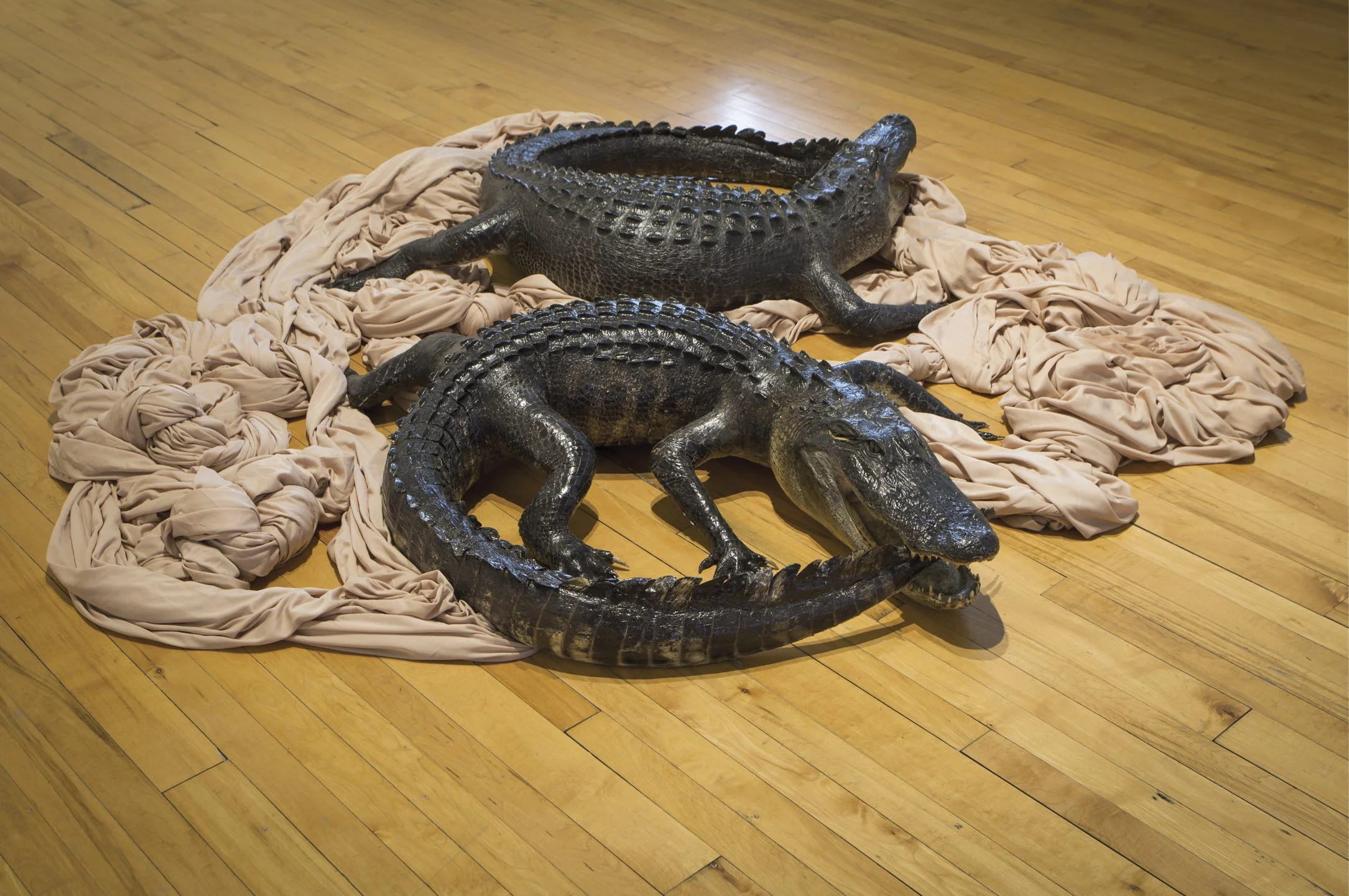
Untitled (Ouroboros), 2017. Alligator carcasses, foam, mixed media. Installation View, Allison Janae Hamilton: Pitch, MASS MoCA, North Adams, MA. March 25, 2018 - March 17, 2019. Photo by David Dashiell
AJH: Part of it comes from my background, which is very practical. The idea of being an artist or a film director, it wasn't something that was necessarily at the forefront of conversation. It took me a while to realize that a creative career is something that is possible and livable and doable. Whereas I've always kept the same interests, I address them in a roundabout way. At first, my major in undergrad was in fashion merchandising because it was the closest thing to a creative career that felt possible, since it's still a little bit practical because I worked on the business side of the fashion world. But the deeper I got into my fashion career, I realized it was more the nature of visual culture and art that I was interested in. I moved into thinking that through an academic lens. From there I realized I didn't want to write about creative practices. I wanted to do it myself and I decided to go for it. Midway through my PhD program, I decided to finish it, but I promised myself that I would go to art school right after.
ED: Well, kudos to you for finishing the PhD. Not many people would do that once they've decided to switch.
AJH: Thank you. It's been helpful in other ways though. I learned a lot about research, which is useful in many ways, even in a creative career. Diving deeply into research and archives is something that feels important for my creative practice.
ED: Is there an early work you can point to for someone who is just learning about your practice?
AJH: I would probably say my first museum solo exhibition, which was called Pitch at MASS MoCA (a contemporary art venue in North Adams, MA) in 2018. The reason being that it was truly an interdisciplinary endeavor. There was film, there was sculpture, there was photography. There was the beginning of mark making, which has evolved into paintings and works on canvas. It is variegated and it has a lot of different materials and methods that feature landscape as the main exploration point, which is my life's work as well as thinking through my culture and Americana through the lens of landscape. That’s a formative example.
ED: We are diving more into your film direction in this conversation. Before we jump into “Venus of Ossabaw,” I wondered if you could speak to a few of your previous film projects. I’ve mentioned to you before that I discovered your work after seeing “Waters of a Lower Register “(2020) in the group exhibition “Aaron Douglas: Sermons” at the SCAD Museum of Art and then viewed “House Called Florida” (2022) in a wonderful exhibition, “A Movement in Every Direction: Legacies of the Great Migration” at the Baltimore Museum of Art. I sometimes struggle to sit through an entire video work as part of an exhibition, but I couldn’t move during that screening! It was so compelling. It felt to me that you approached landscape artistically while still letting it speak for itself in many ways. What are a few works that you can point to as building up to your current project of Venus?
AJH: A lot of the experimental projects, especially the film installations, grounded me in a moving image approach to immersion. The film that I had on view at MASS MoCA is a film installation artwork titled FLORIDALAND (2017/2018), which is also the title of the narrative feature that I am now working on. I titled it the same because the original was this first foray into thinking about myth through installation artwork. Florida is both a tangible place and a set of mythologies, both historical and contemporary. The piece featured a collage of images and music and a multi-channel video. You walked into the room and were surrounded on all sides by screens of experimental images.
I'm now working on a feature script that's part of the Sundance Screenwriters Lab Intensive. I wanted to title it the same thing because in the narrative fashion of a “movie,” I'm exploring the same idea of the folklore and very real nature of Florida. From FLORIDALAND (the installation) to Floridaland (the feature film). The second to last stop on that journey is Venus, which is my first narrative project and short film. I love that it's having its debut in an exhibition first because I do
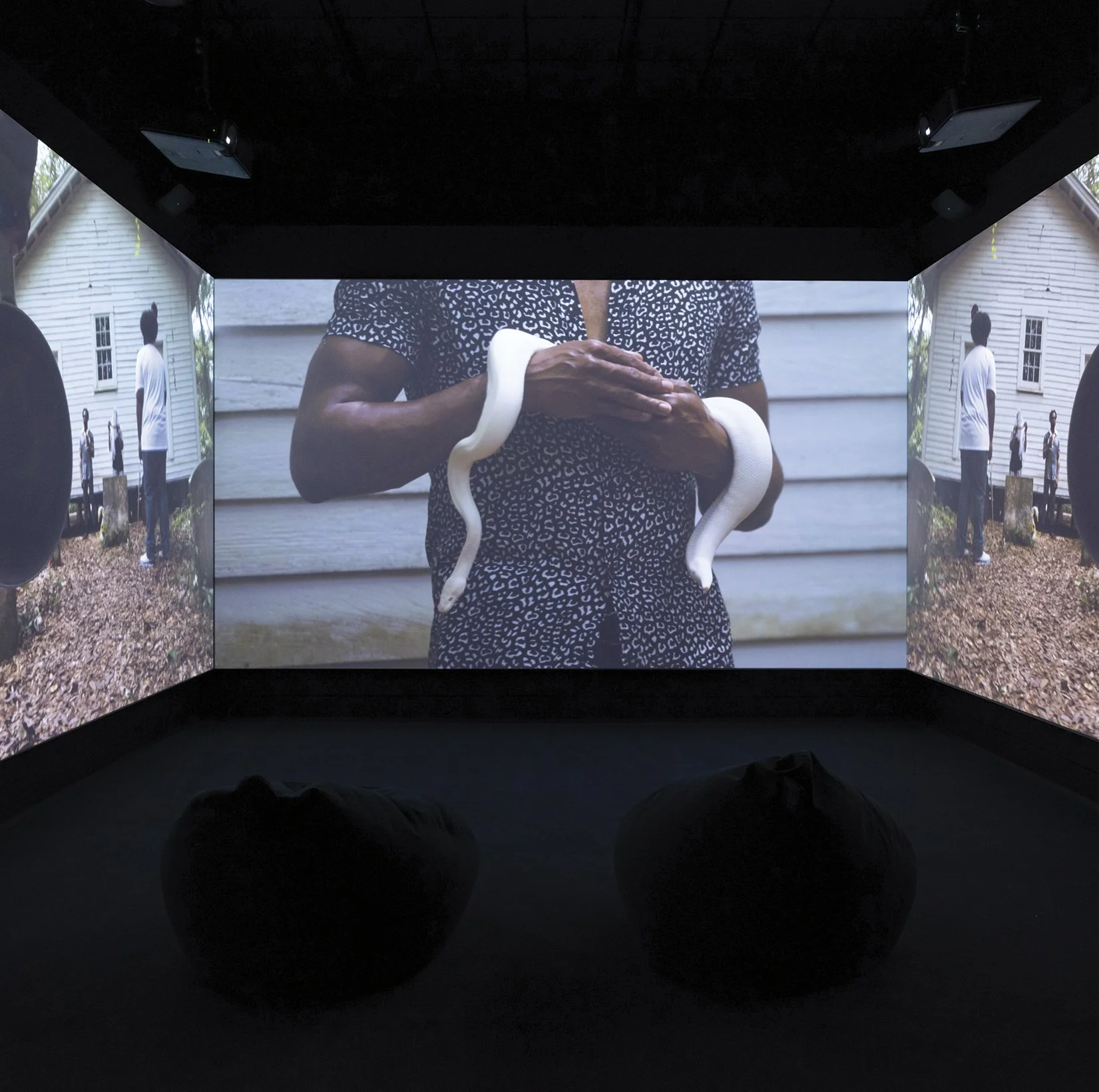
A House Called Florida, 2022. Three-channel film installation. Total runtime: 0:34:46. Installation View, A Movement in Every Direction: Legacies of the Great Migration, Mississippi Museum of Art, Jackson, MS April 9 - September 11, 2022. Photo by Mitro Hood Courtesy of the artist and Marianne Boesky Gallery, New York and Aspen © Allison Janae Hamilton
think it's appropriate to my moving image practice overall, which has a foot in the contemporary art world, but also in the film world too. Going from FLORIDALAND to something like Wacissa (2019), which I first showed at MoMA PS1 as part of the culmination of my Studio Museum in Harlem residency through to Waters of Lower Register. And of course, there's A House Called Florida. I have been moving more and more into narrative storytelling but also keeping a deep immersion into place and a deeply visual language and an artistic approach to directing. A cinematic approach of course, but one that's rooted in my long-standing study of portraiture and fine art.
ED: I think your fine art eye certainly comes to bear in “Venus”. Something else that we had to consider as part of the planning for this film was the public component which was an element of our grant proposal for VIA. I approached that component with some trepidation because it involves a lot of factors outside of our immediate control.
You have a lot of experience with public art, both in your sculpture and multimedia practice as well as your moving image practice. Can you share some of the public forums for your work and how it brings another layer of the landscape into the moment?
AJH: My first outdoor work wasn't necessarily a public art piece. It was at Storm King Art Center (a monumental stack of tambourines titled The people cried mer-cy in the storm (2018). That was my first toe in the water of a large-scale outdoor artwork. I'm always in a conversation with public art, even at Storm King, even though it's a contemporary art institution rather than public art. But it was my first experiment with scale and making artwork to live outdoors. So that started there and then after that project, I had the opportunity to do several public projects with similar tambourine towers. I've now started to do them in bronze, which has been exciting over the last couple of years. In addition to that, I’ve had large-scale film installations that have been outdoors as well like Waters of a Lower Register (an installation of five screens in Brooklyn Park in 2020 by Creative Time New York). Public art allows the experience of stumbling upon an artwork rather than making the decision to go into the museum or go to a sculpture park. You can be walking your dog or going to get your coffee or in traffic and you stumble upon an artwork that can make you think or consider new ideas or resonate in some way. Public art is special to me, and I like engaging audiences in that way.
ED: What I've learned through the process is that it’s an extreme act of collaboration when you're trying to put something of that scale together. Looking back at emails, we started this process back in late 2023. Beryl Gilothwest (guest curator for “Off the Coast of Paradise”) and I knew from the beginning that we wanted a contemporary artist to create a film in response to Ossabaw Island, but we were grasping at straws a bit because we didn't have the funding for the project yet. However, we felt strongly that you were the artist that we wanted to work with. I approached Savannah Downs (Director at Marianne Boesky Gallery) at Art Basel that December about the possibility of working with you, following up with her in January 2024 where she shared our idea with you and scheduled a meeting. I wondered if you had any memories of that kind of initial meeting and what you started to think about after that?
AJH: First of all, I was honored to receive the invitation, and the first thing I always do is sit down and think “OK, well, what am I going to make?” Because I am an artist who's interdisciplinary and I knew from the images that you shared of Ossabaw that I wanted to immerse the viewer in it. I thought about it and proposed this project and thanks to VIA Art Fund we were able to make it happen. But I started thinking about it and I felt like the history of this island was so rich and I wanted to do it in a big way. I’m thankful for all the collaborators that helped make it possible, because it takes a ton of people to pull something like that off, but we did it.
ED: When we started it, it wasn't quite as ambitious as it ended up. But big ideas generate that kind of support. We were grateful that you took on the challenge! I believe you were taking a script writing class, or had just finished a script writing class before the proposal?
AJH: Well, I took one because of the project. I had written scripts before, but they were for experimental projects. I wanted to hone my skill set in narrative screenwriting. Venus was the first project that I delved deeply into. I took on a whole other project, learning the language of screenwriting, because I had directed things and I had written again, experimentally, but I hadn't written a narrative script before Venus. I took it so that I could do the product justice.
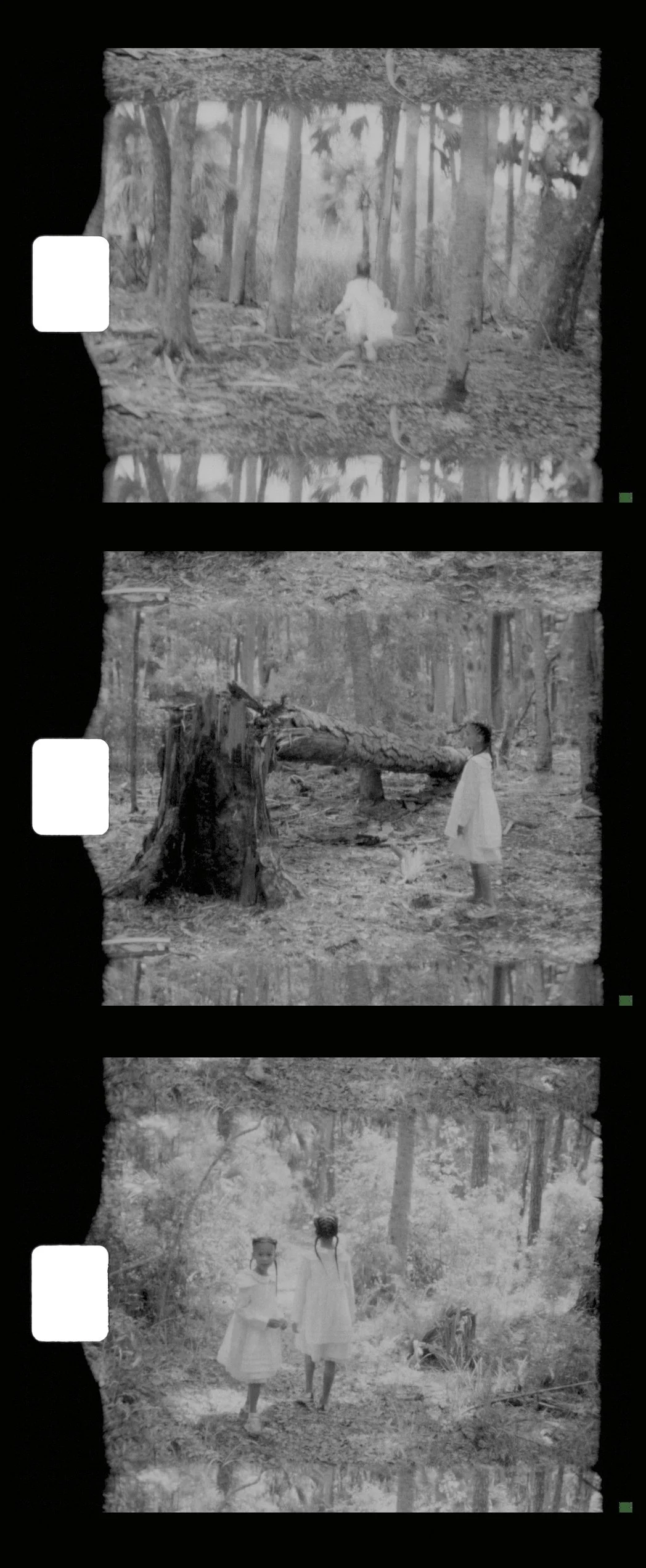
Wakulla Cathedral, 2019. Single-channel video (8mm film), Total Runtime: 0:03:25. Courtesy of the artist and Marianne Boesky Gallery, New York and Aspen © Allison Janae Hamilton
ED: I don't think I realized that process was so new to you. I thought you were already working in that realm before this moment, so that's very interesting to learn.
AJH: No, it was this project that gave me the kickstart and I decided to do it. I was feeling a strong inclination to experiment and try new things. I had a one-year-old too at the time. I figured, why not? Let’s do everything anew. So that's how it went.
ED: One of the things we thought made an interesting geographical parallel between Ossabaw and your work is Dr. Paul Pressly’s new book “A Southern Underground,” where he retells the story of Titus, an enslaved man who escaped from Ossabaw in the late 18th century and traveled to Florida, a place that surprisingly offered refuge. Some people ended up forming maroon communities and others joined the Catholic Church in Florida, which was controlled by the Spanish at that time. This choice is explored beautifully in “Venus.” I wondered if you could talk about learning about that history and what you were able to pull from that.
AJH: I enjoyed coming across Dr. Pressly's work. I became fascinated by the story of Titus. Most of us learn in school about Harriet Tubman of the Underground Railroad and that she continued to go back down south and bring people north. But history of this southern route toward freedom is far less known. People traveled southward across the Florida border in an attempt to gain access to freedom and to flee the brutal conditions of captivity that they were risking everything to leave. But in this case going deeper into the South and trying to make it into Spanish Florida. With Venus, first I thought, well, maybe I'll do a historical fiction and make it about Titus. And then I thought about creating a story that was based on this history and based on the journey of Titus but asking what would have happened if one of those groups of people coming down were shipwrecked. What if only a young girl were left as a lone survivor? And that's basically the story of Venus. It’s a fictional story, but it's based on this rich period of people escaping.
ED: The script is one very important aspect of filmmaking, and you were working on that as we were applying for funding and then we received the VIA Art Fund grant. Then we had to start planning to make the film, which was exciting and terrifying at the same time. One of the most important components was getting you to Savannah for a site visit to visualize the journey that Venus was going to travel. How was the experience of scouting locations, and seeing some of these places, especially Ossabaw? Did it strengthen and support the script you were working on or change it in any way?
AJH: Well, I definitely felt very comfortable in the landscape. It looks so similar to northern Florida in almost every way. I immediately felt at home in Savannah and on Ossabaw and was ready to get to work. That's a special part of the filmmaking process. The scout, getting to know your team, and getting to know your director of photography and your location manager and all those people who make it possible to make the film. I loved every step of it, and it was special to get to know the island.
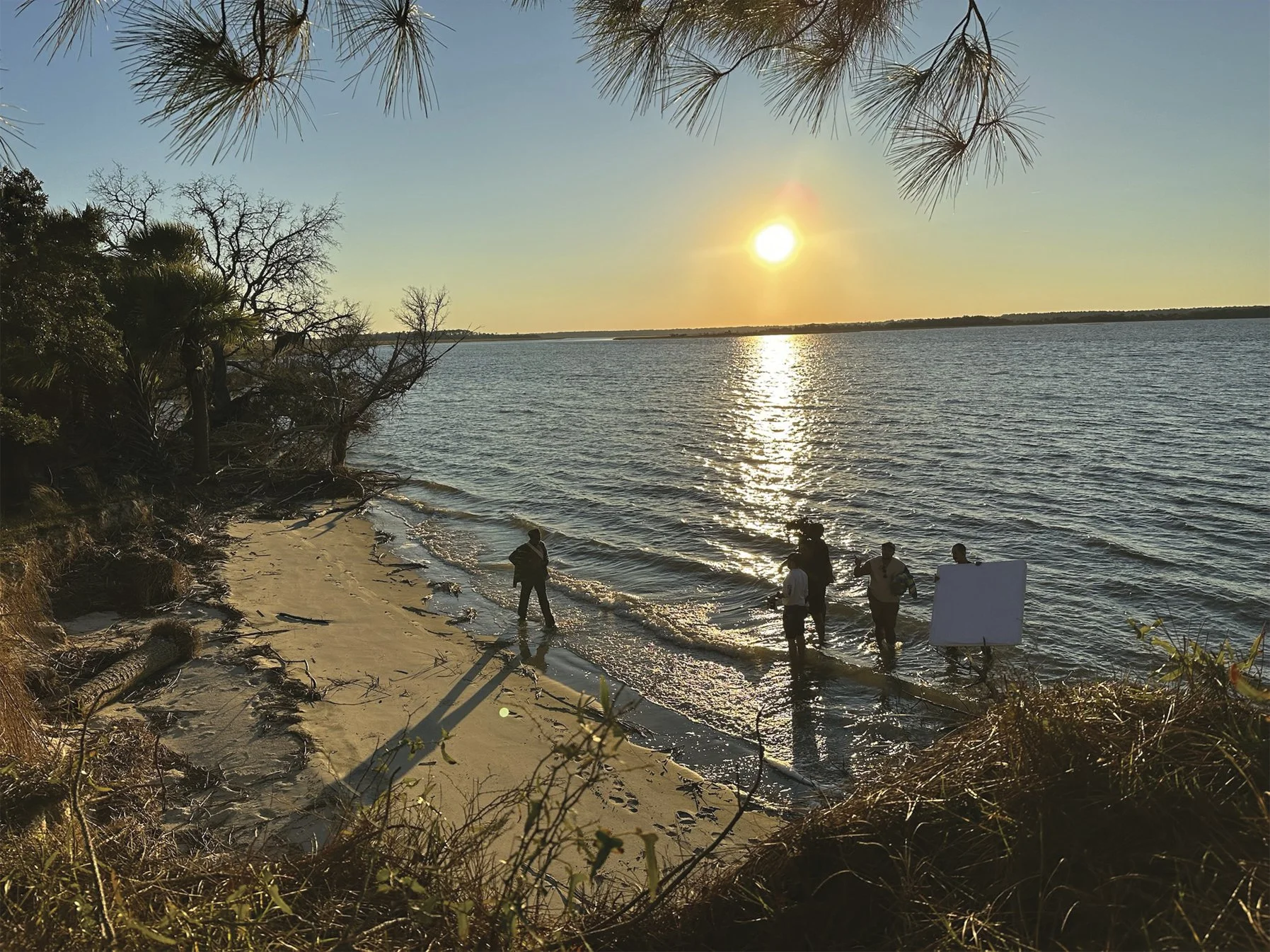
Behind the scenes, Venus walking on Ossabaw. Courtesy of the artist and Telfair Museums.
ED: We started with an idea and budget of all the people that we would need to make a film, and it very quickly expanded, especially once we started working with First Team Films, a Savannah-based production company. Producer Nora Clark helped bring together the stellar cast and crew. It was interesting to see how everything evolved from what we thought would be required to make this film to what it ultimately ended up taking in terms of equipment, time, and number of people.
AJH: We had the best team. From marine coordination all the way to costume and hair and makeup and craft service. I’m so grateful for the opportunity to have met them, to work with them. Savannah crews are incredible. I would work in Savannah again any day of the week.
ED: I joined for one 12-hour day on set, and it was so impressive to see everyone in action making it all come together so quickly and look seamless. Turning toward the content of the film, landscape is very much a central character in addition to the protagonist, Venus. The exhibition featuring the film is titled “Off the Coast of Paradise: Artists and Ossabaw Island, 1961-Now.” I read about a previous exhibition of your work titled “A Romance of Paradise” and in an interview, you talked about the complications of the word ‘paradise.’ It’s an ideal of something, a utopia that doesn't ultimately exist. Many people approach untouched spaces like Ossabaw as this sort of space. But it's a place with a lot of complicated human history. And I wondered kind of how you approach that paradox of landscape? I'm specifically thinking of the scenes in the film where the audience sees two versions of Venus — one struggling to survive in the harsh terrain and one thriving.
AJH: I wanted it to be a true wilderness narrative, even in a short film format. And you do feel that, you feel that you are part of her journey and you get to see her as a traveler. Some of the most gorgeous places on the planet are in Tennessee and Florida. I'm constantly awed by their beauty. And there’s a haunting aspect to it. There’s layers and layers of history, some complex, some painful, beautiful. There's a little bit of it all. Everything is contained therein; I don't shy away from any of it. I put it all into the frame, into the soundscape and you feel that when you watch Venus.
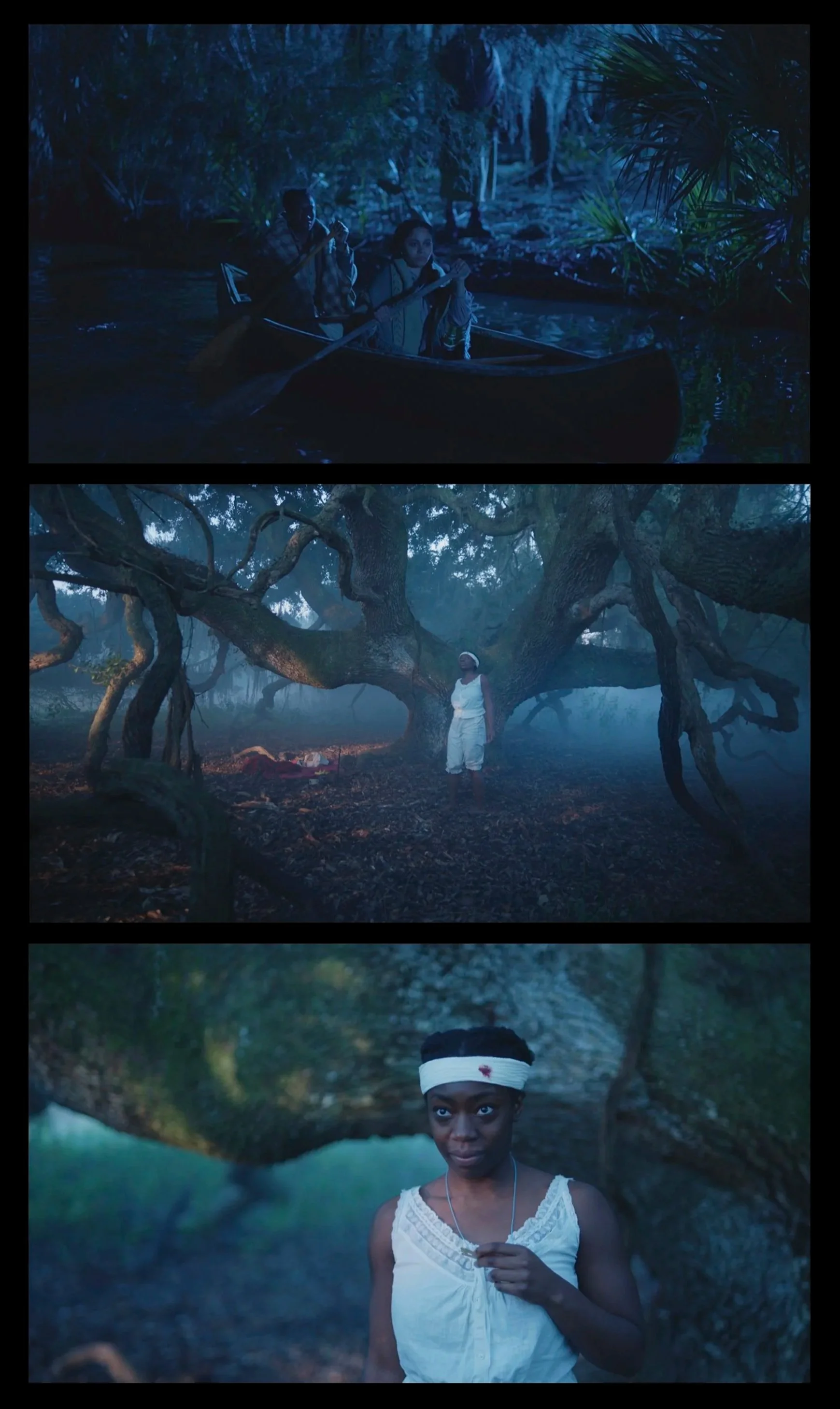
Stills from Venus of Ossabaw. Total Runtime: 0:18:06. Courtesy of the artist and Marianne Boesky Gallery, New York and Aspen © Allison Janae Hamilton
ED: The weightiness of history is also evident in some of the historical visual markers you include such as indigo.
AJH: Indigo is an important element in the film and it's a humble homage to the enslaved laborers of those indigo plantations throughout the Sea Islands, including Ossabaw. Bringing that color motif in, continuing to be a presence throughout the film. It’s more so a wilderness narrative about Venus' journey. I wanted to bring in the remembrances of the people who worked the land and who made those arduous journeys to escape.
ED: How was the actual filmmaking process? You and the crew spent four working days between two locations, Ossabaw Island and Myrtle Grove in Richmond Hill. What were the days like?
AJH: We worked long days, but every day was exciting adventure. Having a good crew made all the difference, especially when you bring a pretty large cast and crew to a remote island. It’s not a hotel situation. You select people for the team, both cast and crew, that are up for that type of adventure. There were a lot of logistics involved. Everything we had to use on Ossabaw, we had to bring on a boat. It was kind of like Burning Man, we had to bring it in and take it away. I've never made a project like that, or I've never made a project with those types of logistics. Experiences like that make you grow and they expand your agility in your artmaking.
ED: What has the post-production process been like? You’ve gone through this exhausting process of filming everything and then you'd have to put it together in this cohesive story for the viewer.
AJH: Well, it's been a great experience working with our editor, Robert Rodriguez. You go through the process step by step, laying out your selects along the timeline and then figuring out how rhythm and pacing and all those editing devices aid in your communication and the mood and tone. We're still wrapping up, right now in February (2026) and we shot the film in November (2025). We went right into post. The post process has been much longer than the pre-production process. I can't even explain what it's like seeing this as an idea in your head that started off as scribbled down notes and then you see it in post come to life. It’s an amazing thing.
ED: And that's where you get to add all those layers on top of it too? You’ve got that material for the film, but then you can add the VFX and the music. And from the beginning you mentioned that you had a particular song in mind by Candice Hoyes that you wanted to use.
AJH: Candice Hoyes is an incredible singer. I've worked with her on a previous project, which was Celestine (Florida Storm) (2025), and I knew that I wanted to work with her again. She's also a fellow Floridian and my neighbor in New York. It’s an honor to have her song Far Away Star (2025) as part of the soundtrack of this project because her voice is so powerful and beautiful.
ED: I want to make sure readers and viewers are aware that there is a secondary version of the film that we'll be showing. In the gallery there will be the full narrative, 18:06-minute-long film and we're hoping viewers will sit down and watch it from beginning to end. And then we'll have an outdoor screening every evening from 7:30 – 8:30pm for the first three months of the exhibition (March 13 – June 21). That will be an atmospheric version of the film with no sound. And I wonder if you could speak about the different ways that visitors encounter your work whether it's an in-gallery showing, outdoor projection, or a film screening. Do you have a preference or know they will get something out of it regardless?
AJH: They'll definitely get something out of it regardless of the format. I am excited about the outdoor projection. Again, speaking back towards the opportunity to do this large-scale type of a project. It is special and I'm excited for viewers to stumble upon our film from an outdoor
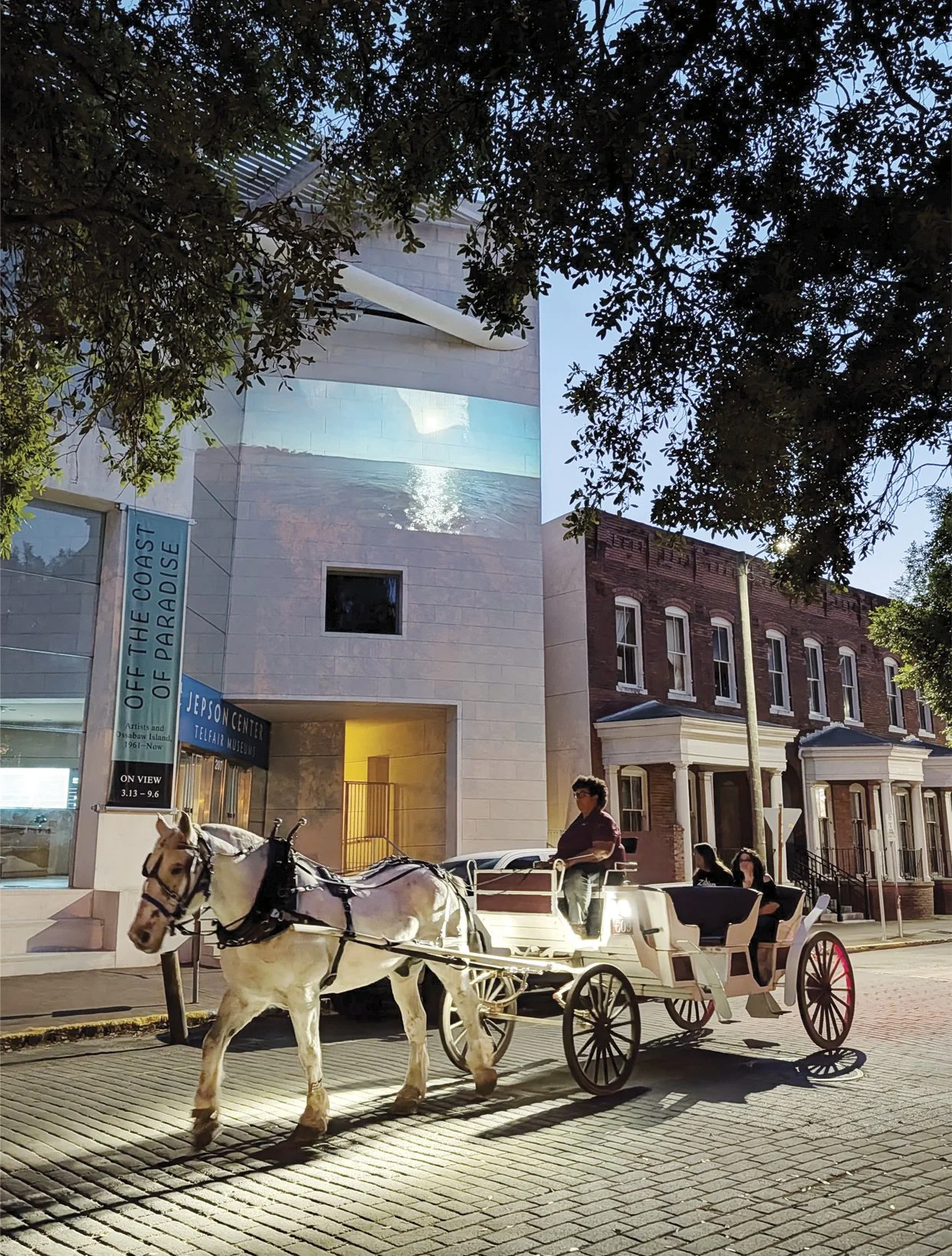
Streetview of the atmospheric version of Venus of Ossabaw nightly projection on the façade of Telfair Museums’ Jepson Center. Photo by Karen Karp. Still from Venus of Ossabaw. Total runtime: 0:18:06. Courtesy of the artist and Marianne Boesky Gallery, New York and Aspen © Allison Janae Hamilton
context. That version features all our atmospheric and landscape driven scenes. It’s an interesting way to experience Venus' journey through her eyes or through the eyes of the landscape. It's very minimal and you get a chance to divorce from sound and other effects. You get to drink in the landscape and feel the emotionality of the piece in a different kind of way. I'm excited about that and engaging the audience in all those different formats in the gallery presentation and programmatically through the artist talk.
I want to shout out the young actors who were lovely to work with on set and express gratitude for their work in the project. Our lead Dami Adeyina played Venus and she carried the project elegantly and beautifully and her performance was breathtaking. I have a lot of gratitude for the city of Savannah and the region and felt held by the film crew there. I want to say again how great the industry is in Savannah is and how much I enjoyed working there. Shout out to the film community in Savannah!
###
Venus of Ossabaw will be shown in the galleries as part of Off the Coast of Paradise Artists and Ossabaw Island, 1961-Now (on view through September 6, 2026). In addition, an atmospheric version of the film with no sound was projected nightly on the façade of Telfair Museums’ Jepson Center. (Thru June, 2026)
Learn more at Telfair.org. See more of Allison’s work at allisonjanaehamilton.com or @allisonjanaehamilton
###
READ MORE FROM IMPACT …