With Off the Coast of Paradise: Artists and Ossabaw Island, 1961–Now, an exhibition at Telfair Museums’ Jepson Center about artists shaped by Ossabaw over several generations, Beryl Gilothwest approaches the history of the island from two positions at once: as co-curator of the exhibition, alongside Erin Dunn, and as the grandson of Sandy and Clifford West, whose stewardship of the island helped shape its creative legacy. In this conversation with curator Melissa Messina, Gilothwest reflects on family history, artistic discovery, and the lasting force of the island itself.
Melissa Messina: Beryl, thank you so much for meeting with me on this beautiful — well, I'm in Atlanta, and it's a beautiful Sunday morning. It may still be a little cold and dreary in New York, where you are.
Beryl Gilothwest: Yes, it's a little dreary, but at least the snow's all gone.
MM: We are meeting on the occasion of Off the Coast of Paradise: Artists and Ossabaw Island, 1961–Now, which just opened at Telfair Museums in Savannah. Congratulations on what is a sprawling, layered, and gorgeous exhibition. The accompanying book matches those descriptors perfectly as well. It's such a gorgeous book. Thank you for gifting it to me; it was a pleasure to look through it in preparation for this interview.
BG: Thank you so much, Melissa. I really appreciate you doing this. I'm so excited to dig into the book and the exhibition with you.
MM: Well, I have to say, I've been wanting to have this conversation with you since we met several years ago. I was trying to think when it was that we met, and I think it's a lot longer ago than I care to admit. Susan Laney, who's a gallerist in Savannah and a longtime Ossabaw Island Foundation board member, introduced us and I’ve just been really intrigued by your background. Then, when you started telling me about this project, I became so excited to have this conversation with you.
I really want the two of us to be sitting with two cups of coffee in front of that gigantic fireplace in the Main House on the island, but such is life. Maybe IMPACT Magazine can insert that gorgeous picture right here in the interview so our readers can imagine that's where we are and get a sense of this amazing place.
BG: Yeah, they could just Photoshop us in. It'll be like we were there. This feels like a full-circle moment because the first time that we met in person was actually on the way over to Ossabaw. That was a moment when I was just starting to think about what I could do to celebrate the legacy of the island. We were talking about a potential residency program over there. So it's nice to come back to this conversation several years later, now that this exhibition is on view and all sorts of other plans are in motion for the island.
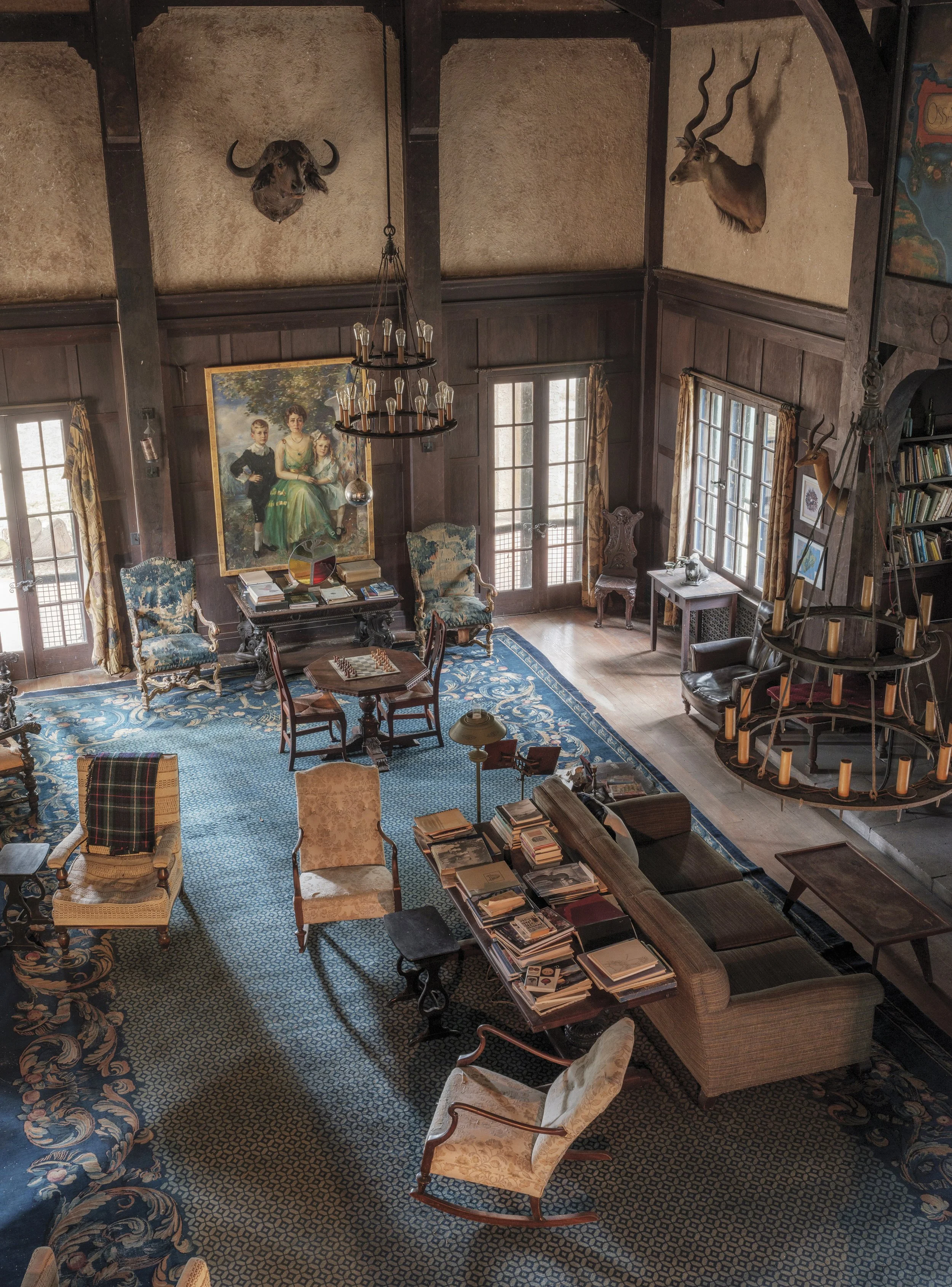
Inside the Main House. Photo by Parker Stewart
MM: Let's talk about all of those things. I'd like to start broadly and kind of zoom in, because I think the island is a bit mysterious in a lot of ways, including where it is and what it is and a little bit of its history. I lived in Savannah for many years, as you know, and I don't think I even knew what Ossabaw Island was until a few years in. And even then, it took me a few years to get there, even though it's literally right there.
So maybe we can start at the beginning. What and where and how is Ossabaw Island?
BG: Absolutely, yes. And that is not an uncommon feeling among Savannahians to not know that much about Ossabaw, and there actually is a very specific reason for that. But before I get to that, I'll say that Ossabaw is 26,000 acres of uplands, marsh, and 15 miles of beach. Most of it is marsh, which I think is something that people not from the Lowcountry may be surprised about when they think about an island. It is about seven miles off the coast of Savannah, right to the south, and it's the third largest of Georgia's barrier islands.
People have lived on the island for 5,000 years, beginning with the Guale people, and later the Creek people, Spanish settlers, English settlers, and thousands of enslaved people. In 1924, my great-grandparents, Nell Ford Torrey and Harry Norton Torrey, purchased Ossabaw as a winter retreat.
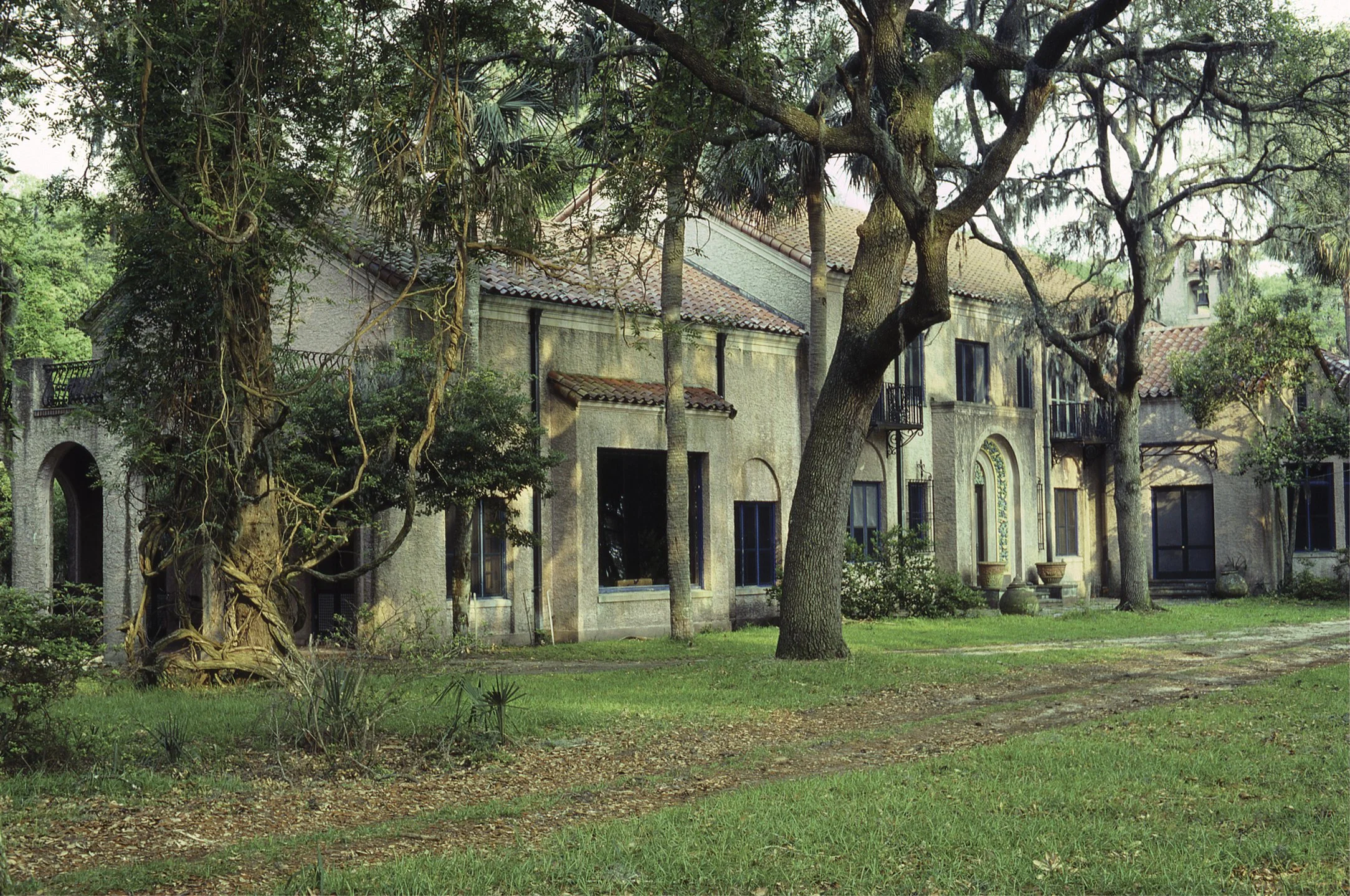
John Earl, The Main House, ca 1970s.
My great-grandmother was a third-generation heiress to the Wyandotte Chemical and Pittsburgh Plate Glass fortunes, and they lived in Grosse Pointe Shores, Michigan. They had purchased a winter home in Savannah that burned down in the early 20s, and kind of by chance, they ended up acquiring Ossabaw and building a new home there.
In the late 50s, when my great-grandmother died, my grandmother, Sandy West, inherited the island, along with her late brother's children. She had this instant desire to share the island. She often described it as feeling guilty that she had this huge, expansive place, this pristine wilderness, to herself, and she felt compelled to share it. My grandfather, who was her second husband, Clifford West, was an artist and an educator. He cautioned her against opening the floodgates and letting anyone who might want to come to visit the island. He suggested that they think about ways to share it more intentionally that could replicate the really powerful and remote experience that they both had spending time there. They ultimately came up with the idea of founding an interdisciplinary residency program on the island in 1961 that they called the Ossabaw Island Project.
Many years later, when it became necessary to convey the island to a new steward for a variety of reasons, my grandmother felt very passionately about protecting the island in the way that it had been used for her residency programs. That meant offering artists, scientists, and other intellectuals the opportunity to spend time in this very unique environment. And so she was very, very careful about who she would allow to take over the mantle of protecting Ossabaw.
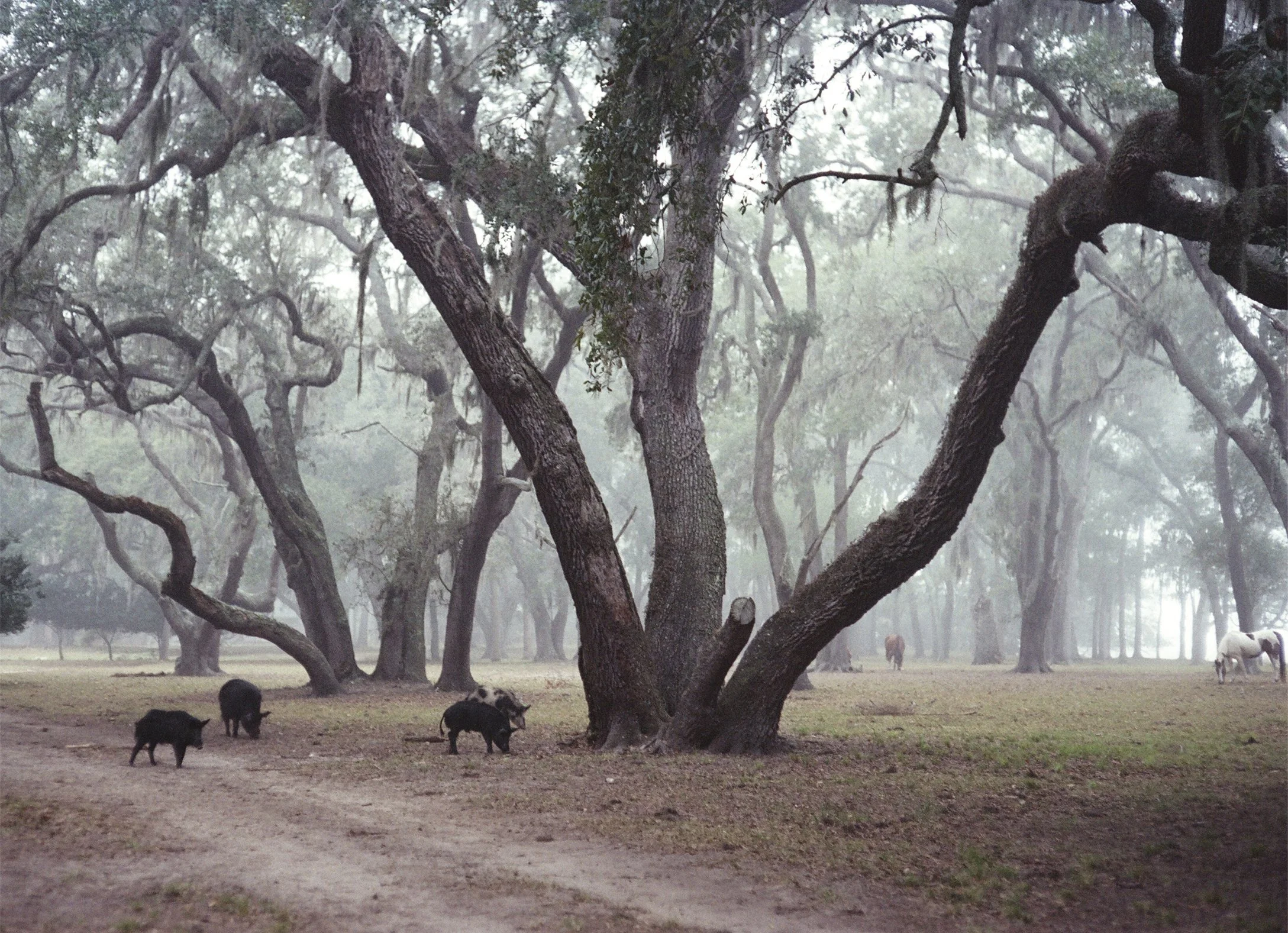
Helen Hamada, Main House Yard at Dawn, 2005
She ultimately selected the state of Georgia and donated half the island and sold the rest, along with her late brother's children, under the very strict stipulation that the island can only be used for artistic, scientific, and preservation purposes. That is the reason why a lot of Savannahians don't know about Ossabaw. There are plenty of other barrier islands that have different stipulations about how they can be used, from the extreme of Hilton Head, which is a complete resort, essentially, to St. Catherines, which is still privately owned. But you have to apply to go to Ossabaw. You have to show that you have a project that you want to undertake over there that fits these very strict guidelines.
MM: I want to put a pin in a couple of those things, just for clarification for our readers, to go back and just talk about you for just a little bit longer. Because I just think you are in such a unique position, given that you are the grandson of Sandy West, who had this incredible vision. But you are also the Deputy Director of Research and Exhibitions at the Calder Foundation, so you have both art world experience and knowledge, and you are in the art center, living in New York. And yet you have such a unique perspective, having family on the island, having all of these personal experiences on the island. So it really kind of perfectly positions you to be this advocate in all of these ways. Tell me a little bit about how the ideas for this exhibition came about.
BG: I grew up in a family of artists. My father is a professor of electronic media, my mom is an artist, my grandfather was a painter and filmmaker, and my grandparents founded these programs. So art is the family business in a way.
I was always aware of what they did on Ossabaw and my grandmother told stories about the programs often. There was a bookcase in my grandmother’s house on the island full of all of the books that Ossabaw Island Project members had left behind. I would comb through them to get a sense of the people who were there when I visited, but it really wasn't until after my grandmother died in 2021 that I made it into a proper research project.
And as we were going through the process of closing up the Main House and going through my grandmother's stuff, I started paying closer attention. She had this shoebox full of note cards that were dedicated to each one of the members of the Ossabaw Island Project, and I decided one day to go through every single card just to see what might come of it.
And as I went through, I was just completely bowled over, because I found these names of people who I had learned about through my work at the Calder Foundation and studying art history in college. I had no idea they had been on the island. Anne Truitt, Agnes Denes, Michael Mazur, Ellen Lanyon, and Miriam Schapiro are a few examples. When that happened, a light bulb went off in my head. I thought to myself, okay, this history that I've always understood on a family level may actually have resonance on an art historical level. I really want to dig into this.
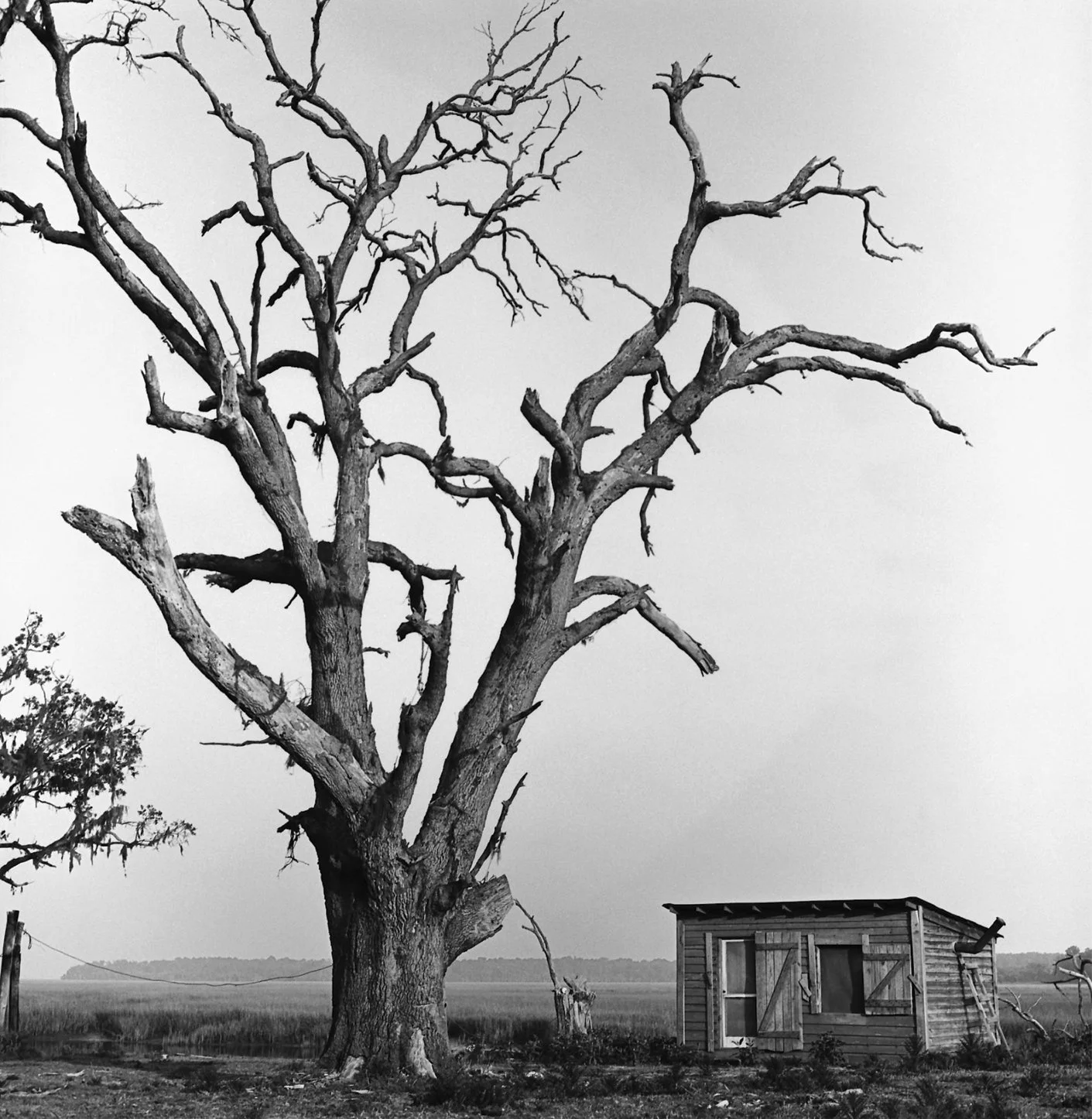
Helen Hamada, Middle Place, 1974
Around the same time, I think it was maybe a week or two before my grandmother died in 2021, I had gotten in touch with Erin Dunn at Telfair Museums for the first time because I had heard through the Ossabaw Island Foundation that she was starting to think about doing an exhibition about Ossabaw. Because I knew that the Telfair was doing the show about this history, I felt like I needed to help them out as much as possible on behalf of our family in the hopes this story would be told in as robust a way as possible.
MM: So how did you get involved then? It sounds like there were maybe two separate lines of thinking. They had something maybe already brewing. How did the collaboration start?
BG: In the beginning, Telfair was thinking of doing a more modest project that looked at the whole history of the island, which is a fascinating topic in its own right. Erin and I started ping-ponging back and forth, sharing the fruits of our research, and it grew from there to focus on the residencies in the 20th century. Ultimately, because of the enormous amount of material that we unearthed, we decided to focus specifically on the ways that visual artists have taken inspiration from Ossabaw. Erin is the Curator of Modern and Contemporary Art at Telfair, and so she was particularly interested in the artistic history, and that is my background as well. One of the really unique things about the Ossabaw Island Project is that it was interdisciplinary. There were artists, writers, scientists, clergymen, businesspeople, and on and on. There could be a whole other project about the writers or the scientists who spent time there. So this is really just scratching the surface.
MM: I love that. I think you described in your essay something about, like, “taking the whole thing on might have been a fool's errand”, I think might have been the phrase that you used. And for such a small island, the richness, the denseness, the layered complexity of that history – it sounds like your grandmother, God bless her, kept very good records. As you know, I manage a legacy project for an artist who did not do that. So for any artist reading this interview right now, keep good records, please, for posterity's sake.
BG: Sign and date your works!
MM: Exactly. Sign and date your works. But I love that you both decided to create a very specific focus with the knowledge that this could be exhibition one of many, right, that there is such a richness to this history that there could be multiple exhibitions. And hopefully the Telfair will take that on.
BG: Yeah. My grandmother did keep great records, and that was enormously helpful to us. But we also went way beyond them.
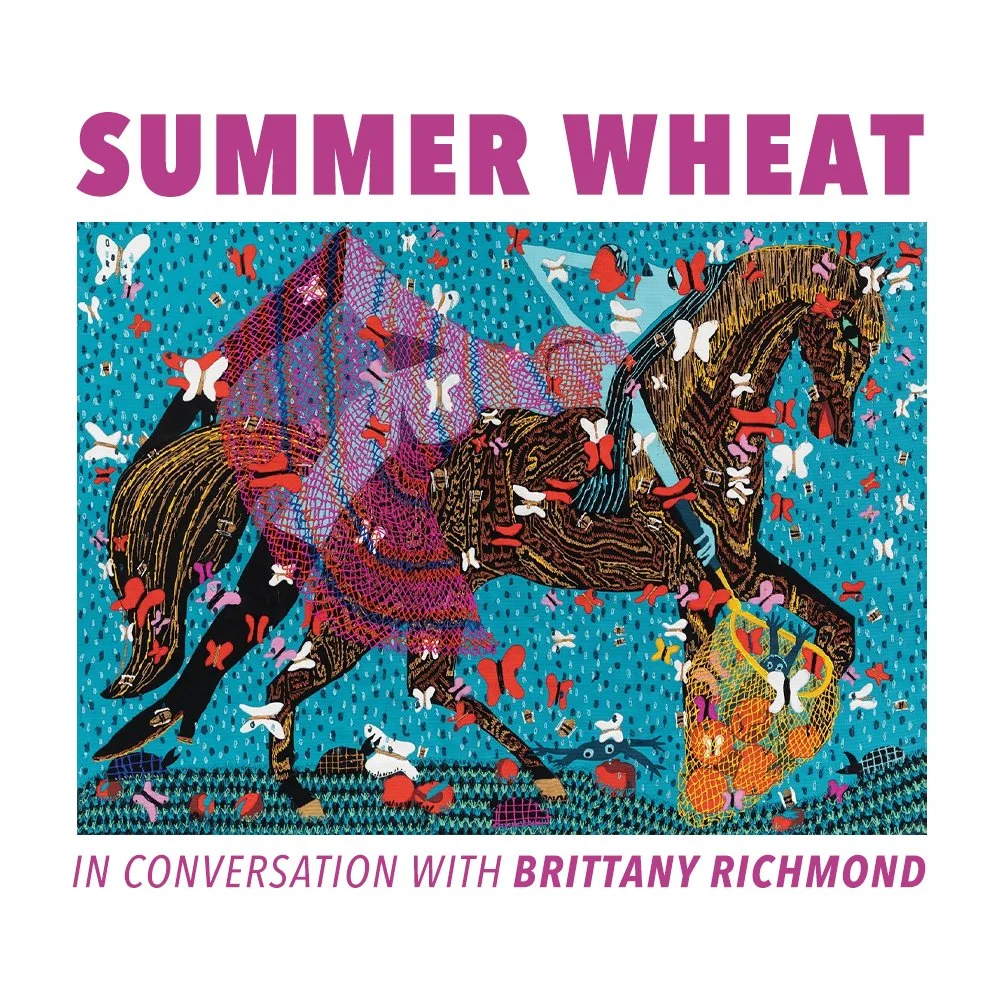
As Erin and I started going through the archives, we recognized names like Agnes Denes and Anne Truitt, but we also found so many names we hadn’t heard of. We started googling them with the word Ossabaw. You'd be surprised at how much came of that. One person that Erin discovered that way was the Vermont-based artist Marcy Hermansader, whose gorgeous multimedia work is on the cover of our book.
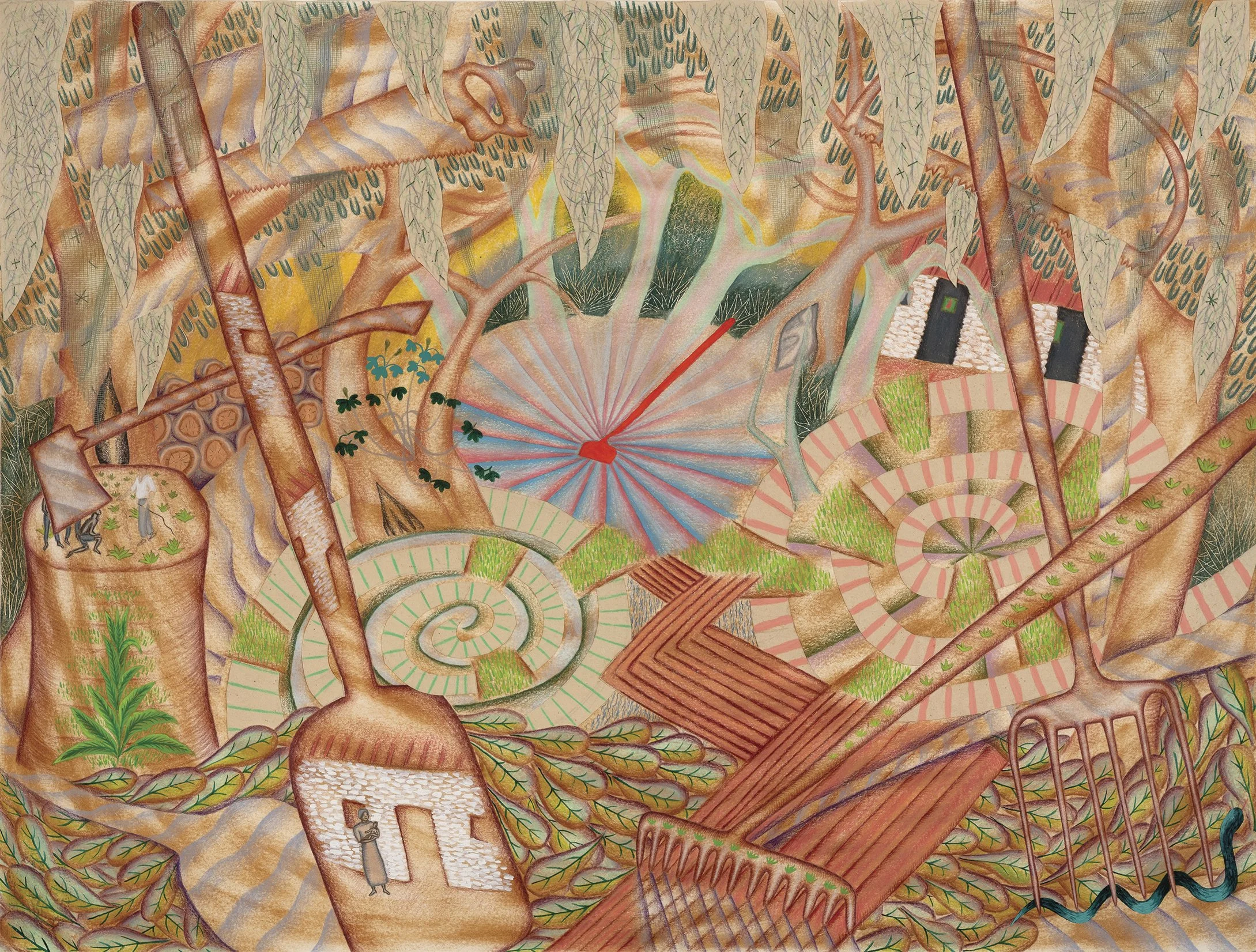
Marcy Hermansader, The Magic Hoe, 1982. Colored pencil, acrylic, paper collage, mosquito netting, and thread on paper rubbed with red clay soil, 21.75 x 28.5 inches. Collection of the artist. © Marcy Hermansader
She was a member of the Genesis program in the early 80s. Marcy is, still to this day, 40 years after having been on Ossabaw, making work related to the island. Erin found that she had mentioned Ossabaw in an interview just a few years ago. There were so many stories like that.
And that's what I mean by saying that this is the tip of the iceberg, because we were consistently amazed by how many people who had spent two weeks on an island 45 years ago are still thinking about that experience. It's incredible that the work they're making today still feels the influence of an experience from all those years ago.
MM: I feel like in some small way, I can understand that. I think I've been twice, and in total, I've probably spent four hours, and I think about it all the time. It is such a unique and magical place. There are so few places left in the world that are just untouched. And you just stay in the present moment when you're there. I'm not at all surprised that there are these artists who are still feeling the reverberations of that, however many years or decades later.
But, you mentioned the Ossabaw Island Project and the Genesis project, so let's clarify for our readers. So, from what I understand, there were two residencies, the Ossabaw Island Project and the Genesis project. Were they happening simultaneously? Are they from different periods? What's the difference between the two?
BG: So actually, my grandparents ran four programs on the island under the auspices of an organization called the Ossabaw Island Project Foundation. The Ossabaw Island Project, which was the first residency founded in 1961, Genesis, which was founded in 1970, and then two others, which were not residencies. One was called Professional Research, which was for academics who wanted to come and do an extended research project on the island. The other was Public Use and Education, which was for Boy Scout groups or school groups from Savannah to come over and spend time on the island.
My grandparents founded Genesis in 1970, as a way to expand the purview of their programs to incorporate students, because the Ossabaw Island Project was really focused more on established intellectuals. They were given a fancy room in the family house, and they were served three meals a day. It was a very particular experience.
They created Genesis as a counterpoint to that, where people were actually living in a semi-sustainable community on the site of a former plantation in the center of the island called Middle Place. They had to help build their dwellings, and each person had to cook dinner for the group each night. And they had to grow vegetables and go fishing to feed themselves. So it was a very different experience that was much closer to the land. Genesis ran for 12 years, and ultimately ended up encompassing all ages. But it was a very different experience than the Project. They balanced each other out in that way.
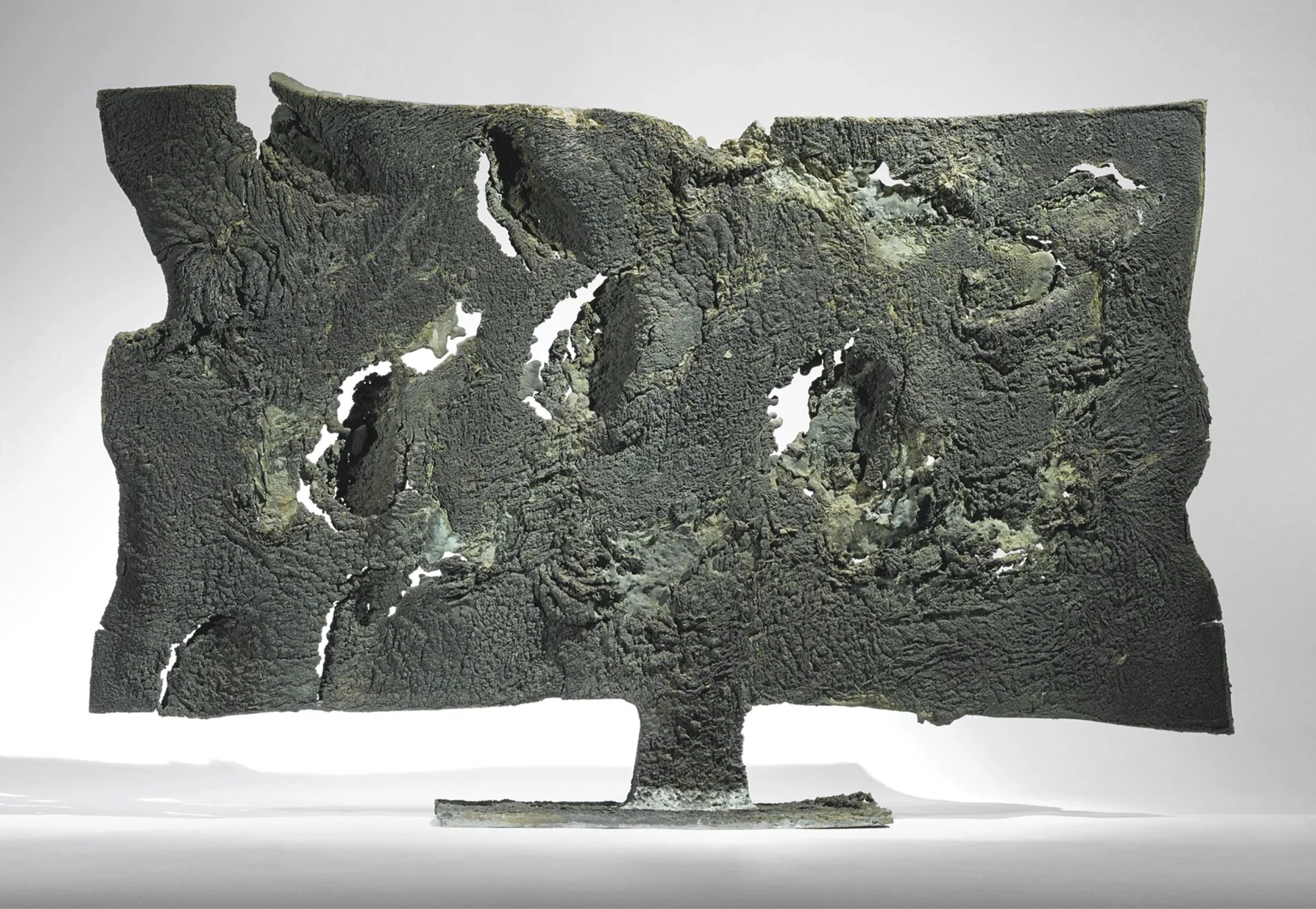
Harry Bertoia, Untitled (Monumental Spill Cast), ca. 1963. Bronze on bronze base, spill cast, 41.5 x 62.5 x 10.75 inches, Private Collection. Courtesy of the Harry Bertoia Foundation
MM: Interesting. Was there an expectation of art-making, or was the ‘art-making experience’ the sort of living off of the land and having that, as you said, sort of semi-sustainable moment?
BG: Well, actually, it was even more a part of Genesis. Because the residents of the OIP were more established, they weren’t required to propose a project. They could just come and be there, and whatever happened, happened. Genesis members had to apply with a project and show that they had completed something at the end. And remember, these programs were interdisciplinary, so it's not just artists. You could have a scientific project, you could have an artistic project, or whatever. And then there were all the other parts of it too.
MM: Milking the cows and growing the carrots, yeah.
BG: Because they had such close proximity to the land, the Genesis members are the people for whom the island is in every pore of their being. There are a lot of people who got married, met there, and then got married out of that program.
MM: I bet if you can survive that, right?
BG: Yeah, yeah, what can't you survive? My grandparents were initially inspired by programs like Yaddo and MacDowell, which continue to this day. But for them, at the outset, the real differentiating factor was this idea of an interdisciplinary program. They wanted to have a place where an artist could talk to a business person or a scientist could talk to a religious leader, or, you know, a novelist could talk to a linguist.
MM: This is really radical, I mean, this is even really radical now. I think we still, in residency programs, keep things pretty siloed, and there's a lot of philosophical reasons for that. I want to just reiterate how radical that is, right? I mean, don't you think?
BG: Absolutely. I think it's totally radical, and as you're saying, there aren't that many examples of that even today. You know, my grandmother wrote to the director of Yaddo at the time with this idea, and she responded, saying that there's no way that'll ever work. That was an anecdote she told a lot. The people who ran these types of programs at the time thought my grandparents were going too far.
But there's this story, and this is the story that I was always told as a kid, but I think that it really encapsulates that they were on to something with this idea. Before they started the Project, they invited people from their extended community to come to the island for a weekend to weigh in on the concept.
My grandfather taught at a girls' school that was part of the Cranbrook Educational Community in Michigan, which was this amazing amalgamation of mid-century artists and designers, interdisciplinary artists, like Charles and Ray Eames, the Saarinens, people like that. So he had quite a large network. They invited lawyers and biologists and composers and artists down to Ossabaw for this weekend.
And one of the artists who came was this amazing sculptor and designer named Harry Bertoia. My grandfather had actually been the best man at his wedding many years earlier, but they had fallen out of touch. But my grandfather reached out to him again and invited him down for this weekend. On the Sunday of that weekend, my grandparents took the whole group down to the beach. And Bertoia had a kind of artistic epiphany on this afternoon on the beach, where he was just totally taken by the way that the water was eroding the coastline.
And we all know this down in the Lowcountry, but that erosion creates these sculptural dead trees that come out of the beach. Bertoia got this really strong impression of "forces continuing," which is the way that he put it. Part of this idea was also influenced by a conversation that Bertoia had on the beach with the biologist Colin Pittendrigh, who explained what was going on from an ecological perspective.
That experience — combined with a later moment at an ironworks in Connecticut, where he witnessed ingots overflowing — inspired Bertoia to create an entirely new form of bronze casting that he dubbed spill casting, where you pour molten bronze onto the ground or into a pit that you've created and allow it to create its own form rather than take the form of a mold. That was a totally groundbreaking idea. I mean, bronze casting is something that's been around for millennia and has always been done in variations of traditional techniques. This happened during a weekend that was meant for just presenting the idea of this project, and so I think it really was a testament to the fact that they were on to something.
MM: Yeah, absolutely, what an incredible story. I love that. Your perspective is so fascinating to me because you wear two really special hats. You have these personal connections and this oral history that's been passed down to you, but you also have a broader art historical understanding of them, too. That's really special, Beryl, it really is. It makes you the perfect person for advocacy and organizing these exhibitions.
Is there anything particular that happened during the course of curating this that you want to share? As a curator, sometimes there's a special, unexpected thing that happens that just gives you goosebumps.
BG: The moment that really gave me goosebumps was connected to Agnes Denes. I was just reflecting on it with the opening this past weekend. A few years ago, I was writing an article for The Brooklyn Rail on Socrates Sculpture Park, and my editor asked me to interview a few of the artists who had done ambitious projects there, and one of the artists who had done that in recent years was Agnes Denes.
I remembered having seen her name in the list of artists who had been to the island. So I thought, okay, I'm going to interview her for this piece, and at the end of the interview, I'll just ask her, and see if she remembers it. Because I had tried to reach out, and some of the other people at Telfair had tried to reach out, and we hadn't heard back. I thought, this way I can get in the room with her and then ask her.
So I went to her amazing studio, which is right in downtown Manhattan. She's been there for decades. Agnes is in her 90s, still working away with an amount of energy you and I can barely dream of. And we work a lot!
MM: You were in the presence of greatness, how amazing.
BG: And we had this nice interview. Although she's tough, you know, she doesn't give it to you easily. You’ve got to prove yourself. At the end, I asked her if she remembered her time at Ossabaw. At first, she had no idea what I was talking about. She kept sort of saying, what? Say that again. Say that again. Finally, just as I was about to give up, it clicked. And this very driven, intense artist, who was not giving me the easiest time as an interviewer — her face changed, and she just lit up.
And she said, oh, you mean Ossabaw? And we just had this lovely conversation about it. She told me she had wanted to write a book about her time on the island. She had had such a powerful experience. She still thought about it. She had taken a whole series of photographs of the island. And she showed me a few of them on her computer screen. You know, she had them digitized all these years later. And I just remember walking out of her studio that day with goosebumps. I just felt so alive. I'm so honored that we are able to debut four works by Agnes in Off the Coast of Paradise that have never been shown before. So that was just really special.
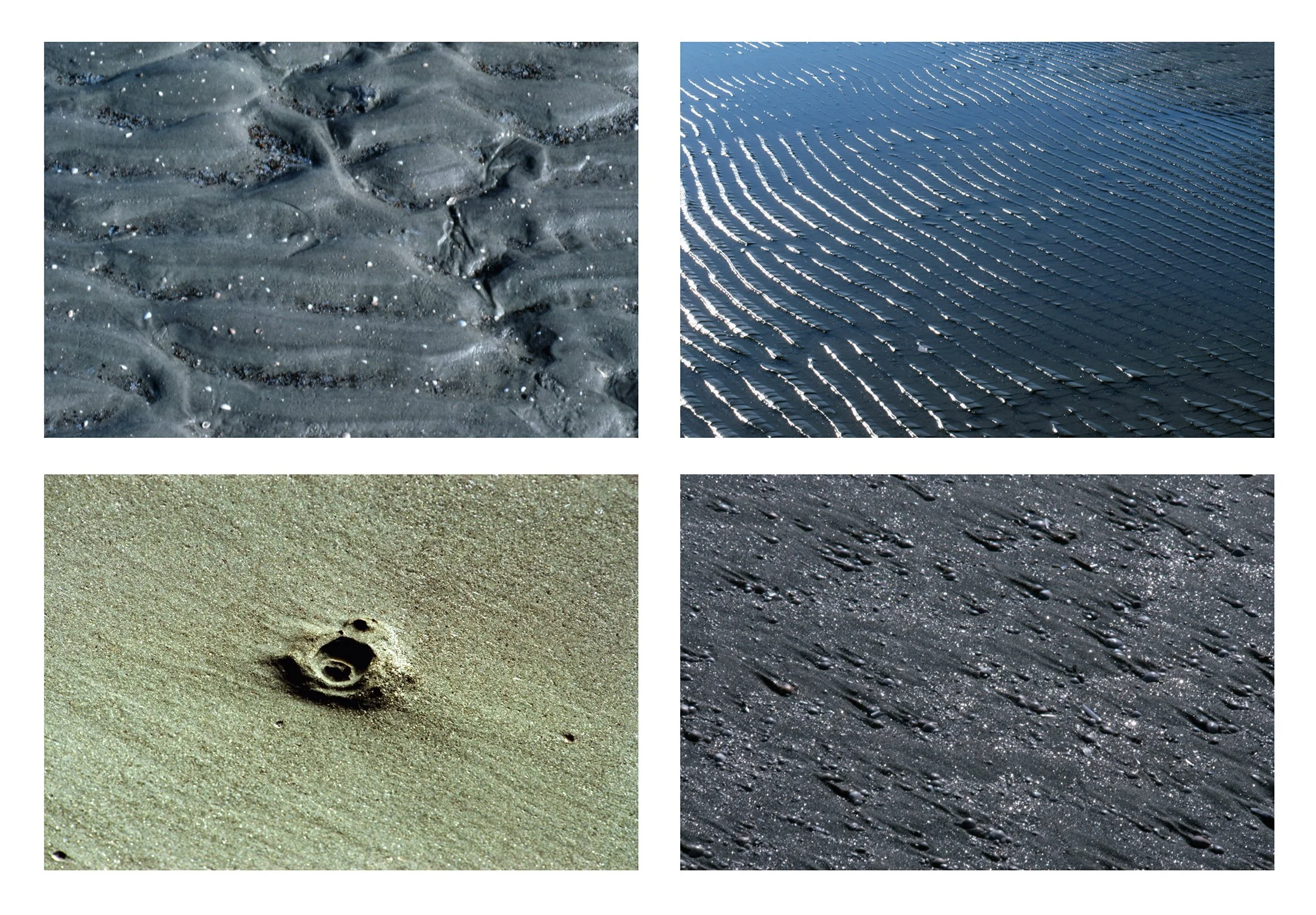
Clockwise from Top Left, Agnes Denes (b. 1931): Silver Shores, 1981. Archival pigment print, 12 x 18 inches; Sun’s Reflection on Wet Sand, 1981. Archival pigment print, 12 x 18 inches. Collection of the artist, via Leslie Tonkonow Artworks + Projects; Patterns in Motion, 1981. Archival pigment print, 12 x 18 inches; Life Beneath the Surface, 1981. Archival pigment print, 12 x 18 inches
MM: Absolutely. Congratulations. That is an incredible story on so many levels. And to be able to premiere something for a 90-year-old artist. And what are the dates generally of the photographs?
BG: They're 1981. All four. And the thing is, that's just one example. There were others like that, too. But it was moments like those where I was like, oh, yeah, we're onto something here. And I know Erin has had similar experiences.
MM: We talked a little bit prior to the interview about why this seems to be resonating now. You were talking a little bit about how you and Erin were a really great tag team for funding, her being rooted and located in Savannah, which is right near the island, and you being networked in New York, and that being kind of a good one-two punch for fundraising. But even beyond that, it seems like you've tapped into a vein. What about Ossabaw seems to be resonating now?
It feels like the right moment for this exhibition. Obviously there's a historical moment too, but there's, I don't know, there seems to be something else at work. Am I imagining that? Am I romanticizing that?
BG: No, I think that there are a few things at play. I think there's been a real interest in this part of the country in recent years. I mean, thinking of the trajectory of an artist like Beverly Buchanan, who has become so well-known in recent years. Or even Tyler Mitchell just did a series based on Cumberland Island.
I think there is a mystique around that part of the country that goes beyond the local area. A huge part of that is the significance of the Sea Islands for African Americans, which comes through in Buchanan’s and Mitchell’s work. I think funders are generally becoming more interested in supporting projects related to the Southeast.
But I think there's also been a renewed interest in historic organizations that support artists. In our exhibition catalog, one of the essays is written by Thomas Lax, a curator at MoMA, who put on this amazing show a few years ago called Just Above Midtown: Changing Spaces about a fascinating gallery that existed in New York in the 70s and 80s and supported Black artists. I took a lot of inspiration from that show, how you can bring artists together through a shared experience like Just Above Midtown or the Ossabaw Island Project. You don’t need to just do shows about one artist.
MM: Yeah, I think context is really important, right? I mean, I think for so long, perhaps we isolated artists as these heroic figures and didn't quite give the community by which their work bloomed enough credit for that blossom, right?
I think, when Erin Dziedzic and I were curating Magnetic Fields: Expanding American Abstraction, 1960s to Today, for example, which included Mildred Thompson's work among a generation of Black female abstract artists, everyone went, oh, she wasn't making work alone, you know, like things that happen in a vacuum. But I think, particularly for Ossabaw too, there is something about its isolation.
And I alluded to this at the beginning of our conversation, I think about the issues that the National Park Service is having, right, where there's so much interest, and we're driving there in our cars, and all of that, the damage that we're unintentionally doing by wanting to get into nature in these ways, or our Instagram selfie moments, where all of these kind of once hidden, undiscovered places are now destinations, because, oops, now we know where they are, right?
So there's something about Ossabaw that I think embodies a little bit of that too, like, oh, it's been there all along, it's been hiding in plain sight. And so I'm excited about the attention, but I'm also a little bit nervous about it too, right?
BG: Absolutely. I think that's such an important point. And my grandparents thought about this when they launched the project. The idea was not to advertise and not to seek out press. They did more so at the end when they were trying to fundraise, but the program never had an open application. It was all word of mouth.
MM: First, people were recommended by the advisory board, and later, former residents could suggest other people, which is also a very different model from something like Yaddo or MacDowell.
BG: Exactly, and that was all very purposeful because first of all, they were a small team and they couldn't handle a huge influx of applications, but also because part of their idea for founding this, as I said before, was really to give people this opportunity to experience a remote environment like Ossabaw, and you see that today. I mean, just to put it bluntly, going to Ossabaw is a very different experience. There's almost nothing to compare it to with going to Hilton Head, for instance.
So, that experience is very rare and needs to be protected. So, I hope that this exhibition will show people why it's important to protect land in this way rather than inspire them to want to visit Ossabaw for recreational purposes. I think part of the struggle over the last 30 years has been to help people understand why the island is protected this way, and I think that's such an important part of the story. I really hope that people who visit the show will leave with a better understanding of that.
MM: It's beautiful, and it makes me think too, I'm hoping this isn't too esoteric a statement, but in looking at all of the works in the exhibition, it was interesting to me how much abstraction I saw, that there's something about this island that's so powerful, it's like you understand the omnipotence of nature, you understand how small you are in the most beautiful way, that it's fascinating to me that the artistic response is like, I can't compete with that. I'm not even going to try to do this.
There isn't a lot of sort of photorealistic representational work, right? It's almost like artists are trying to dissect, as you were saying, the sort of biology or the patterns or the rhythms. There's something really kind of, I don't know, zen about it, not to get too woo-woo-y, but there's a beautiful presence of mind in all of the work that I see on view, and it really struck me that having experienced that, you do get out there, and it's an overpowering feeling in really the most profound way.
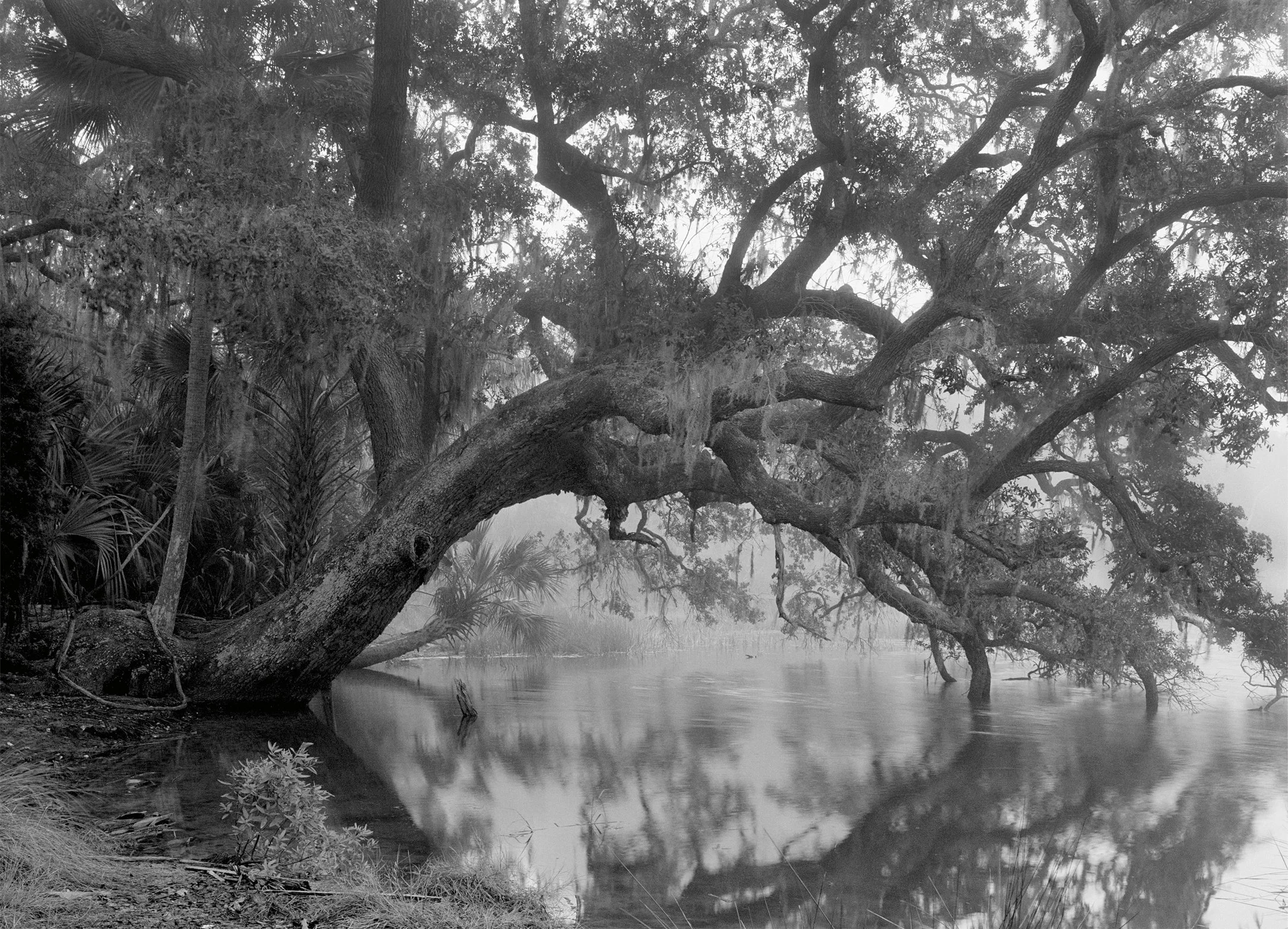
Jack Leigh, Leaning Oak in Fog, 2002. Courtesy of Laney Contemporary.
BG: Yeah, you totally nailed it, Melissa. I mean, that's always been my personal experience of the island, growing up visiting there, is that it's so rare that you go out into an environment and you think, oh, wow, I am at the mercy of this place. There's no hospital down the road. Nature is in charge here, and I have to act accordingly. And I think that really put things in perspective for me as a kid, and I think that a lot of the artists who go there experience that too.
There's just a really powerful energy there that you can't help but succumb to or respect. I’ll also say that Erin and I really were very intentional about trying to emphasize the more indirect means of inspiration that people took from the island. Of course, it's a beautiful place, and there are many artists who have taken beautiful photographs of the landscape or painted beautiful depictions of the landscape.
But there are just as many others who created works related to it that you would never associate with the island out of context. And I think that's really important because Ossabaw is not just what you see when you step off the boat at that first moment on the dock. It slowly reveals itself over the time that you spend there, whether it’s the poisonous snakes or the history of enslavement and displacement or the spirits that you perceive there.
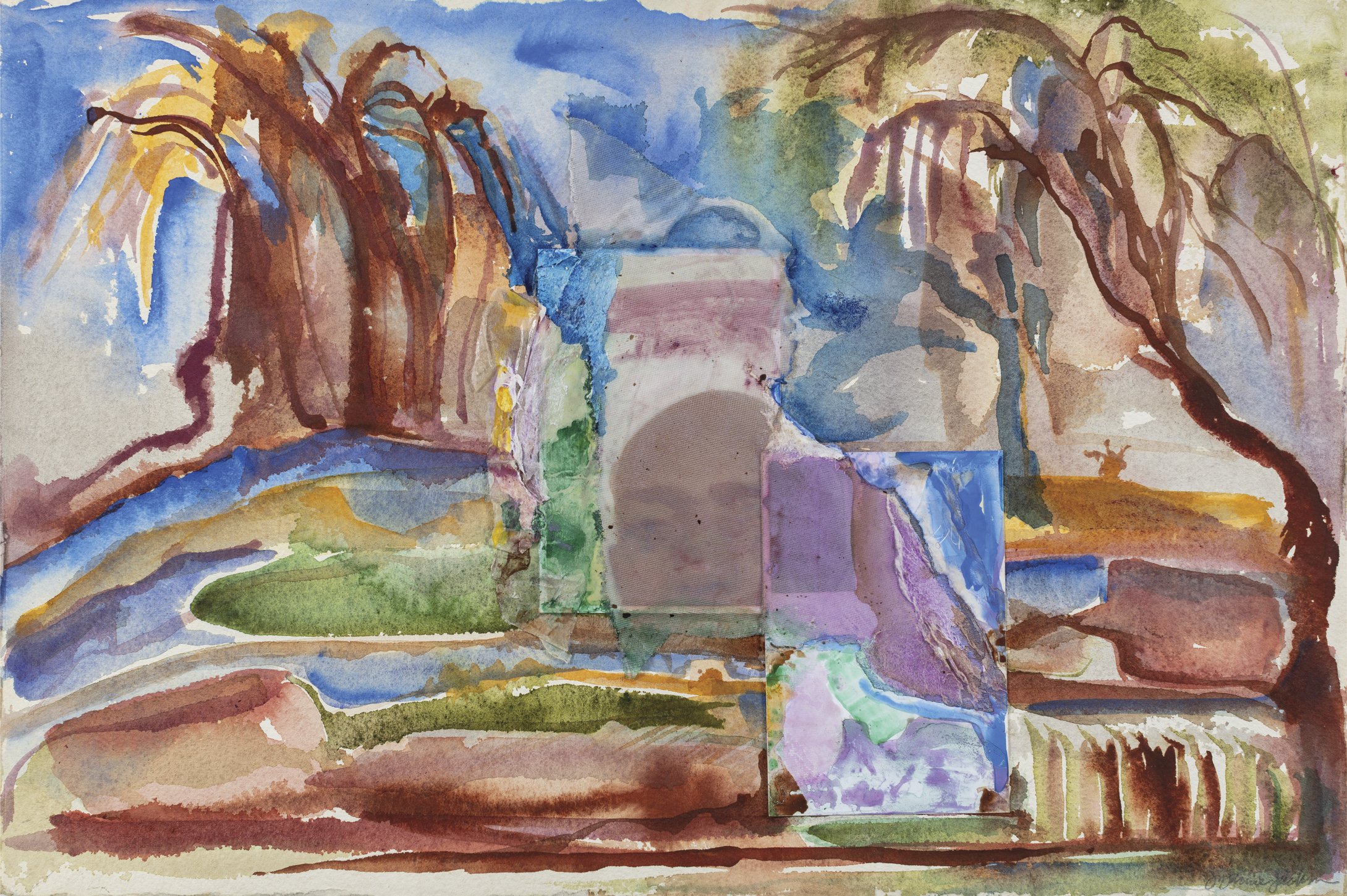
Suzanne Jackson. Origins, 2010. Watercolor, acrylic on inkjet photo-paper, nylon, D’Arches 300 lb. paper, 15 x 22 inches. Martin and Rebecca Eisenberg. © Suzanne Jackson, courtesy of the artist and Ortuzar, New York
And I think that's the type of experience, that slow looking, that time and space, that catalyzes the most powerful artworks that have come out of the island.
MM: And I love how... timeless that response is that someone was having that experience even in the 60s as much as they're having it today. And obviously we've made a lot of technological work. You know, we're more attached to our technology than ever and we are more environmentally endangered than ever. But it's interesting to see that that response surpasses space and time.
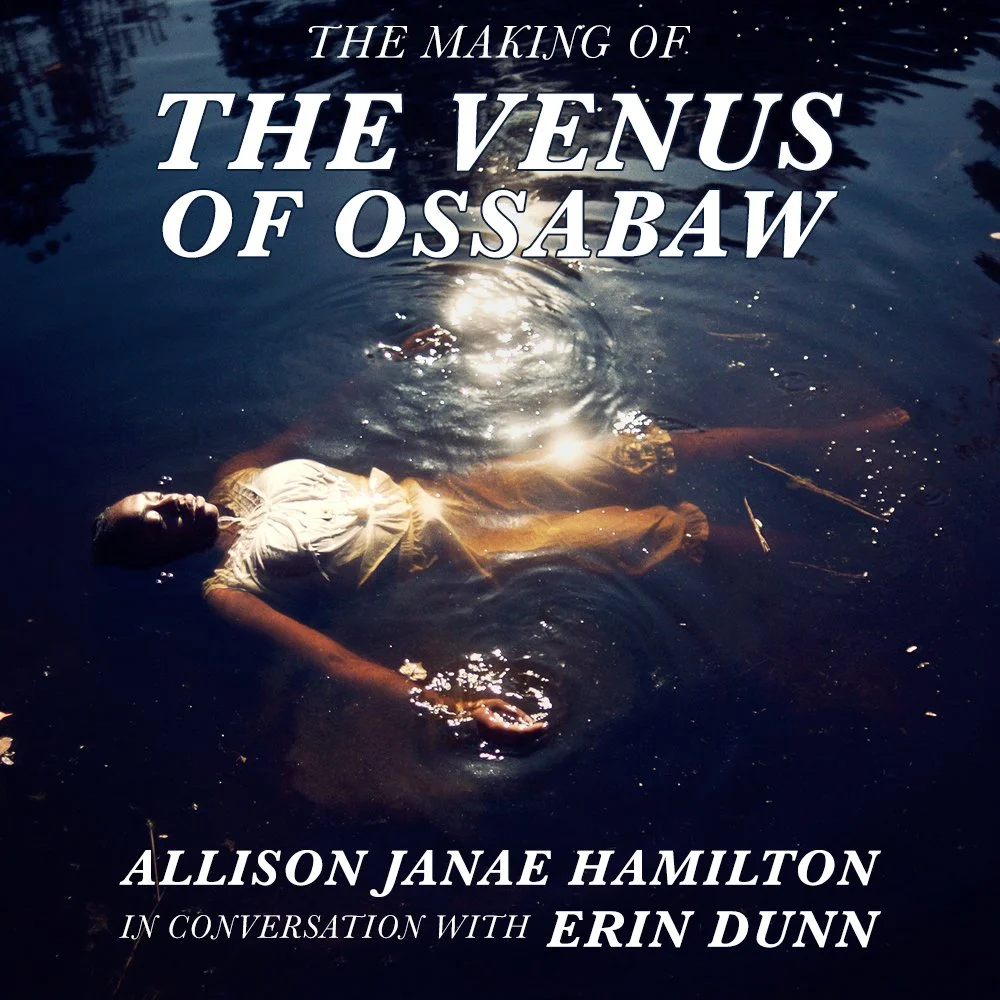
This isn't all the artists, but Betty Tompkins, Jack Leigh, Miriam Schapiro, Agnes Denes, Anne Truitt, Harry Bertoia, Tyrone Mitchell, Sally Mann. I mean, these are all artists who are not just bold-faced names for the sake of bold-faced names. These are artists with really great, rich, deep practices. I go, oh, of course this island impacted them, or they were impacted by this island. But then I also love looking at the more recent artists who have been. You know how Betsy Cain and Suzanne Jackson have been advocating for this place, for the more recent decades. I would love it if you could talk a little bit about how the Allison Janae Hamilton commission came about because, oh, my goodness, I mean just wow, that has been such an exciting part of this project from the very beginning.
BG: So I should say Erin ended up bringing me on as a co-curator about two years ago, and one of the first conversations we had was about commissioning a contemporary artist to make a work to represent the ‘Now,’ — the end of our exhibition title is ‘from 1961–Now’. We really wanted to showcase how the island remains an incredible resource for contemporary artists, and Erin immediately suggested Allison as a potential artist to ask, and it felt like such a natural fit.
She's from the south, she grew up between Tennessee and North Florida, and her work is deeply engaged with the Southern landscape specifically. So we reached out and took a chance. At the time, we weren't even sure how we were going to fund a project. We just knew that we wanted her to make a film. And she responded really positively and came up with this amazing idea based on new scholarship by Dr. Paul Pressly about the history of a southern underground railroad, where enslaved people on the Sea Islands during the 17th century were going south to Florida to seek refuge with the Catholic Church rather than heading up north. She ended up securing this major grant from the VIA Art Fund in New York, and was able to make this extraordinarily ambitious film to anchor the contemporary moment in our show, which was so much bigger than we ever imagined at the outset.
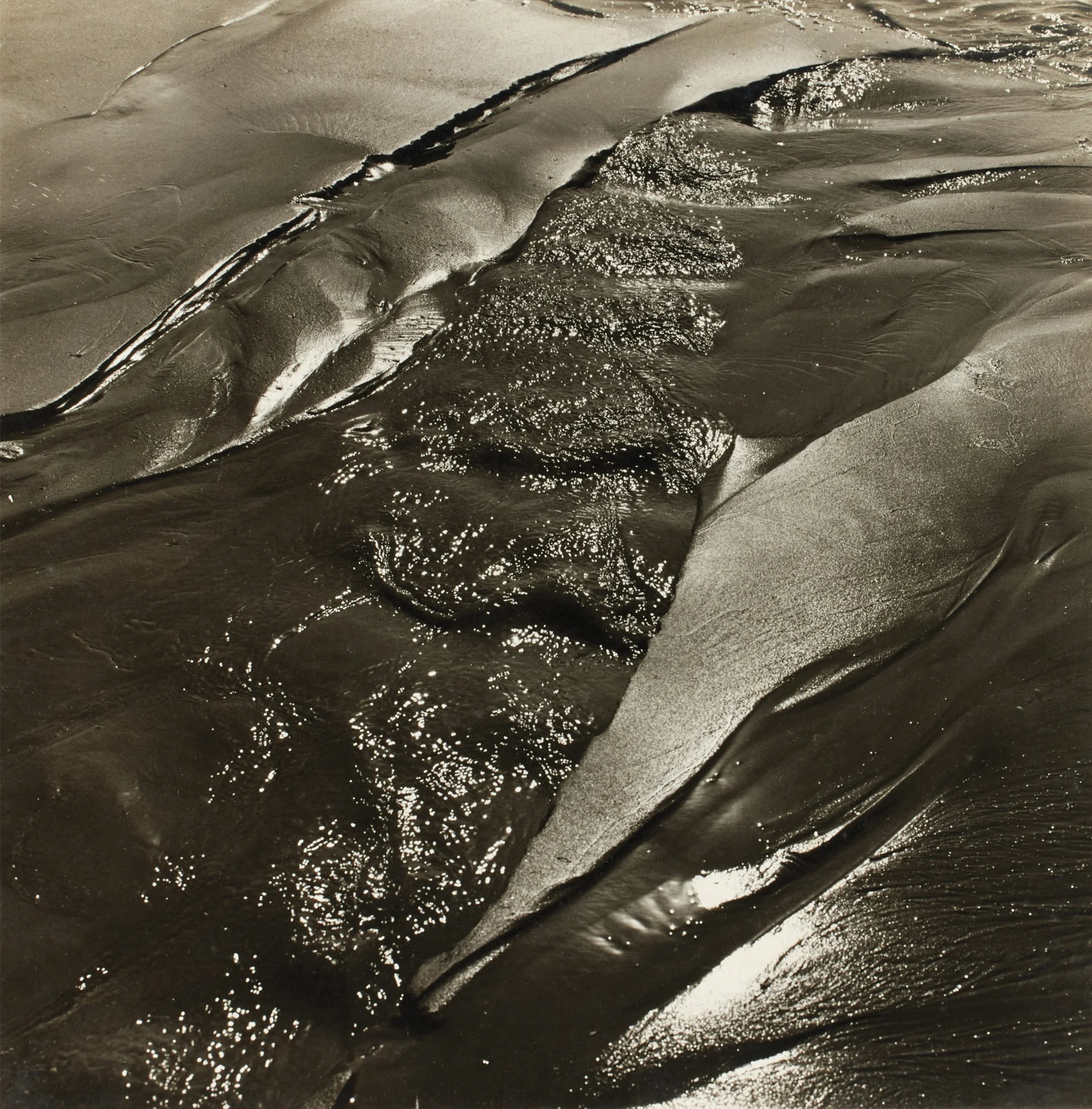
Helen Hamada. Bradley Beach, 1974. Gelatin silver print, 6.5 x 6.5 inches. The Ossabaw Island Foundation. © Helen Hamada
MM: You know there's an energy, and I think with that comes a certain serendipity, right, where it all comes together — it's the right artist, the right moment. It feeds their practice as much as it feeds the project, and those are always the best collaborations.
BG: Yeah, I think that's one of the things I've been most excited about working with Allison. She has made several films before, but she is now on the trajectory of making a feature film, and this project allowed her the opportunity to make her first narrative short.
There are so many examples throughout the exhibition in which Ossabaw allowed artists to explore new directions in their practice, and so it was really special to see that happen once again with Allison.
MM: Are we allowed to talk about the burgeoning residency project?
BG: Yes, of course.
MM: Excellent. Well, I really am grateful and honored to be on the Advisory Committee for the Ossabaw Island Residency, and I would love to have you talk about what we're trying to do so that other artists can have a similar opportunity as Allison had.
BG: We're so excited to have you involved, Melissa. I know this is something that you've been thinking about for years. It's something that I've been thinking about for years, among many other people. On my first day as a board member of the Ossabaw Island Foundation in 2019, I met Susan Laney, who I'd heard about from many different people. We got to talking and hit it off immediately. One of the first things that came up was how amazing it would be to bring an artist residency back to Ossabaw. We started talking about it kind of casually. She brought you into the conversation. That was how we met.
And then a few years later, I saw an article in the Savannah Morning News about an organization called ARTS Southeast come through my Ossabaw Google alert. Emily Earl, who is the co-founder, mentioned Ossabaw in the article because her parents actually met there.
Her father and mother were both Ossabaw Island Project members, and so she has a strong connection to the island through her family. In the article, she mentioned that she had also been thinking about starting a residency on Ossabaw. So I just sent her an email, and it was so great to connect with her just in terms of our connected family histories. But soon, the idea started to take shape, and we brought in Helen Hamada, who is an artist in the exhibition and a former co-director of Genesis. She also runs a residency in upstate New York.
Susan got involved, you got involved, Suzanne Jackson got involved, and last year, Betsy Cain hosted a benefit exhibition to raise money for the program. And so we're very excited to launch the Ossabaw Island Residency this coming fall as a new program of ARTS Southeast with a cohort of six artists who will be invited to spend a week on the island, and we'll see what happens. But I'm very excited, and I think this is a great way to continue this tradition that my grandparents established 65 years ago.
MM: Absolutely. Well, maybe IMPACT will have us come back and do a second interview a couple of years from now about how wonderfully the residency program is going and all of the artists who have been there and all the incredible work that's coming out of it. I would love to end this interview on the L word. You touched on the word tradition, but I think maybe a more accurate word for what's going on here is legacy, right? I mean, it's your family's legacy, it's the island's legacy, it's the legacy of residency programs in general. So I would love to get your thoughts on that word and where you think this is all going, and maybe what your grandmother might be thinking about what's going on around here these days.
BG: Yeah, I mean, legacy is a word I think about a lot for all the reasons that you just mentioned. I think, honestly, for me, it's a lot about serendipity. That's something that my grandmother always instilled in me about Ossabaw, and that I witness time and time again. Things just come together when it comes to that place. And you just have to follow the tides when they come in. One reason I say that is because, for the past 10 years, as you mentioned, I've been working at the Calder Foundation, steeped in focusing on an artist's legacy.
I've learned so much through that experience that has ended up being incredibly useful in terms of thinking about Ossabaw and how to nurture the legacy of that place in the right ways. But none of that was intentional. I never even made that connection until a few years ago. My boss is Calder's grandson. So it is very much his family.
MM: Oh, wonderful. Yeah.
BG: So I've witnessed the ways he has bridged the legacy of a historic figure with his own personal connection as a grandson. I think that has really set me up well for this situation. I've been really honored to try to amplify Ossabaw the last few years. And a lot of it has just been meeting the right people at the right time and then having a gut reaction and sort of going with it. That's how it went with Emily and Jon Witzky at ARTS Southeast. That's how it went with Erin at Telfair.
I have found, at least so far, that trusting myself and my gut to tell this story with the right people is the best way to further the legacy of this extraordinary place that is also very near and dear to my heart.
MM: So beautifully said. And I think that trusting of the gut, I mean, I can relate to a lot of what you're saying, having inherited a legacy project myself, although Mildred Thompson was not my blood relative. I call her and her former partner my aunt. Having entrusted me with this and having known them since I was a teenager, they were mentors to me and they were sort of aunt figures to me. And I do think there's something really beautiful about having that relationship, a personal relationship.
And I find that what you describe as ‘gut’ is usually my knowledge, an intimate knowledge with these people. So you sort of hear them in your head, not to sound insane. But I'm sure you know what your grandmother would have said about a certain situation or a response to someone, you know? So I think it's in your DNA, right? Like your gut is your intuition. And in some ways, it's your ancestors telling you what needs to get done. At least that's been my experience.
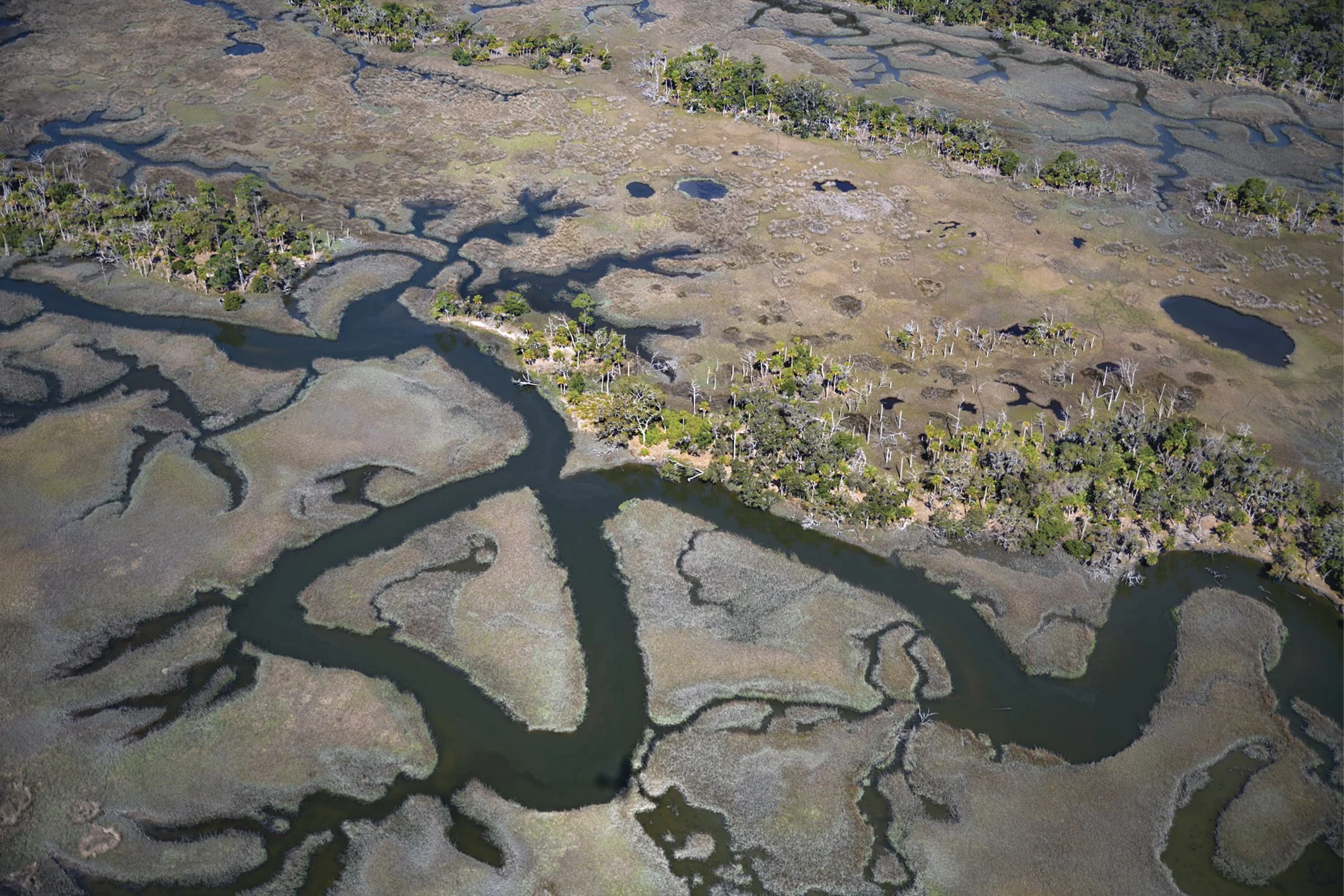
Teake Zuidema, Ossabaw from the Air, 2026
BG: I think that's totally true. I think trusting is a better word for it. ‘Gut’ almost diminishes it. You and I both have a really deep understanding of these people. And so it's an intuition based on deep understanding. We are trusting our knowledge to make the right decision about who should tell these stories. And you're right. I definitely hear my grandmother's voice in my head. I don't always agree with her, but I always factor in her opinion. And I imagine it's the same with you and Mildred.
MM: Absolutely. And times change. There's a moment where you say, okay, they entrusted me to do this, right? And it's a different time. You know, you would have probably had an argument with her and come to some conclusion about it. I would also just love to give one final plug to this gorgeous book. Because as we know, exhibitions close way too soon, but books last much longer. It is an absolutely gorgeous publication. Where can people find Off the Coast of Paradise: Artists and Ossabaw Island, 1961–Now?
BG: Thank you for plugging that. Yeah, the book was a huge dream of mine from the very beginning of working on this project for that very reason. And, you know, a lot of our research for the exhibition was based on primary sources. None of this has ever been explored in depth before.
And so, Erin and I really wanted to create something that could act as a definitive source on this subject, but also as a catalyst for, hopefully, future explorations to dive deeper into a lot of the topics that we weren't able to within the confines of this project. So it was extremely rewarding, and I'm very happy to see it in print. You can find it on Telfair's website, on the University of Georgia Press's website, in any big online retailer, and in bookstores.
MM: Beryl, thank you again so much. You really are an incredible testament to your grandmother's tenacity and legacy, and she is so lucky to have you walking in her footsteps. And the island is lucky to have you as an advocate. Congratulations again on a fantastic exhibition, and it's clear the amount of research that went on for this book. It's a feat for history and for art history, and hopefully it will be one of many.
###
READ MORE FROM IMPACT …