
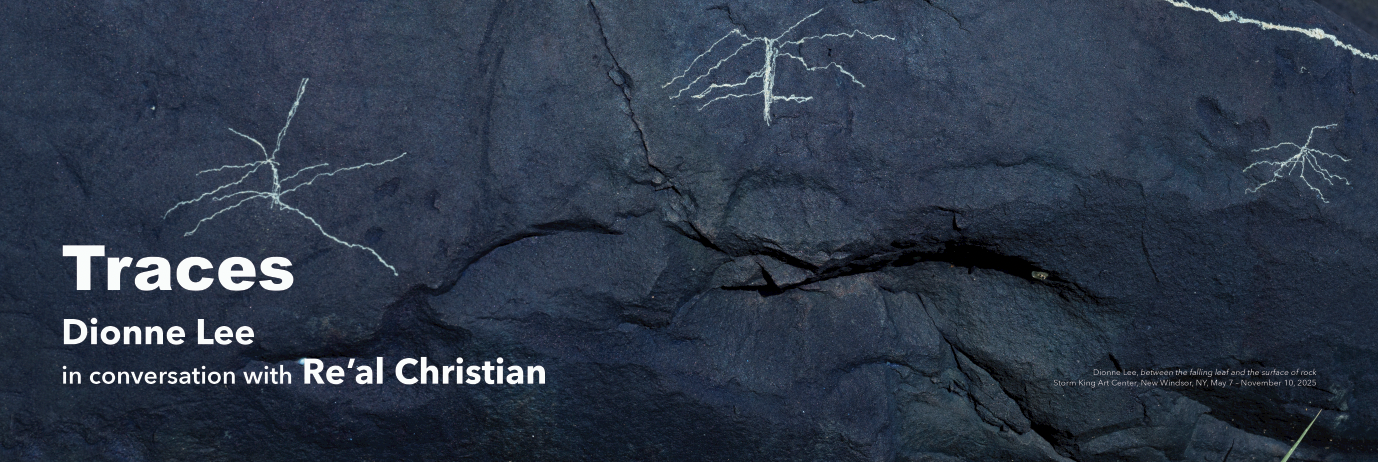
In her own words, artist Dionne Lee tends to work “close to the ground.” As an image maker, her practice draws on the historical canon of landscape photography, pushing against the traditional privileging of the far-reaching gaze to instead focus on objects more immediate and intimate in scale. Raised in Harlem and based in Columbus, Ohio, Lee often embeds elements of her personal and familial connections to land within her work, creating images that speak to broader narratives of collective survival and resilience of Black life in the US. Using a downward perspective, her images attune to things lost or overlooked: A place of meeting. A source of sustenance buried under the earth. Or a site of worship or collective conjuring hidden in plain sight. In doing so, her work constitutes an act of remembering, finding spaces where complex histories can begin to surface.
Lee and I first began our dialogue in the months leading up to her two-person exhibition Divination at the Contemporary Arts Museum Houston. The show brings together Lee and Beverly Buchanan, exploring how both artists have engaged with embodied, intergenerational practices of knowing and navigating the American landscape. Coincidentally, before our dialogue I had recently written about Lee’s work for the Medina Triennial in west New York, focusing on her series Currents, a body of work that documents the artist’s ephemeral landscape interventions. At the same time, I was in the process of reading/listening to Beverly Buchanan, Athens, GA, 8 July 1995, a video interview and recent book that focuses on Buchanan’s time living in the South after her departure from New York.
Speaking about these convergences with Lee, as well as her upcoming residency on Ossabaw Island with ARTS Southeast, we lingered on the familiar trajectories of Black life in the US through our shared connections between the East Coast, the South, and the Midwest, circling around notions of rootedness, movement, and return. Whatever defines our relationship to place, Lee recognizes the transitory as a space of creative encounter. Wayfinding is fundamental to her photographic practice, where her intention isn’t simply to “capture,” but to reorient our gaze toward things unseen. “I just want to see exactly what’s there,” says Lee. “Those things are always coexisting.”
Lee and I met over Zoom from our respective homes in Columbus, Ohio, and Queens, New York. She sat on her front porch. A stately magnolia tree surrounds her background.
Re’al Christian: I have a lot of questions, but maybe just to start, do you want to walk me through what you're working on right now and what's going on in your studio. What's around you?
Dionne Lee: Well, honestly, I'm working on my syllabi right now. But I did just come back from a workshop in Kentucky with an artist and friend of mine, Sa’dia Rehman. We went to a natural-building workshop, learning how to build structures from mixtures of mud, straw, and clay. It was an interesting material study.
The soil in my yard is basically clay, so I'm thinking about using some of that for something. I don't know what. I went there without a plan; I just wanted to learn.
I’m wrapping up a year away from teaching thanks to my Guggenheim fellowship and I feel like a lot of my work lately has become increasingly hyper-local.
Part of the year was supposed to be me taking a more southward direction in my practice and thinking more about that region of America. I took two trips to Georgia to inform my exhibition with Beverly Buchanan, Divination, at the Contemporary Museum of Art in Houston, TX, but outside of that I feel like I’m just now getting started with redirecting my research... My family has roots in the South, but they've also been in New York for three generations. I've been tiptoeing and pretty slow with that new direction.
I've also been making some work that feels — I don't know how much I want to say about it because it feels unusually personal for me — but I think it has to do with more existential questions and species-extinction, which folds into a graduate seminar I'm teaching in the spring: Feminist Perspectives on the End of the World.
RC: Ooh, good title.
DL: [laughs] Yeah, thanks. You have to make them flashy for the students!
That's kind of been in the back of my mind. At the start of my fellowship leave, I thought I'd be making work, visiting the South more, doing more things like that. But I ended up making work aligned with this class that I'm thinking about — so I’m excited to continue my research alongside students.
I don't know how much to say about it because I think it's going to be a pretty big body of work that will happen over time. But the vaguest way I can describe what I’m thinking about is that I'm grappling with the current context of climate, social, and government collapse – and what it means not just to live in it, but how it affects and limits the choices you can make in life. Those can feel very individual, but there's this relationship between what's individual and what becomes collective. I don't really know yet.
I've been cutting out a lot of open mouths of babybirds. So I have a pile of that in my studio. What that means, I don't know right now. We have a lot of birds that like to nest on our porch. Last year I recorded the entire life cycle of these robins, from eggs to fledging the nest.
RC: I've been thinking about that a lot too — the disappearance of landscape, or the relationship between ecological erosion and histories of dispossession, but also movement, migration, and upheaval. Could you speak about that in relation to your work — how you document these sites of absence as a way of addressing broader issues of erasure?
DL: The work I mentioned, that still feels like it's coming into being, I think it is related to the things you mentioned around erosion and dispossession, because I'm really thinking about how external forces affect our autonomy and our choices.
In earlier work, particularly what I was making in 2019 and 2020 around wilderness survival skills and thinking about how that is a mirror for everyday survival, I was thinking much more ancestrally — about how autonomy could or could not play a role in migration patterns, or in response to, at that time, not ecological climate but social and political climates.
Now it's kind of like: am I thinking ancestrally? I am thinking ancestrally, but by looking backwards and forwards in time.
This is a little bit of a tangent, but I read Motherhood by Sheila Heti earlier in the year. She's dealing with this question of, should I have a kid? Should I not have a kid? But she's also talking about being an artist and how — she doesn't call it a form of mothering — but there is creation that comes from you and lives on in a way that a child could. There's just this other way of thinking about your individual timeline, not only through other people, but through your output.
When I think more largely in terms of species and climate and longer time scales — geologic time scales — I feel like “erasure” is both inevitable and also never real, because it's always embedded. It's in everything. Time is recorded in a slice of rock.
I think I'm toggling back and forth between the individual — what does it mean for me as an artist, as a woman, as a Black woman, as a person who lives in America — and this larger thing. It's hard to speak to both at the same time, but I feel them both at the same time.
I think that's it: trying to hold all those things together. There is a tension between fighting erasure and feeling like I have a duty to stake a claim, as part of a lineage that has had to struggle for that.
RC: Yeah, that's really — I like that complication of how we talk about erasure, which —
DL: It's not to diminish, because it's true. Especially now. They're literally trying to erase so much right now.
RC: But to your point, the idea of erasure as this kind of closure is a very colonial concept — one that's projected, and that we internalize. The history is never really gone, it's literally embedded in the earth. So I think it's about trying to find ways to resist that closure.
You're reminding me: I was rereading Alice Walker's essay “In Search of Our Mothers’ Gardens” yesterday and just weeping [laughs] as one does when reading Alice Walker. She's writing about the generational inheritance of trauma, but also the ways creativity flourishes even under oppression for Black women. It speaks to what you were talking about, a kind of endurance of the self — it expands the time scale of how we think about existence, how we think about our imprint, so to speak.
DL: To stay with the first thing you said, about how this concept of erasure has been embedded in a very colonial way: that is the power of colonialism — to erase. The effect of that also births a kind of mass illiteracy in feeling, reading, experiencing, and being aware of time, or seeing history in a landscape. We don't have the skills.
The only thing I can compare it to is spending time in the Southwest and learning how to recognize when there's been mountaintop removal, or when a mine has been built. All that stuff can be hard to see if no one ever points it out to you. It was similar when I went to visit Marsh Ruins in Georgia. People who live there see the same thing every day, so they're not necessarily walking around with a constant hyper-awareness of local history, even though it's there and very visible. Rebecca Matalon [CAMH curator] and I got lost on a former plantation looking for these preserved tabby cabins where enslaved people lived. We asked the groundskeepers there for directions, and they had no idea what we were talking about. Similarly, a lot of people have no clue Marsh Ruins is even there.
As a visitor, I'm feeling the weight of where I am and what's taken place there, and I'm thinking about it all the time. But because I'm not from there and don't live there every day, I don't have what may be a local's intimacy with the place — or their blindness.
As you were talking about In Search of Our Mothers’ Gardens, I also thought about Lucille Clifton's Generations, which I have not finished because it makes me cry every time I start it. I always get to a certain point, and it's too much for me. I feel like thinking generationally tends to be positioned in the past, but I like to think about it going in two directions: past and future. And I guess my hope is that's what I'll get out of that book if I ever finish it.
RC: Maybe we could return to the South. You were speaking earlier about having roots there, which is a common Black experience in the U.S. I'm from Missouri originally, my family's from Texas, and I've lived in New York for about 15 years. I feel like we share a similar trajectory between the Midwest, the South, and the East Coast.
Could you speak a little more about whether the South fed into your life growing up, or if it was something you returned to later?
DL: It definitely didn't, growing up. Most of my family, like I said, has been in New York. My dad's mother immigrated to America from St. Kitts, and his dad was from Philadelphia. The stories deteriorate. I don't know all of it. But on my mom's side, I do know that someone was able to acquire land in Salisbury, North Carolina, and we still have the land.
I plan to hopefully make a trip down there one day. I think my relationship to that part of the country also has to do with going to grad school in California. I was interested in landscape broadly, and I literally had a boss who said, “You should go to school in California.” And I was like, “Okay!” and just went.
It made sense to go there. There's such a history of landscape photography, especially in the Bay Area. I was definitely thinking about identity in grad school and making work around that, but I didn't feel the pull to go South. I think I was honestly intoxicated by the Western landscape because it's so majestic and overwhelming. I hadn’t really experienced that much sky until that point.
What got me interested in the South was my work turning toward thinking more personally. It started to seem obvious that I needed to mine my own family history — not necessarily to make work that's directly referential to me or my family, but as a source of information. I also have a lot of interest in thinking about how enslaved people survived — not just staying alive, but having moments of spirit and joy.
For a long time, I was resistant. Not afraid exactly, but there's so much to unpack that it feels daunting. I realized this is probably multiple years of work that I'll slowly chip away at. And there are complicated family dynamics. You don't know people that well, and you're trying to forge a relationship without being extractive. It's all this other, more complicated stuff.
Some of my hesitation also has to do with my own ignorance about that part of the country and what to expect from being there. Which is kind of embarrassing to say, but it's true. I grew up where I grew up, and I am who I am. I just feel so New York. My partner was the one who told me that my parents and sister — and everyone except for me — have New York accents. And I was like, “How does it skip me?” [laughs] But that's so much of how I see myself.
RC: I'm nodding because you're speaking to a lot of things I've also experienced, growing up in Missouri, where my dad's family moved in the 1950s.
DL: Yeah, Missouri. That's interesting.
RC: But a lot of my extended family is still in Texas.
DL: Where in Texas?
RC: Kind of spread around. Both my parents are from Longview. A lot of family lives in Dallas, some people are in Houston, and some are closer to the San Antonio area.
Oh, yeah. I was saying I wanted to visit family in Houston so I could go see your show at the Contemporary Arts Museum Houston.
DL: Oh, yeah!
RC: It’s funny that you mentioned accents, because that's something I was very self-conscious about growing up. My family in Texas would always notice my accent. It actually made me not speak very much, which made it difficult to ask questions. I have a lot of questions for both sides of my family.
DL: That's interesting. I was a very shy kid, so I wasn't speaking for different reasons. But that desire to ask questions is embedded in how I'm starting to think about the South, which I've been doing through Beverly Buchanan's work. And for this [Ossabaw Island Residency], even though my family's not from Georgia, I'm interested in the whole region — ecologically too.
There's this thing about having questions and maybe asking them but not necessarily being given answers. Not everyone has answers, and some people just don't want to talk about it. I think that's probably a lot of the reason for my hesitation, because I wasn't brought up to investigate that history.
RC: I think there is this reticence to ask questions, or the feeling that asking questions is rude.
DL: Right. Or just annoying.
RC: Yeah, or just annoying. I was also a very shy kid, so I was happy to sit and be seen and not heard.
DL: Sure. I don't want to annoy anybody. I don't even want to — I'm invisible, please. [laughs]
RC: I don't want to be perceived. [laughs] But lately I've noticed more Black artists and writers making work in collaboration with family. I do feel like maybe we're moving toward a moment where older generations want their stories to be told, and so there's a little more openness.
Maybe that transitions into talking about your exhibition at the Contemporary Arts Museum Houston with Beverly Buchanan. As we've talked about, I happen to be reading this book on her work and her time in Athens, Georgia — Beverly Buchanan, Athens, GA, 8 July 1995 — so I was excited to hear about your show.
DL: Yeah. It's interesting because as the show approaches, I'm getting more self-conscious talking about her work. It was one of those things that felt private, and now it's like, oh, right, I need to express this and be concise. I feel a kind of nervousness about that because I'm coming to it as a fan and as an artist.
I've read about her work and gone through the Smithsonian archives, which is an amazing resource. Even though I teach at a university, I don't consider myself an academic. So my interest in and connection to her work feels hard to put into words.
I’m pretty sure I went to the Brooklyn Museum exhibition [Beverly Buchanan — Ruins and Rituals, October 21, 2016 – March 5, 2017], and I feel like that was a lot of people's entry point if they didn't know her work before then. But it wasn't really until reading Amelia Groom's book on Marsh Ruins and thinking about Buchanan's ideas around ruination — which feeds into your earlier question about erosion, dispossession, and erasure — that I felt this deeper connection to her work.
I take a lot of inspiration from the idea of the ruin as a testament to what withstands, and from not being afraid to let the work live its own life. As an artist, from a creative perspective, that's very inspiring to me.
There was a period when an image of her burning one of her shacks was my desktop, the cover of my syllabus, my Zoom background. I know — or I think — she was just adding a burn effect, because some of her shacks have that look. But in my mind I was like, oh, she's burning it all down. Her entire piece. That felt so badass and liberating, like you can just start over. I think her sensibilities as an artist feel very free.
In the show Beverly’s Athens at the University of Georgia’s Athenaeum, curated by Mo Costello and Katz Tepper, a lot of the works were things she had traded with people in her community. Being an artist in the “Art World” can feel very limiting and honestly terrible, and that show reminded me that I can also just be making and trading. I have to remember that I can do whatever I want in the private space of my studio, and all of that is part of the research, whether or not it makes it to a public display.
I find a real freeness in her hand and her aesthetic. A lot of the artists I admire have that: it's free but intentional. The most important thing about feeling connected to an artist's work is how they inspire me to show up in the studio. That's a lot of where my fandom comes from. And I think that's why she's become my entry point to the South through this exhibition, but also through her observations and work about that place. I have a lot of thoughts. I have to edit myself. [laughs]
RC: Speaking of the show at the Athenaeum, the book I'm reading comes out of that show and focuses on this long-form interview between Buchanan and Judith McWillie, who did a series of interviews with artists in the South. They talk about the practice of yard art that's so prevalent in Southern Black aesthetics.
DL: I love it.
RC: Me too, and going back to Walker's “In Search of Our Mothers’ Gardens,” it speaks to this way of forming a creative practice outside of how we typically think about studio or institutional practices. Something that's really intriguing me about this book and interview is the backyard of Buchanan's house in Athens, which becomes a kind of third protagonist. It contains all these pieces she made, collected, or exhibited, and they're in different states of being absorbed by the yard — roots, vines, overgrowth.
In the interview, she also talks about how the process of leaving New York was when she was able to connect to a new sort of time scale in her work and materiality. Maybe that goes back to what you were saying about working locally and with the clay in your yard. I'm curious if that was inspired by Buchanan —
DL: Actually, no. I mean, that's kind of how I’ve always worked in a real practical sense, because I don't drive and I can't get anywhere. [laughs]
RC: You still don't drive?
DL: [laughs] No, I know. It's bad. But I take buses, I bike, I walk. Even in California, I would take Ubers out to trailheads and just go.
But it does align with how I like to live my life and how I think about everything, even how I teach. I always say I have an analog pedagogy. I'm very interested in what is directly around me.
There are a lot of layers to this, and I think about it as an ethic in my work. Earlier you said that I am a photographer. I do call myself a photographer, even though I work across mediums. While photography isn't always my primary way of working anymore, it's how I was trained as an artist and it's my first point of interpretation.
So when I started making work about place and landscape, I was thinking about the canon of landscape photography and wanting not to use the same rules. Part of that meant not making work about places I don't really have a connection to, which may also be part of my uncertainty around the South.
I'm not going to go to some “exotic” place, take pictures, and bring them back. I do go to those places and think about them, and they inform my work, but I'm not trying to make work about those places in particular.
The other part of the ethic is that there's enough around me. I don't feel limited in resources. I've been doing so much in my yard this year. I grew indigo in the front yard and processed it and was dyeing things. There's also a marshy spot on campus with cattails that I plan to harvest with a colleague. There's enough around. This sensibility isn’t disconnected from why I don't like to drive. I went through years of being like, it's a political choice why I don't drive. But now I'm just afraid. [laughs] I also just think people should use public transportation. I want to use the bus here so that people are using the bus here. Anyway, that's a whole other interview!
RC: It does relate to another question I had about wayfinding.
But going back, I also wanted to note the scale of your work, which is quite intimate. I believe I described it as “anti-monumental” in the text I wrote about your practice for the Medina Triennial. Your photographs push against a tradition of historical landscape photography, and even painting, that attempts to capture something vast. Instead, you tend to focus on things that are more immediate and close to the ground.
DL: Yeah. I think working in a hyperlocal way creates intimacy with where you reside, or where you're staying for a long period of time. That definitely shows up in the scale of my work. The initial reason for working at a smaller, more intimate scale was not wanting to continue what was happening in the [landscape photography] canon, but over time it evolved into a more personal and conceptual choice.
RC: Maybe that connects to your practice of wayfinding and alternative ways of navigating environments?
DL: I collect divining rods all the time — ones I find walking around the neighborhood, on a trail near me, or by the ravine where I live. I usually pick them up.
I've described collecting them in my studio as a form of map making: every place where I find one and pick it up is almost like dropping a pin. It started as more of a compulsion. When you find one, it's exciting, so you have to get it. But even that little bit of excitement over a stick felt meaningful.
Rebecca [Matalon] already had the title Divination in mind when she called me about the show, so it's not a direct reference to my divining rods. But there was this nice happenstance: I have those, and the videos I make with them I call video walking sticks. I use them as wayfinding tools, holding the stick and walking around with it, following its shadow.
And Beverly Buchanan had a collection of her own walking sticks, more traditional ones for hiking, and the daughter of her partner has a collection of them. Some are going to be in the show, which is very exciting. We didn't know that overlap was there, so it became this nice one-to-one connection between the practices.
I think the way I make work is about trying to make sense of where I am. That happens in a very hyperlocal context, but also, like I was saying earlier, within this broader, universal geologic time scale — which is an impossible thing to place yourself in because you're invisible within it.
RC: Which, for our childhood selves, maybe worked out.
DL: [laughs] Yes!
RC: You also work with petroglyphs created out of things in your immediate vicinity — I’m thinking especially of your series Currents, where you created symbols out of water and other natural materials that dissipate over time. I'm curious about the ephemeral aspects of your work and how they relate to your approach to photography — a medium often associated with permanence or truth.
DL: Yeah. I think part of it is related to that ethic in my practice. It fits conceptually with thinking about time scales, impact versus impression, and what our role and presence are in the places that we are.
It's also related to the leave-no-trace rule for hiking or camping. That became another constraint or challenge. Those rock drawings, for example, I made in a park by my house. It was a public space, even though I had carved out what felt like was a private zone. One day one of my colleagues showed up with her daughter, just coming through and kind of bum-rushing my whole scene, which was fine — but it reminded me that it's not private. I'm working in public, and I don't want to alter where I am very much. That's a useful challenge.
The ephemeral nature of the work also speaks to how I think. I would almost like to leave no trace, not in the literal sense that I want it to be like I never existed, but I want to blend in.
I think it’s my small response to larger issues of species behavior and large-scale extraction and violence. In a lot of early popular landscape photography, extraction and genocide were rendered invisible.
I like to imagine a shelf in an archive where William Henry Jackson, Timothy O'Sullivan, Carleton Watkins, and whoever else are there, and ask what it means to put that rock spiral drawing among those images. I want to add to the story we're telling about land and how we live on it.
I've also started working from this idea that the plant fossil is the first photograph — the first photograph was not made by a person. What does that mean? What does that say? What if a fossil was also on that shelf?
I want to make work about what I think is missing — not to correct what's there, because what's there also tells a story.
RC: And that connects back to Marsh Ruins. I think what's so beautiful and enduring about that work is that it was created to return to the earth in a way.
As we're talking, I'm also thinking about Cecilia Vicuña's Precarios — objects made to disappear — as a direct response to land privatization and the extraction of natural resources.
DL: Totally.
RC: What I admire about your work is how you tread this line between what endures, what is precarious, and what is intended to disappear.
I think something about that is also visible in the palette of your work, which tends toward black and white, creating this stark contrast between what's there and what's missing.
DL: I love that you brought up [Marsh Ruins and Vicuña’s precarios] because I feel like, yes, I strive for that. My work is very quiet. And I think what I'm interested in, or what's starting to happen, are new boundaries around how radical that can get.
There is something about quietness — something not loud and flashy — that can also be read as radical. I'm not saying my work is that, but that way of working can be read that way. I keep thinking about the Storm King work and how much of a challenge it was because it operated at a very different scale. I did try to keep it true to my sensibility: you couldn't see the installation easily at all times of the year; when the grass got high, it was hard to see. But it was still a different way of working that I'm wrapping my head around, and a more invasive one. There are traces. It's not totally ephemeral.
RC: It's interesting that you mentioned the work is quiet. It is, but I think there's also something interesting happening sonically in the work that I can't quite describe. I'm curious if you have thoughts on that.
DL: Yeah. I guess I'm thinking about some of my videos, which are sometimes silent and sometimes aren't. I made a video for the closing at Storm King that documented the installation in an experimental way. Some people left in the first five minutes because the sound was so intense. It opened with noise from a Dremel I was using to carve into the rocks. I knew it wouldn't sound good. I knew it would be jarring. When people left, I was like, okay, noted. Not bothered by it — just, okay.
When I use sound, it's very intentional. In the context of my quieter or silent videos, it can feel more intense, more in your face.
There's another four-channel video going into the Divination show that starts with metal being dragged on the ground. My partner told me it sounded awful, like, “You can turn that down.” And I was like, “I think I won't.”
RC: I'm thinking about how in your images — even without looking at the video documentation — I can almost hear the slow scrape of metal across stone. That has a very particular sound: the metallic scratch and the porousness of the rock. It can be quite jarring, but maybe meditative in a way. I guess it depends on your relationship to that sound, or that noise.
And I want to say “noise” because I'm thinking about the tradition of noise music and this sort of disembodying, discombobulating frequency.
DL: It's very physical.
RC: Yeah, noise is something that both reveals and conceals at the same time. Noise also abstractly connects to practices of wayfinding, as a kind of generational knowledge. Thinking about scoring as a kind of notation or aural mapping, especially in your work in the 2024 Whitney Biennial — Fault Condition? Was that part of the —
DL: Oh no, Challenger Deep.
RC: Okay, okay. But thinking about Fault Condition, it reads as a kind of notation system.
DL: Related to wayfinding, I see them as maps. I've spoken about that work as my version of an aerial map. I'll never make an aerial image — although I should never say never — but it doesn't feel like my sensibility.
So it was my way of thinking: what if I were to make a map or an aerial viewpoint? What am I looking at? For that one, I chose to think about time. There are fossils, older geologic references, and then more contemporary references to tools we use to access those things or penetrate the earth. I was thinking about what it would mean if time were compressed and you could look at all those things at once. Maybe I'm just looking at one square mile. Maybe it's a really tight view. But they're definitely abstract maps.
RC: Returning to something you were saying earlier about familial connections to a place and how stories “dissipate” over time, how does that tie into the ephemerality and impermanence in your work? I'm thinking about what's captured in the process of trying to find and document these stories, but also what's lost in transmission. What remains in these intergenerational processes of knowledge transmission or ancestral keeping?
DL: The first thing that came to mind when you asked about the connection between that familial part and the ephemeral nature of the work was sadness. I do think it's sad. Stories can dissipate and become really hard — or impossible — to access.
I know my ancestral story will run out for me. I will hit a dead end. That lives inside me as a deeper sadness: there's a curiosity that will never fully be fulfilled.
And I think when I'm making works like the rock drawings, or even the thing at Storm King — a cyanotype that changed over the course of eight months — there is a sadness in that too.
That's actually, unfortunately, my true state in terms of how I think about people's relationship to place and our collective relationship to land, or the earth. I'm not really an optimist. I have some optimism, but I also think it's important to sit with how heartbreaking and sad everything is.
Whether that's where my family's stories run out, or what we've done — speaking just in the United States — to the surface of where we live and underneath it.
As much as I appreciate the amazing writers, artists, and thinkers imagining, and encouraging us all to imagine different futures and new world-building, I also feel like we need to sit with how fucked up it is right now: why we're here and how we got here. That's where I'm at. I want to sit in that space. Which can feel wrong when we're living with such an understandable level of urgency.
When you asked about where the stories run out, I also thought about this piece I made. It's the cover of my book, where I learned how to map the night sky using different hand formations. That felt like a way to connect to something very ancestral. I could imagine someone related to me holding their hands in that position to find the North Star, or using other techniques. There's something I can imagine. And that imagining — to give credit to why we need to imagine different worlds — is helpful. It helps me sit with what is difficult.
But it's different when the imagining bubbles up on its own versus when you know eventually you will just have to imagine something. Those are two different experiences. And yeah, I don't know. I just think it's all quite sad. But here we are.
RC: Something that always annoys me is the co-option of the term Black joy, or the misunderstanding of what joy means in a Black context. The fact that it can be sad. It's not just pure happiness.
DL: No, it's always in context of something else.
RC: It's a way of finding something positive in the midst of other, more negative things. I'm thinking about Saidiya Hartman — there's a passage in one of her books about enslaved people finding ways of slipping off the yoke to be together in space, to have fun, to dance and sing.
That, to me, is a perfect embodiment of what joy is: it's in the context of so much else, but it's there.
I don't know if I consider myself an optimist either. I think I'm a realist, which is both a pun on my name and also just practical.
DL: Yeah. I tend to put it in this pessimist-optimist binary. But I think I just want to see exactly what's there. Those things are always coexisting.
It's harder to do that, actually — at least for me. And I think collectively it's harder too, which is why we've had such a hard time doing it as a whole.
Divination: Beverly Buchanan & Dionne Lee is on display at the Contemporary Arts Museum Houston from September 4, 2026 through February 14, 2027
