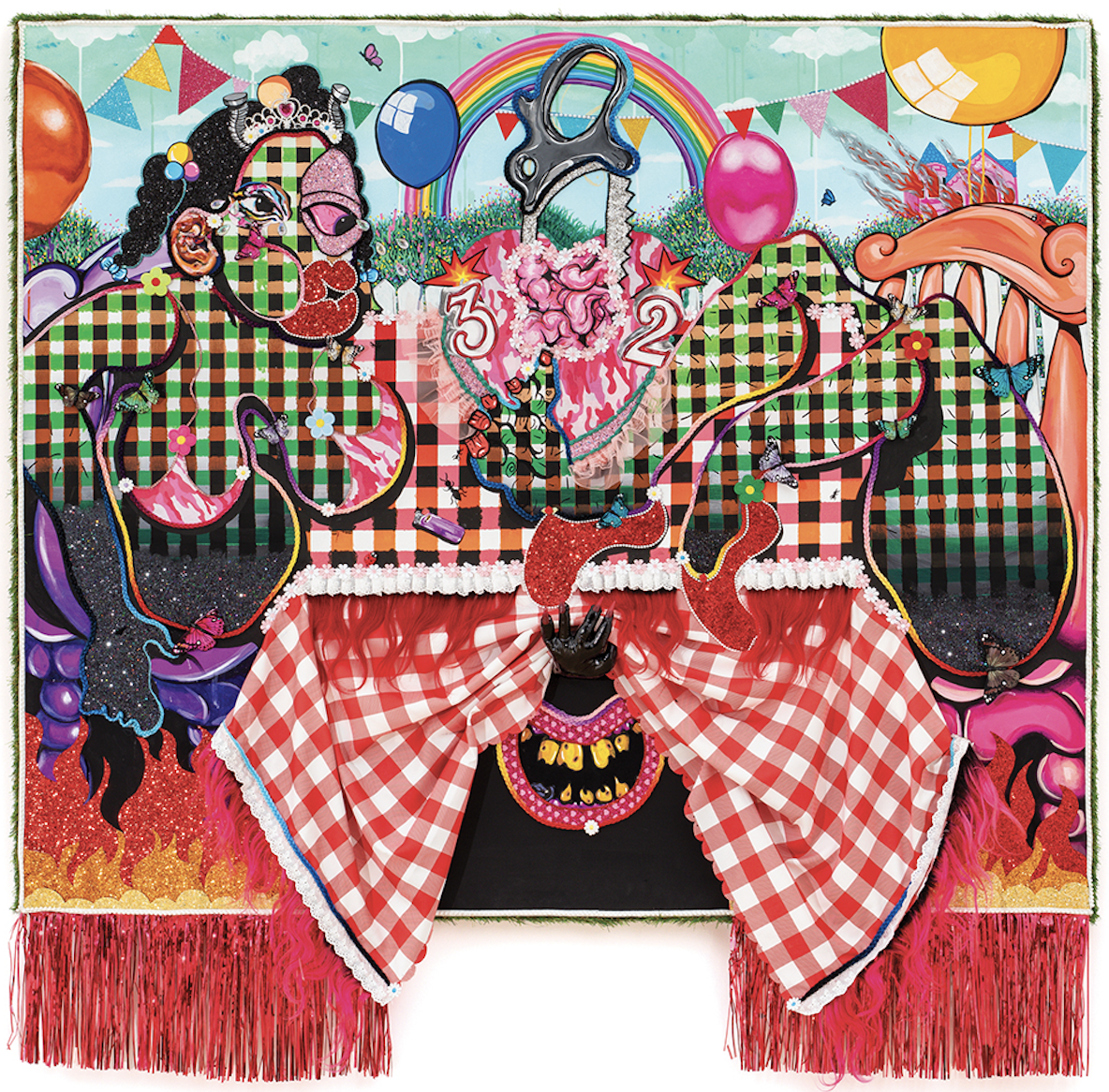
Victoria Dugger, Pity Party, 2024. Gouache, fabric, and glitter vinyl on wood panel, 60 x 72 inches. Courtesy of the artist and Sargent's Daughters
“According to the map, we’ve only gone four inches”
— Dumb and Dumber
Low Grit Grins is the featured exhibition at the 3rd annual Atlanta Art Fair, taking place October 1 – 4, 2026. Curated by Sarah Higgins, the project includes Antonio Darden (Atlanta), Victoria Dugger (Athens), and Tori Tinsley (Decatur), each of whom uses humor as an entry point to their mixed-media works. We gathered to talk about creating connection through comedy, inviting laughter into difficult narratives, the relationship between humor and horror, and to crack each other up in the process.
Sarah Higgins: You each entwine personal lived experiences with broader historical, interpersonal, or political contexts, and it grants each of your practices an intimacy that goes beyond social commentary — it feels bigger, and therefore more relatable than pure autobiography. And each of you balances that dichotomy so well. The work is related to personally lived and experienced topics, but it is being mobilized toward a larger critique, or a larger observation. So, responding to the humor or absurdity or parody or satire that appears in your practices, I was thinking about how humor often mobilizes the familiar toward an “aha” reveal. You're following along with a narrative that's like, 'You know this. It's familiar — and then there's a twist. There's a connection that can be surprising, or that offers a release of realizing that it's a shared revelation.
That's one of the things that I find the most cathartic in comedy: the re-presentation of what you already know in a different light. And I was wondering if that definition of humor resonates in the way that you also think about humor.
Tori Tinsley: I've been thinking a lot about humor since you invited us to do the exhibition, and you said that you wanted us to participate, as a group, because of how humor resonated through our work. The way I've used humor in my work — because when people hear the backstory, especially with my work about my mother's illness with dementia — they're like, 'But you use such bright colors, and they're funny,' – they don't understand.
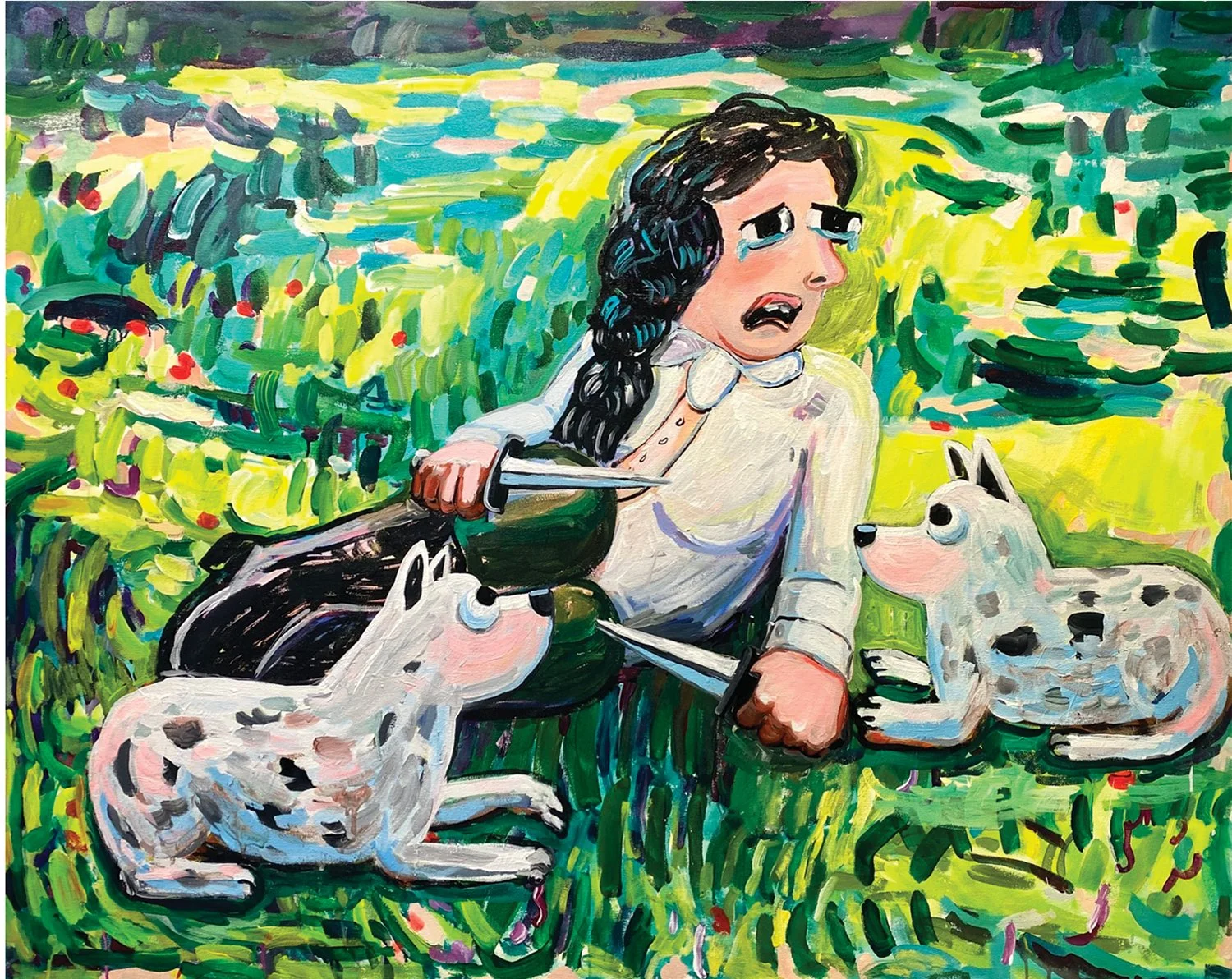
Tori Tinsley, Crying Rider, 2025. Acrylic on canvas on panel, 48 x 60 inches. Courtesy of the artist and Laney Contemporary
Victoria Dugger: [laughs]
TT: But it's a layered experience. And humor is the way we get through it — or I get through it. I have to laugh at the dark stuff, because otherwise I would just fall into an abyss. And it continues today. Maybe it's my default mode, but I just — yeah, I have to laugh about it. And it does help people connect more with the story underneath. And sometimes when they find out that story, it pushes them away a little bit. But it does invite people to share the experience I'm putting forth.
SH: Yeah, I did reach out to you guys as three people who I'm bringing together out of this relation in your work, something that I love in each of your practices, which is a wry humor, or a humorous pathos, or a gesture toward campiness or bombastic absurdity, as an entry point. And I was thinking about how we live in these heavy, heavy times, and humor is different in heavy times. It emerges differently. And the heaviness that some people don't have the ability to escape, ever, has spilled over and started touching the lives of people that maybe felt more immune to the heaviness before. And humor is a way of bringing people together in that newly shared context. So anyway, that was where I was coming from. But then, I also realized that this isn't a way that your work has been framed explicitly before. Did that invitation context seem surprising, or out of left field, or did it feel tangential to your practice? Or, if not, then how do you think about humor in your practice?
VD: I've actually been thinking, in the past couple of days, about the idea of masking, and obviously about lived experience. I want to make people comfortable because I can already tell they're uncomfortable when interacting with me, or with my story,' or, like Tori, when speaking about your mother. So, it puts people at ease in a way. And maybe it puts me at ease to talk about these more vulnerable things. But, in a way, taking that masking element that I've become comfortable with myself — to make other people comfortable with me — I've taken it into my art as well. You gotta — what is it? You gotta take a spoonful of sugar to help the medicine go down. Kind of like that. So, having these more personal conversations or personal narratives and then intertwining them with an element of humor, or the bright colors. That's why I laughed so hard before, because people say that about me. They're like, 'Oh my God, but it's so bright.' And I'm like, yeah, it's that emotional complexity, and like you were saying, Sarah, other people who might have been immune to the heavier things of life are now experiencing them in different ways, or experiencing the breadth and the spectrum of life, which is really wonderful. And that's sadly and fortunately, at the same time, what life is about: that we get to experience this range of emotions and experiences and feelings. So, then that layered complexity makes more sense in a work that's able to hold sadness or anger, grotesqueness and happy colors and humor all at the same time. Because in a 24-hour day, you may experience all those things. So it would make sense that a flat surface could hold those things too, like a flattening of time and space. If that makes sense.
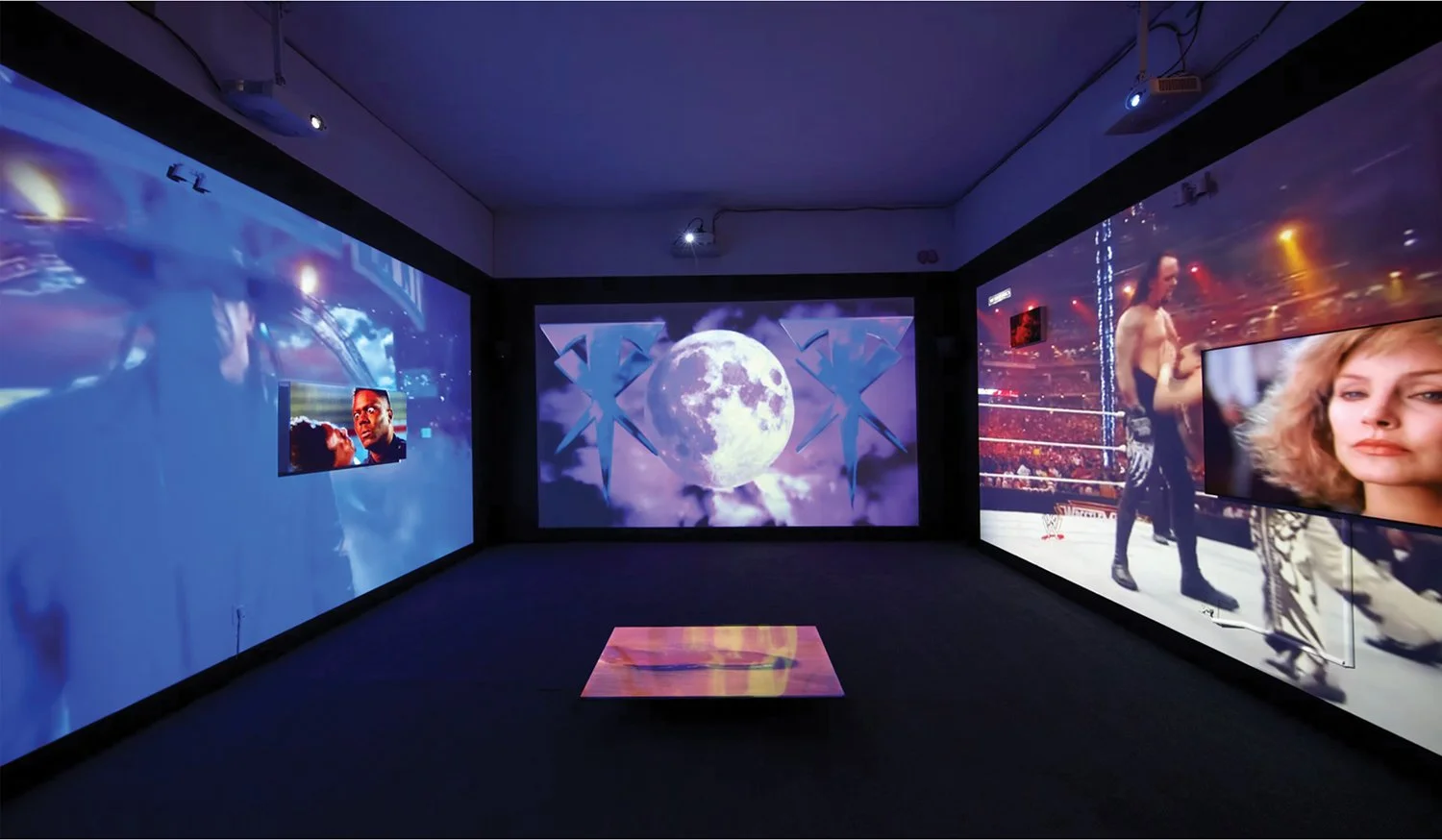
Antonio Darden, It reads both 'BRUISED' and 'BRUISER' (A hologram) - Still, 2025. Four-wall projection/Six-channel video, asymetrical sound, digital archive print on panel, 00:06:17. Photograph by Devyn Galindo
SH: Antonio, your work engages with a more internet-based style of humor, in the sense that it compounds multiple references that, like a sampling practice, build together a context-specific and sometimes encoded meaning. And if you know the references, you can get the joke. And that's a very pointed way of building not only what you're saying, but who you're talking to. And, like internet humor, it's also deeply situational, where the punchline can be fixed or it can be malleable depending on where and when it's deployed. And I feel like you do that, too. There's always a little bit of a wink, a reference, a reference within a reference — there's an interest in where references intersect and where they diverge. Could you talk about that a little bit?
Antonio Darden: I just want to say, if we pan out, it's almost like our entire existence itself is hilarious. These play things moving about on this round object. I don't know when it was, maybe in my twenties, when I figured out that I was funny. No, I don't know when it happened.
VD: I feel like we're hilarious by the way.
SH: Funniest people I know.
AD: Yeah. And so, in reference to your question, a lot of it is about timing, right? When the punchline hits, and I mean, I'm not telling jokes, none of us are, but that's what helps to distill the gravity of what we talk about. The way you space the setup, the time between recognizing the reference, the internet meme or the colors — that time gap between recognizing something familiar and then understanding that this is not what you thought it was about. And so, just like Victoria was saying, for a lot of people, it helps it go down. It's a little more digestible when we discuss the poignant, heavy topics.
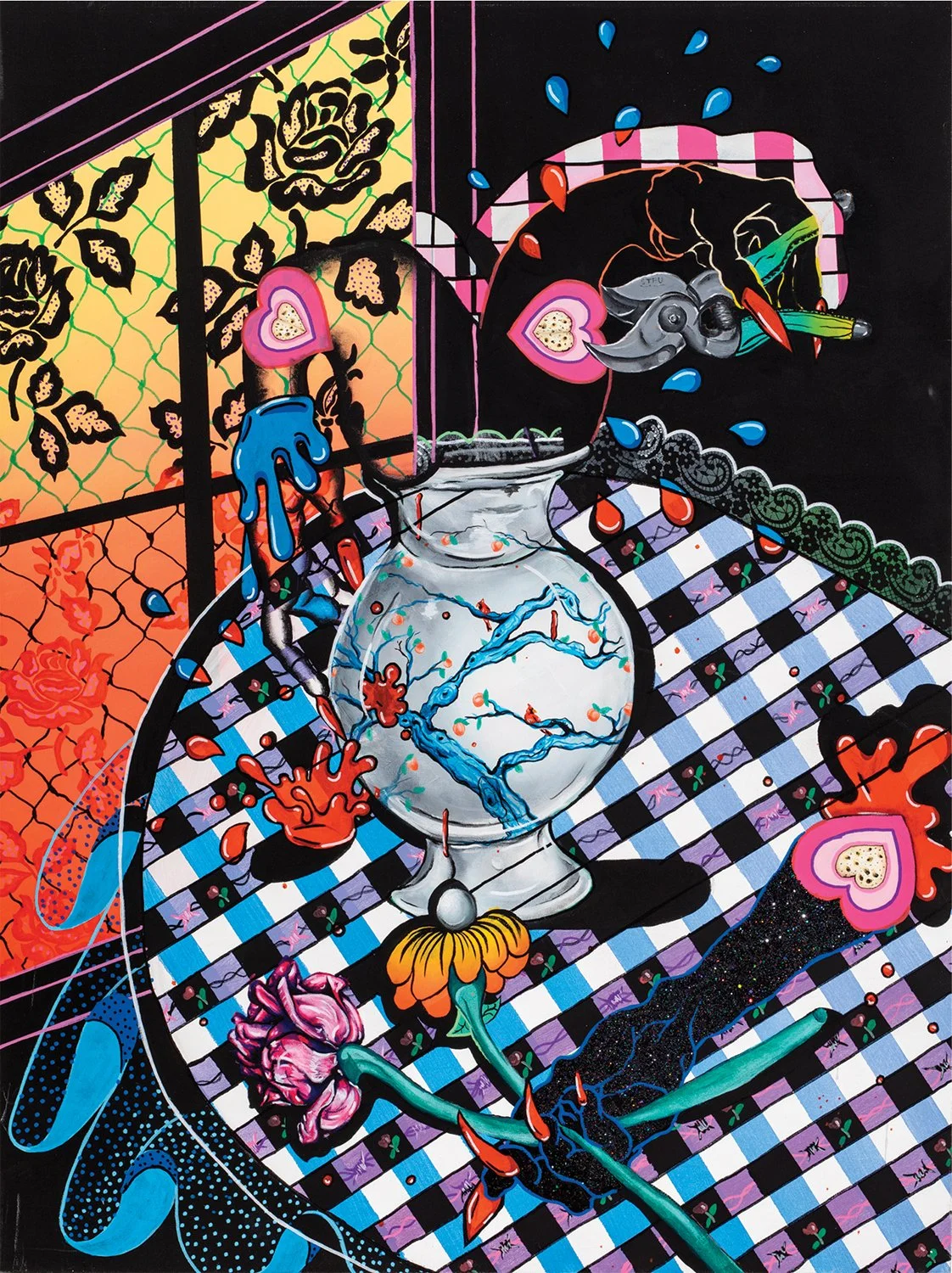
Victoria Dugger, Nip it in the Bud, 2024. Gouache and glitter on stretched canvas, 48 x 36 inches. Courtesy of the artist and Sargent’s Daughters
SH: It’s an entry point for viewers. It's a way of getting them to think about something that they might avoid, or that they might feel uncomfortable talking about. I'm also curious if it's entertaining to you — if some are jokes that you make just for yourself. It's true that you're not telling jokes, but are there moments where you do a gesture in your work that just gives you a chuckle?
VD: I feel like my whole practice is just me saying, 'I think it would be funny if ‘dot, dot, dot.’’ I want to do a painting called Spilled Milk, like, 'Don't cry over spilled milk.' But it's about motherhood and the entry point to motherhood, and who gets to experience it, and the grief over that. But also, I think it would just be funny if I was milking myself. With painting and with art, there are material jokes that you can make that are also funny — in the sense that, personally, they're just funny to me.
I find myself very funny, like Antonio said. I feel like I just found out I was funny and I leaned into that. And I don't know if other people think that I'm funny, but I amuse myself a lot. And you have to, because we are on a floating rock, and it is hilarious.
TT: I often love laughing at my little figures when I put them in a predicament, and I'm like, 'Oh, I feel so bad for you.' And I laugh, and I feel like they bring me joy even when they're on the verge of something disastrous. But yeah, it's super important. Without that, I wouldn't keep doing it. I'd get so bored in my studio.
SH: You all make a good case for artmaking as prop comedy.
Antonio and I had a conversation in our first studio visit about the difference between people who are funny and people who have jokes. They're two different types, though sometimes people have both. I was like, Bill Murray is one of those people that is funny and has jokes. It's the ability to just be funny. Just being you, in a situation, is already funny.
TT: That reminds me of a time I was in front of other people, and there was another artist talking about my work, and they were like, “Your work is so humorous, but you're not.” I don't know how to take that. I think it was some kind of backhanded compliment. But yeah, sometimes that can happen. I'm maybe not a funny person, in person, but I hope it comes through in the work.
SH: That's something that made me want to bring the three of you together: you have this ability to explore people's fears — in some cases, maybe their deepest fears — of caring for a parent with a difficult disability, of their own body's vulnerability, of vulnerability in the face of structures of power that are oppressive and that can be disproportionately so to the people that we love. Those are elemental human fears.
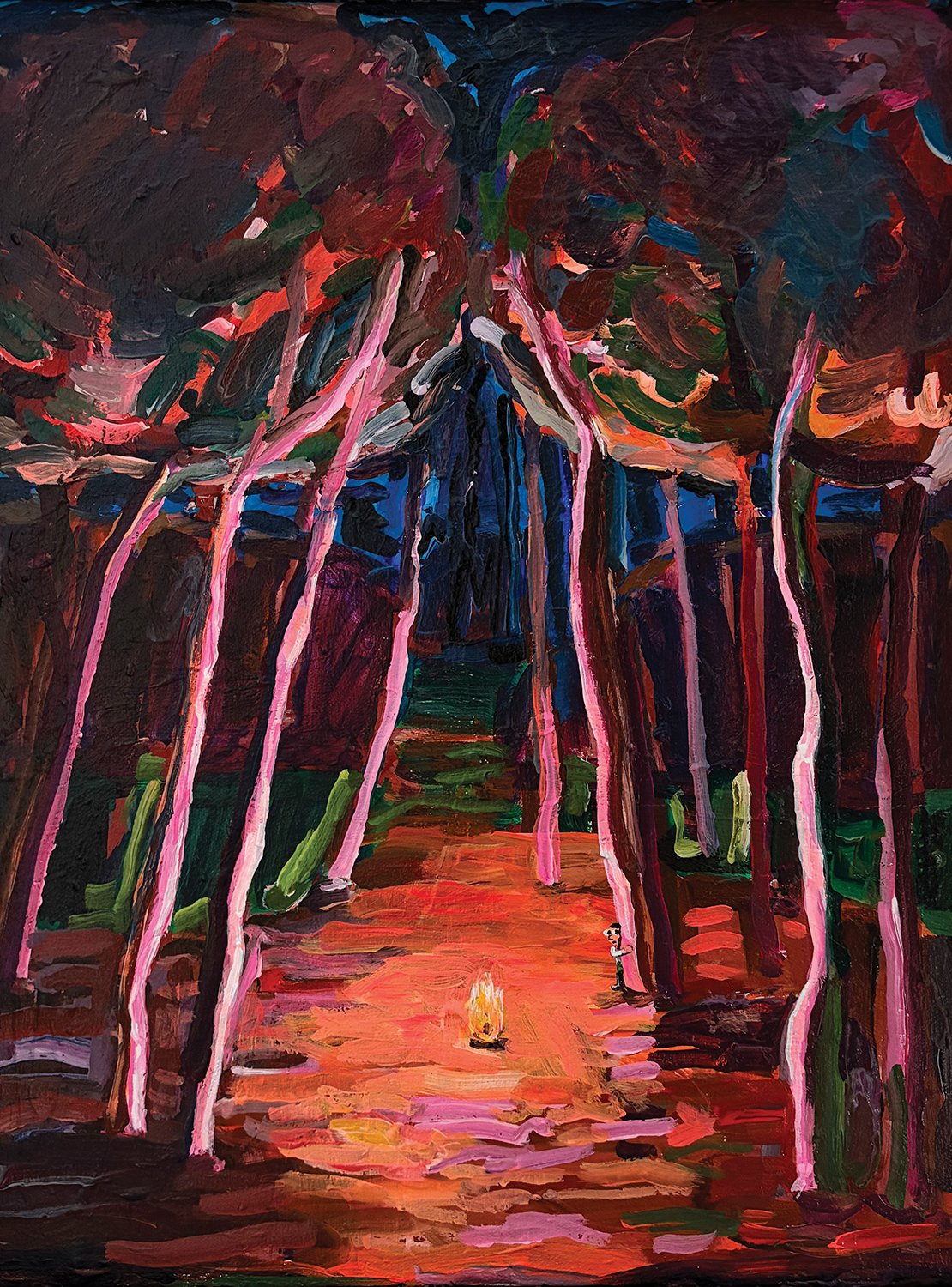
Tori Tinsley, Rider in the Dark Woods, 2026. Acrylic on canvas, 20.5 x 16.5 inches. Courtesy of the artist and Laney Contemporary
One of my favorite comedy movies is The Evil Dead, and also Evil Dead II. The first two Evil Dead films are hilarious, but also terrifying and grotesque, and hilarious in their grotesqueness. And there's something about humor and fear, like the way teenagers sometimes react to being made afraid or uncomfortable — or suddenly overly vulnerable — by laughing and joking. It's a response we have to learn our way out of, for social reasons. I see that at work in your practices. And I guess that maybe brings me to the exhibition title, Low Grit Grins. It's a play on words. Low-grit sandpaper is the roughest; it's the most abrasive. But the title is also playing with the idea of smiling through gritted teeth, and the way that humor — when it conveys a deep cultural critique that you have personal stakes in — is often an act of smiling through gritted teeth.
TT: I like all the different meanings.
VD: I'm a really big horror fan, so I love it. Horror is one of those genres where you can have a range of emotions in a movie and it still be considered horror. A romantic comedy can't necessarily have horrific moments — then it would no longer be a romantic comedy. But fear is a privilege, because who can express their fear openly? Sarah, what you said made me think of women being in really anxious situations with men, and feeling unsafe. And it's like, you can't really say you're scared, or you can't say, 'Hey, I'm uncomfortable.' You sometimes have to just grin and bear it, and hope. You have to kind of get through that. But men can perhaps easily show their fear. But then there is another level of that too, because of masculinity and the expectations of that as well. Or Black men not being able to show fear, or be afraid, or you're not masculine, even in the community.
SH: Yeah, I think horror allows a safe place for us to feel fear. Horror allows a safe confine, this fictional space where you can let your startle show. You can revel in the safety of being able to feel the fear that you have to suppress so often. And I think that probably touches everybody. Comedy does a similar thing. I think comedy and horror are closely related — these little microcosmic moments of rupture.
Your practices have a playfulness that's really genuine, and yet they're all rooted in serious cultural problematics. With Tori, how relationships of care and interdependence — and sometimes just dependence — relate to patriarchy, and how care is gendered as feminine. That's serious subject matter. And Victoria, how the body and its vulnerabilities track onto interlocking histories of ableism and misogyny and racism. And Antonio, your work grapples with how the violence of white supremacy, and specifically anti-black racism, is locked into this co-production cycle with Black creation and joy. And those are heavy. That's heavy. And for me, those high-stakes kinds of engagements are what make me believe in art. And I do tend to be drawn to art that has heavy conceptual stakes, but that type of art can get really dry really fast. You can lose the joy. There are questions, like, “Why make it an artwork instead of an essay? Why do a performance instead of a protest? Why make an object for people to encounter rather than leading a petition campaign?” And that humor and playfulness and absurdity have a really important role to play in the answer to those questions.
AD: Can I tell a quick story?
SH: Yeah, yeah, yeah, yeah!
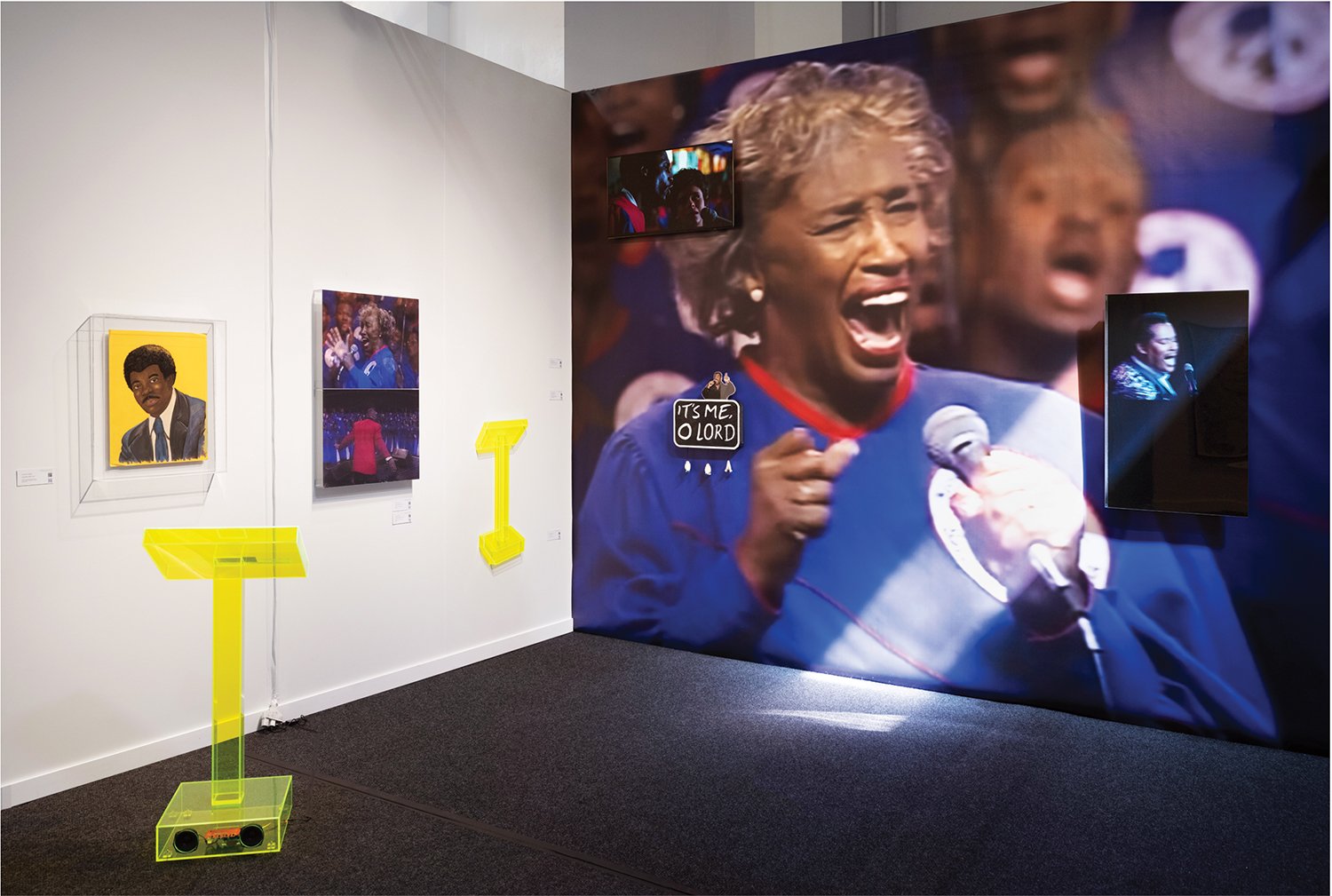
Antonio Darden, Installation view of the exhibition, RICO at The End Project Space, Atlanta, GA, 2022. Mixed media installation with plexiglass podium, speakers, plexiglass frame, pastel on paper, mp3 audio recording by the artist, dimensions variable
AD: This is in reference to the show’s title. I don't want to backtrack, but — one of my good friends, who's kind of a self-elected cousin, is a comedian. Her name is Dulcé. And a long time ago, before she was doing comedy, when we would hang out, all we would do is laugh. We would just make each other laugh the whole time. And so, we would laugh so hard that our cheeks would be hurting because of all the jokes that we just kept riffing off of. And so, we came up with this thing that was, 'Smile like it hurts.' And we just kept feeding into that. We came up with BCS, which is Burning Cheek Syndrome. And so, from that, we came up with a diagnosis. We never produced this, we would just act it out, and it was like a diagnosis commercial: 'Are you suffering from BCS?' Somebody would try to laugh and then — ouch — you know how, on the infomercial, they'd be laughing and then they'd be like, 'Oh no.' And then, immediately after that commercial, it would be a wrongfully diagnosed BCS attorney commercial. This was summertime, and you don't have anything to do but watch the talk shows and all the diagnosis commercials.
I just think 'Smile like it hurts' is also one of those things where something is so hilarious that we become numb, right? Have you ever laughed so much that you kind of forget how to laugh, and your body is just — your cheeks don't know what to do, and it just seems like you're deadpan because the laughter is just innate?
VD: So that makes me think about — yeah, they're both extremes. Fear is an extreme, and then laughter or humor, joy, is such an extreme as well that you arrive at the same place: that deadpan-ness, or that neutrality, once again. Yeah. Also, is it Dulcé from The Daily Show? Oh my God, bro, she's so funny. Also, the world is so small. That's crazy.
AD: Yeah.
SH: This leads into something I wanted to ask. Antonio's already tipped his insider connection to a professionally funny person. But are you consumers of humor? What makes you laugh? Do you seek out comedy as a relief? Do you appreciate more wry, satirical things? What are your favorites? What kind of humor do you guys like?
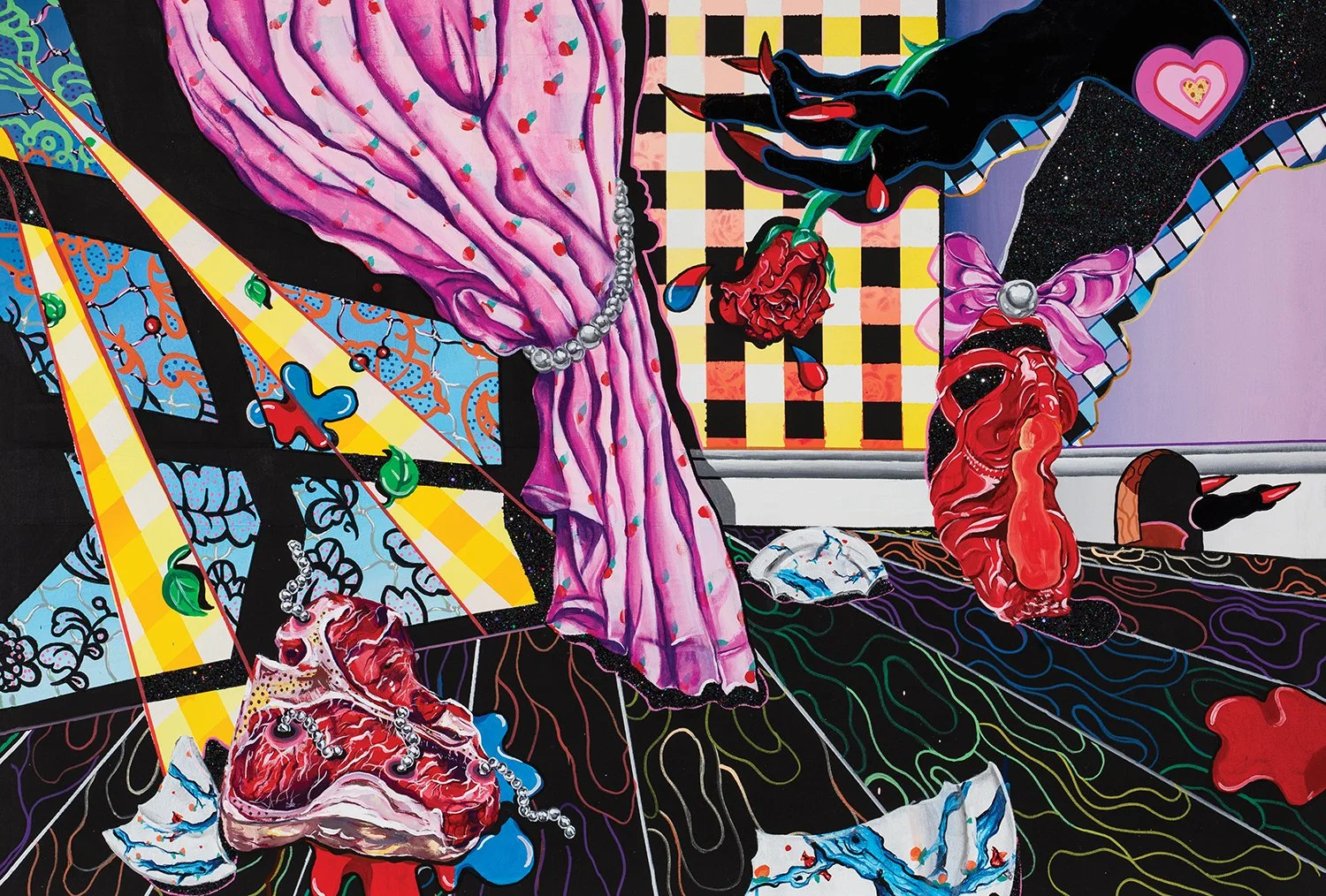
Victoria Dugger, The Good Foot, 2024. Gouache and glitter on stretched canvas, 36 x 48 inches. Courtesy of the artist and Sargent’s Daughters
TT: I keep thinking about the show Widow's Bay. Have y'all seen that yet? Oh God, y'all, it's so good. But it's horror meets comedy throughout the whole thing. It's the only way I would watch it, because I can't watch a lot of horror stuff. I get sucked in, and that's all I think about for days on end afterward. But if there are funny parts — it's scary, scary, scary, and then something just ridiculous kind of lets the pressure out, and then it can build again. Right? So, for me, that's what I need. I need that intersection. But I'm so jealous of very funny people, because I want what you were saying, Antonio. I want to have the wits about me to engage with someone long enough that we're making each other laugh like that. I have a high school friend from long ago that I could do that with, and I haven't found that person who makes me just cry nonstop laughing since. But I like quick humor. I want to be best friends with Conan O'Brien or someone. I would just sit there and listen to him because I'd have nothing to say back. I like silly humor, I guess. I like silliness.
VD: I've been watching — I love cartoons, like Looney Tunes or Courage the Cowardly Dog, which is very funny because his owner kind of looks like my grandma, and she lived in the middle of nowhere, and I would go visit her for the summer. It was very — I was in my Courage moment. I don't know. But with Looney Tunes, it's interesting because, like you were saying, Tori, I feel like your work does that so well. And it's something that I want to do more of in my work, this resiliency. In one scene, they'll get their head blown off, but then they'll be right back, and be fine. And it's kind of fun. It talks about the human condition and perseverance and resiliency. And it reminds me of Dana Schutz's Self-Eaters. I love that series of paintings.
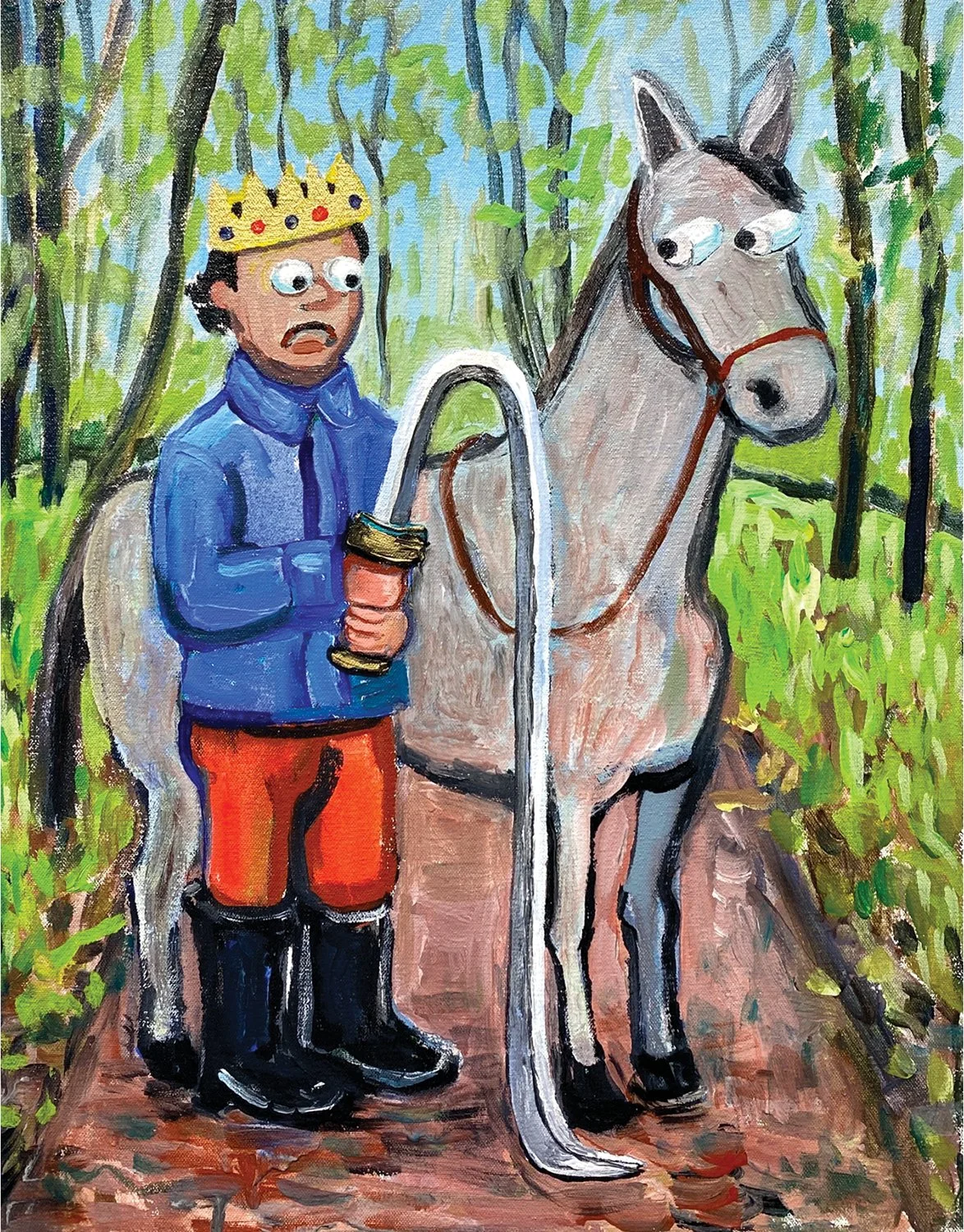
Tori Tinsley, The Prince, 2025. Acrylic on canvas on panel, 20 × 15 inches. Courtesy of the artist and Laney Contemporary
Yeah, I don't know. I like Adventure Time.
TT: Ooh, Sarah brought that up with me as well. Have y'all talked about that?
SH: We haven't, no. I'm a big Adventure Time fan, too.
VD: I love Adventure Time, dude. I love Adventure Time so much. It's so funny, and it's so good. What's another one? Adventure Time is my main show. I like Regular Show as well. That's a little bit more — I feel like it's not as palatable as Adventure Time. But that's so funny, Tori. Yeah, we're very kindred.
TT: Sarah introduced me to it. I didn't even know about it. But yeah, now I'm a big fan. It's brilliant.
VD: It's so good.
SH: Antonio, where do you stand on Adventure Time?
AD: I guess I'm just being introduced to it. I just wrote it down.
SH: I started watching Adventure Time when I was in grad school because I was in this super-theoretical curatorial program. It was very heavy reading. We would have hundreds of pages of philosophy and critical theory to read a week, and I just needed something to pull me out of that every now and then. A friend recommended Adventure Time because the episodes are only 15 minutes. I could watch one in between readings, and it's not a huge time commitment. And there's just something so sweet about it. So original, so weird, so unafraid to be weird. Kids nowadays have so much more interesting media to consume. Whereas, growing up in the eighties, it was all just of-a-type, which, of course, I'm also nostalgic for. But Adventure Time really exemplifies the way that things can be for kids — super metaphysical and conceptually challenging, and maybe in some ways not always “for kids,” and really different and playful in their style. Anyway, I digress.
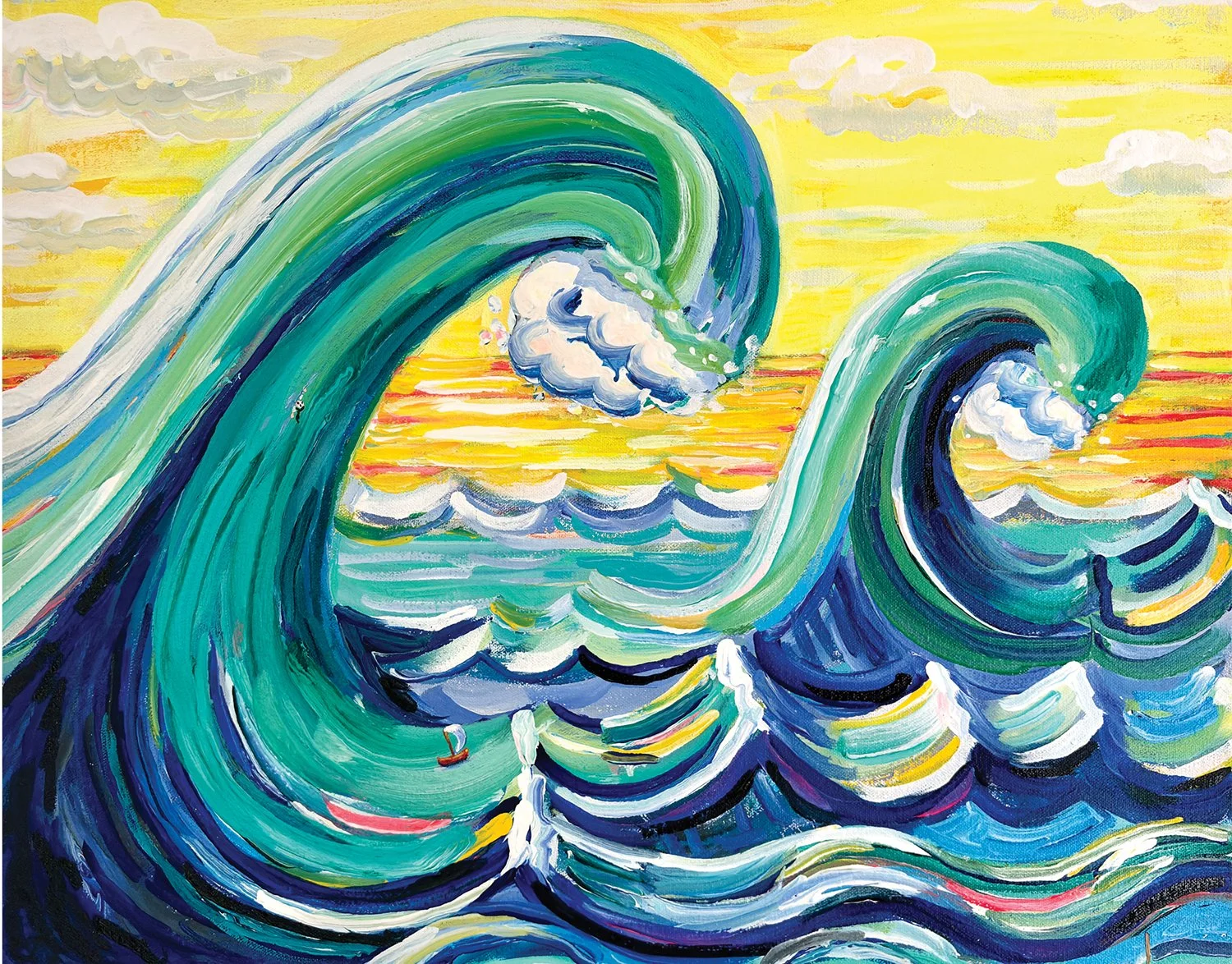
Tori Tinsley, Rider in the Waves, 2026. Acrylic on canvas on panel, 15.25 x 19.5 inches. Courtesy of the artist and Laney Contemporary
Victoria, it makes me wonder if you have the TV on while you're working in your studio. And I was curious about inspiration and influences. What do you listen to in the studio? What are you reading? What do you look for to refill your cup? What puts a little sugar in your bowl?
TT: We talked about this a bit in our studio visit, but I'm obsessed with romantasy, and so I am slightly embarrassed to admit that. Are you as well?
VD: Are you kidding me? We've been kindred. We were burned at the stake together many centuries ago.
TT: I agree. I'm sad you're up in Athens. We need to hang out. Do y'all know that we used to work together at the High?
SH: How long ago was that?
TT: Oh, God, what? Ten years ago?
VD: It had to be. Yeah. I was in the trenches.
TT: I feel like I was in the trenches also. We were working for nothing.
VD: For pennies. For pennies. And then that guy was stealing all the money.
TT: Apparently, that's where the pennies went.
SH: How many pennies are in $600,000?
VD: Well, a lot.
SH: What about you, Antonio? I feel like you would make a hell of a studio playlist.
AD: Oh, God, I don't know. Right now, I'm just trying to stay cool. I have a flat screen in there, and I always play with the idea that I could just have something playing. But if I did, it would probably be in the background. It would be maybe SVU, which is weird, I know. Or I've been watching a lot of Martin.
VD: Dude. Yes.
TT: Taking me back.
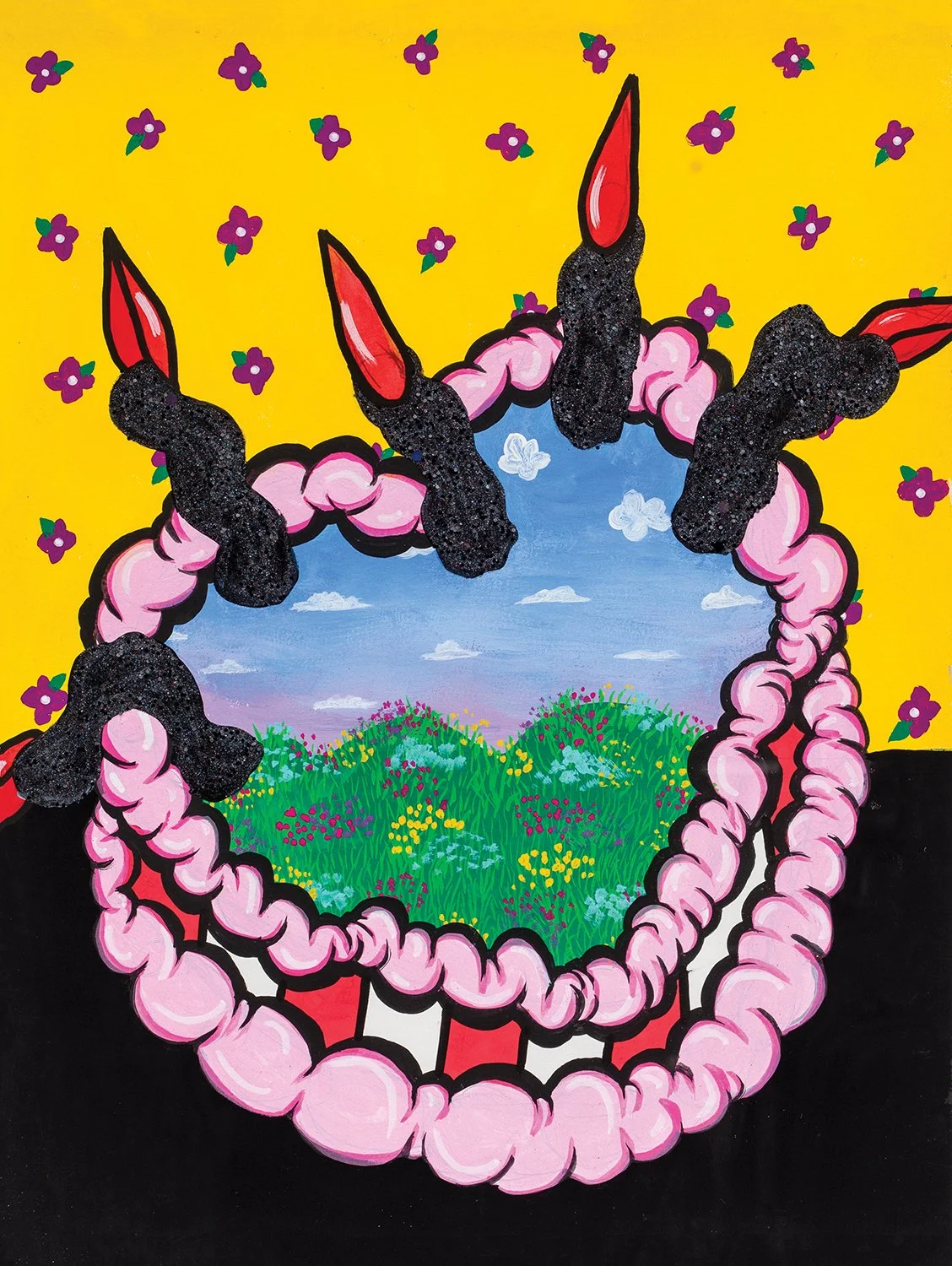
Victoria Dugger, Pound Cake, 2024. Gouache and glitter on watercolor paper, 14 x 11 inches. Courtesy of the artist and Sargent's Daughters
AD: Yeah. A long time ago, I used to live in Candler Park, and my nephew was about 22, and he came to live with me. I was broke, and he was broke, and we went half on the Martin DVD box set. We would sit down and watch it together. And I was blown away with how ahead of its time it was. So, I tried to sneak that in. My son is nine now. He is into SpongeBob, finally, so we watch SpongeBob together. I've made plenty of references to SpongeBob in my work.
TT: I was thinking, just before we were gonna talk today, about the eyes. And I remember seeing both of your work, over time, especially the pieces with the cartoon eyes. I was like, 'I get this. I get what's going on here.' I mean, I need to read, obviously, what's really going on, but the emotion behind it and the humor and not-humor, the depth and all the things, through those cartoon eyes — they say so much.
VD: Yeah, I love the big eye from SpongeBob. And what's the other one? Ren & Stimpy has really good eyes.
SH: Yes, like the gesture of the cartoon eyes coming out and protruding way out as an emphasis of what they're looking at, and the way that they're looking — you can almost feel it in your own eyes.
VD: I, too, listen to romantasy. I love it. So good. I also watch true crime, which is so intense, but I watch the ones with dramatizations more because it's just funny. You can put it on in the background. I love period shows, like Father Brown. I'm into BBC cozy mysteries, and they have millions of seasons, and it's so great.
SH: When I was having a lot of anxiety, I got really into Downton Abbey because I really love shows — especially period dramas — about the British aristocracy. Because first of all, I do not care what's happening to them. A house can fall down on their heads and I'll be like... [shrugs] But I also appreciate how that kind of privilege and affluence can be situated within a total melodrama. It’s soap-opera stuff happening all the time. But most of the time, the affect is very smooth.
Something crazy happens and the characters are like, 'Oh, my.' Oh, to be so unaffected! I find it very relaxing. I want to know about anything that you have going on this summer, or that's going to be concurrent with Atlanta Art Fair, or immediately following the fair. If people see your work there, and want more — because this is a very small sampling of your work — where can they find more?
TT: Can I just say I listen to more than romantasy? Yeah. I just want to make clear, I do listen to other podcasts and whatnot. About today's events. I don't have anything coming up right away. I'm hoping for things. I'm making work. There are things coming, so people can follow me online and see what's happening.
SH: Victoria, you just got an award that includes an upcoming exhibition in Athens — could you talk about that?
VD: Yeah, the Margie E. West Prize Award — that'll be up close to the fair, which is super cool. I'm very excited about that. And that'll be through November, I believe. I'll be in a show at Johnson Lowe Gallery, too.
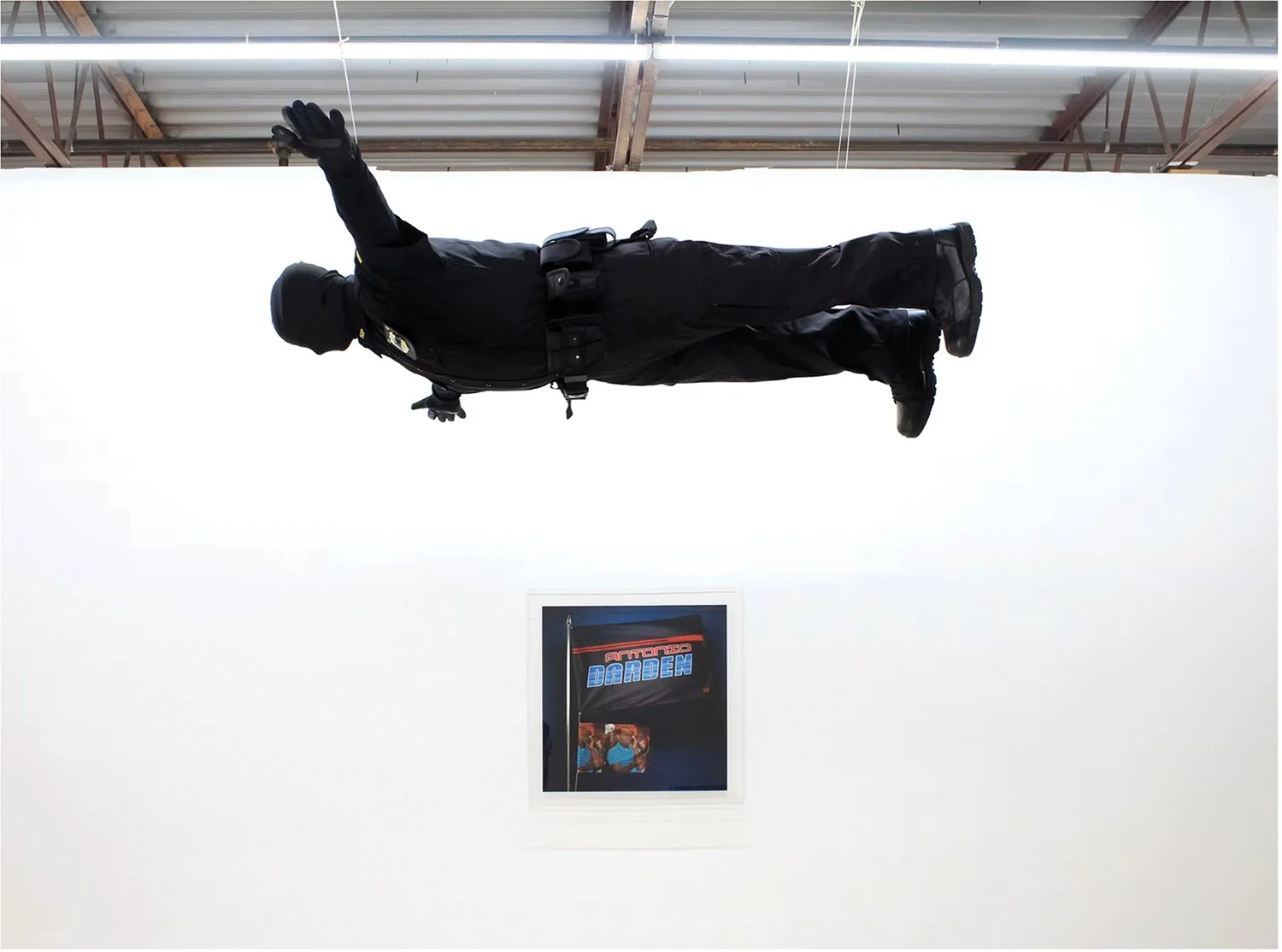
Antonio Darden, W.P.F., 2022. Mixed media installation with NYPD uniform, boots, batting, filament, digital archive print, plexiglass frame. Dimensions variable
SH: Awesome. And Antonio, I know you've had a big summer — maybe you've got a little lull coming up. And if that's the case, you could just talk about what you've just had up.
AD: The group show, Fade, at the Studio Museum closes September 6th, so that'll just be coming down the weekend of the fair. I'm in a group show at Below Grand in New York. And then I go to MacDowell Colony that same week.
VD: You're gonna love MacDowell. All I did was nap. I ate like three times a day. The food is so good. I'll also be at Bemis. I hope I can actually make the art fair, you guys, because I didn't know Bemis was two months. I hope it's not cold. And I don't know what to do in Nebraska. I guess make work. That's the whole point.
SH: Well, is there anything burning a hole in your pocket that you'd like to say about the show, about Atlanta Art Fair? Is there anything you forgot, or that you'd like to mention — like that Tori also listens to serious podcasts?
VD: Yeah. Also, I'm reading The Unabridged Journals of Sylvia Plath, so I do read other things. Also, she's very funny, despite the stove. She's actually really funny.
SH: Yes. Read Sylvia Plath for her humor.
Low Grit Grins, curated by Sarah Higgins, is on display at the 3rd Annual Atlanta Art Fair, October 1 – 4, 2026 at Pullman Yards.
###