
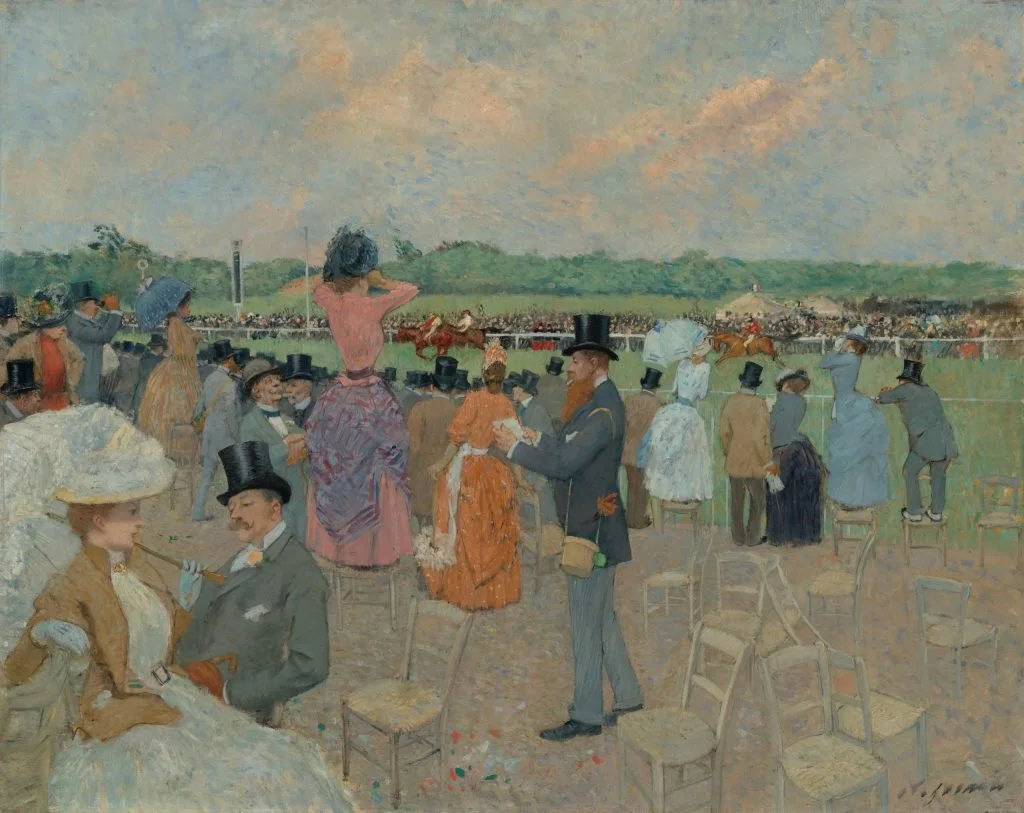
In celebration of Telfair Museums’ 140th anniversary, Impressionism and Modernity: French and American Painting brings together Telfair’s prominent collection of Impressionist art with key counterparts from the National Gallery of Art, Washington, D.C, including paintings by Edgar Degas (1834–1917), Alfred Sisley (1839–99) Vincent van Gogh (1853–90), among others. Through a series of works that attest to themes of modern life, leisure, and spectacle, the modern city, and nostalgia for the natural landscape in a rapidly changing world, this exhibition aims to show how Impressionism originated and developed with the introduction of modern art to the United States and to American institutions.
When the Impressionists first exhibited together in Paris in 1874, their work was a shock to critics and the public alike. Characterized by loose, expressive brushwork which captured the fleeting effects of light and color, and devoted to the representation of modern, everyday life, Impressionism was a radical departure from the art that came before. Highly detailed, traditional scenes of history and mythology had long been favored at the Salon, the official annual art show sponsored by the French government, forcing the Impressionists to form their own independent series of exhibitions. By the 1880s, interest in the movement began to spread across the Atlantic, as opportunities to view Impressionist pictures in the United States became increasingly available. In a landmark exhibition held in New York in 1886, organized by the Parisian art dealer, Paul Durand-Ruel (1831–1922), over three hundred Impressionist paintings, pastels, and watercolors attracted significant interest among American collectors as well as artists, who flocked to the French capital to study modern art.
By the turn of the 20th century, Impressionism had taken hold in the United States, where American artists adapted the style to local subjects. With their depiction of evolving American cities, landscapes, and society, the American Impressionists and artists that followed helped to reshape and picture national identity as industrialization and modernity transformed the face of the country. Opening in 1886 as the first public art museum in the South, the Telfair Academy of Arts and Sciences (now Telfair Museums) also became one of the earliest institutions to begin acquiring modern art. With the help of Gari Melchers (1860–1932), an internationally renowned artist and the museum’s art advisor from 1906 through the 1920s, Telfair amassed one of the most distinguished collections of American Impressionist painting of its time.
